
[논문 리뷰] Neuro-Symbolic World Models for Adapting to Open World Novelty
이 논문은 \\sysname를 제안하며, 이는 사전 비정상 환경 동역학의 상징적 규칙를 학습하여 변화를 탐지하고 비정상 이후 전이를 시뮬레이션함으로써 개방형 세계의 비정상 상황에 빠르고 샘플 효율적으로 강화학습 적응을 가능하게 하는 신경-기호 세계 모델이다. 이 방법은 실제 상호작용과 기호 세계 모델에서 유래한 상상 기반 롤아웃을 조합함으로써 신경 모델 전용 기준보다 적은 정책 업데이트와 환경 상호작용으로 뛰어난 적응 효율성을 달성한다.
Open-world novelty--a sudden change in the mechanics or properties of an environment--is a common occurrence in the real world. Novelty adaptation is an agent's ability to improve its policy performance post-novelty. Most reinforcement learning (RL) methods assume that the world is a closed, fixed process. Consequentially, RL policies adapt inefficiently to novelties. To address this, we introduce WorldCloner, an end-to-end trainable neuro-symbolic world model for rapid novelty adaptation. WorldCloner learns an efficient symbolic representation of the pre-novelty environment transitions, and uses this transition model to detect novelty and efficiently adapt to novelty in a single-shot fashion. Additionally, WorldCloner augments the policy learning process using imagination-based adaptation, where the world model simulates transitions of the post-novelty environment to help the policy adapt. By blending ''imagined'' transitions with interactions in the post-novelty environment, performance can be recovered with fewer total environment interactions. Using environments designed for studying novelty in sequential decision-making problems, we show that the symbolic world model helps its neural policy adapt more efficiently than model-based and model-based neural-only reinforcement learning methods.
연구 동기 및 목표
- 배포 후 예측할 수 없게 변화하는 환경 동역학으로 인한 개방형 세계 비정상 상황에 대한 도전에 대응하기 위해.
- 비용이 많이 드는 실제 환경 상호작용에 대한 의존도를 줄이며 비정상 이후 정책 적응의 샘플 효율성을 향상시키기 위해.
- 기호 표현을 사용하여 비정상 상황을 신속하게 탐지하고 비정상 이후 전이를 시뮬레이션할 수 있는 세계 모델을 개발하기 위해.
- 비정상 이후 정책 수렴 속도를 높이기 위해 상상 기반 적응을 실제 세계 상호작용과 통합하기 위해.
- 기호 세계 모델이 순수 신경 세계 모델보다 적응 속도와 효율성에서 뛰어나다는 것을 입증하기 위해.
제안 방법
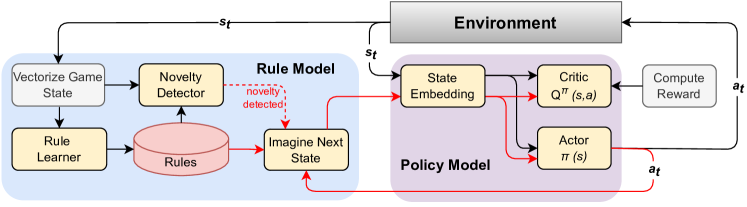
- 단일 비정상 관측 후에 업데이트되는 규칙 학습기로 사전 비정상 환경 전이의 기호 세계 모델을 학습한다.
- 실제 환경 전이를 기호 세계 모델의 예측과 비교하여 비정상 탐지 수행.
- 비정상 탐지 후, 세계 모델은 비정상 이후 환경의 상상된 롤아웃을 생성하여 실제 상호작용 데이터를 보완한다.
- 정책 적응은 실제 환경 상호작용과 기호 세계 모델에서 유도된 상상 전이를 조합한 하이브리드 학습 루프를 사용한다.
- 백프로파게이션을 통해 실제 및 상상된 궤적을 모두 활용하여 정책을 미세조정함으로써 적은 업데이트 수로 신속한 수렴을 가능하게 한다.
- 기호 세계 모델과 정책이 경사 하강법을 통해 함께 최적화되는 종단 간 엔드 투 엔드 학습 방식으로 훈련된다.
실험 결과
연구 질문
- RQ1기호 세계 모델은 순수 신경 모델보다 개방형 세계 비정상 상황을 더 효율적으로 탐지할 수 있는가?
- RQ2기호 세계 모델을 활용한 상상 기반 적응은 비정상 이후 정책 학습의 샘플 효율성을 어떻게 향상시키는가?
- RQ3기호 세계 모델은 드림어V2와 같은 최첨단 신경 세계 모델보다 더 빠른 수렴을 가능하게 하는가?
- RQ4실제 데이터와 상상 데이터를 혼합할 경우 정책 업데이트 효율성에 어떤 영향을 미치는가?
- RQ5다양한 유형의 비정상 상황, 특히 원래 최적 경로에 포함되지 않은 비정상 상황에 대해서도 시스템은 어떻게 성능을 발휘하는가?
주요 결과
- 빈 미니그리드 환경에서 기호 세계 모델은 약 2,000개의 훈련 스텝 내에 거의 완벽한 예측 정확도에 도달하여 빠르고 샘플 효율적인 학습을 입증했다.
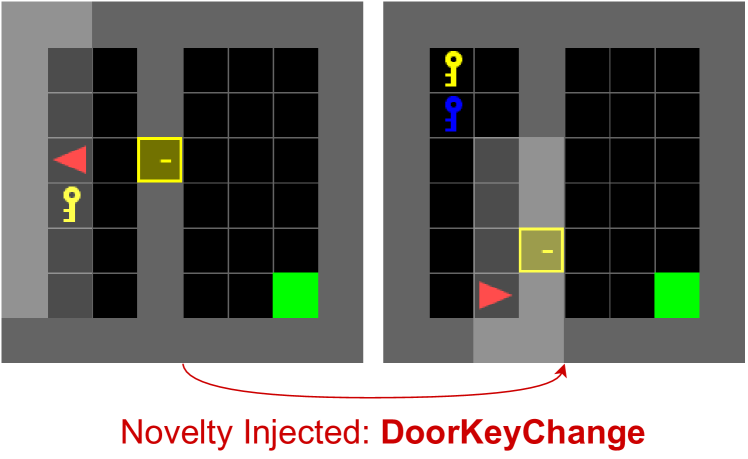
- 모든 테스트 비정상 상황에서 \sysname는 PPO 및 드림어V2보다 훨씬 적은 정책 업데이트를 요구했으며, 라바허츠 및 도어키체인지 환경에서 가장 적은 업데이트 수를 기록했다.
- 단지 40%의 상상 주입으로도 \sysname는 모든 비정상 유형에서 세계 모델이 없는 신경 정책보다 적응 효율성이 뛰어나게 성과를 냈다.
- 드림어V2와 경쟁 수준의 적응 효율성을 달성하면서도 훨씬 적은 정책 업데이트를 사용함으로써 뛰어난 샘플 효율성을 보였다.
- 라바허츠 및 도어키체인지와 같은 사례에서 \sysname는 드림어V2보다 수렴 시간의 변동성이 낮아 더 일관된 적응을 보였다.
- 결과적으로 기호 표현은 순수 신경 세계 모델보다 신경 정책에 더 효과적인 보완 요소임을 시사한다.
이 논문 읽기
누빈트 뷰어에서 원문을 열고, 읽으면서 궁금한 곳을 바로 물어보세요.
누빈트에서 이 논문 읽기이 리뷰는 AI가 논문 원문을 바탕으로 만들었습니다. 인용하기 전에 원문을 확인해 주세요.