
[논문 리뷰] nnU-Net Revisited: A Call for Rigorous Validation in 3D Medical Image Segmentation
논문은 최근 3D 의학 영상 분할 방법을 재평가하고 CNN 기반의 U-Net 구성이 nnU-Net 내에서 하드웨어에 맞게 proper scale 되어 Transformer- 및 Mamba 기반 접근법을 능가한다는 것을 보여주며; 또한 업데이트된 Baselines를 공개하고 엄밀한 검증을 옹호한다.
The release of nnU-Net marked a paradigm shift in 3D medical image segmentation, demonstrating that a properly configured U-Net architecture could still achieve state-of-the-art results. Despite this, the pursuit of novel architectures, and the respective claims of superior performance over the U-Net baseline, continued. In this study, we demonstrate that many of these recent claims fail to hold up when scrutinized for common validation shortcomings, such as the use of inadequate baselines, insufficient datasets, and neglected computational resources. By meticulously avoiding these pitfalls, we conduct a thorough and comprehensive benchmarking of current segmentation methods including CNN-based, Transformer-based, and Mamba-based approaches. In contrast to current beliefs, we find that the recipe for state-of-the-art performance is 1) employing CNN-based U-Net models, including ResNet and ConvNeXt variants, 2) using the nnU-Net framework, and 3) scaling models to modern hardware resources. These results indicate an ongoing innovation bias towards novel architectures in the field and underscore the need for more stringent validation standards in the quest for scientific progress.
연구 동기 및 목표
- 3D 의학 영상 분할 연구에서 검증의 함정을 식별한다.
- CNN-, Transformer-, Mamba 기반 방법에 대해 일관된 하드웨어와 교차 검증 설정에서 대규모의 엄격하게 제어된 벤치마크를 수행한다.
- 벤치마킹 방법론에 대한 데이터셋 적합성 평가를 수행한다.
- nnU-Net 내에서 업데이트된 표준화된 베이스라인과 공정한 비교를 위한 가이드라인을 제공한다.
제안 방법
- 검증의 함정을 카탈로그하고 구체적인 권고(R1-R4)을 제시한다.
- 일관된 하드웨어 및 교차 검증 설정 하에 여섯 개의 공개 3D 분할 데이터세트에 대한 대규모 벤치마크를 수행한다.
- 동등한 VRAM 예산을 보장하면서 nnU-Net 프레임워크 내에서 CNN-, Transformer-, Mamba 기반 아키텍처 및 Auto3DSeg 프레임워크를 비교한다.
- 모델 확장(scale) 효과와 데이터셋- 및 작업 특성 성능을 분석하여 진정한 진전 요인을 식별한다.
- 업데이트된 표준화된 베이스라인과 데이터셋 적합성 평가 프레임워크를 발표한다.
실험 결과
연구 질문
- RQ1최근 아키텍처 우위 주장들이 공정한 벤치마크와 표준화된 구성에서 엄격한 검증 하에 성립하는가?
- RQ2데이터, 컴퓨트, 베이스라인 품질을 제어할 때 3D 의학 영상 분할에서 최첨단 성능의 핵심 요인은 무엇인가?
- RQ33D 분할의 방법론적 진전을 벤치마킹하기에 가장 적합한 데이터셋은 무엇인가?
- RQ4모델 확장 및 아키텍처 유형(CNN 대 Transformer 대 Mamba)이 동등한 자원 하에서 성능에 어떤 영향을 미치는가?
주요 결과
- nnU-Net 내에서 구현된 CNN 기반 U-Net 방법이 여섯 개 데이터셋 전반에 걸쳐 일관되게 강한 성능을 제공한다.
- MedNeXt는 종종 최상의 Dice 점수를 산출하지만 교육 시간이 훨씬 더 많이 필요하고 일부 이득은 아키텍처 자체보다는 목표 간격에 관련된다.
- 트랜스포머 기반 네트워크(SwinUNETR, nnFormer, CoTr)는 이 벤치마크에서 CNN 기반 nnU-Net의 성능에 미치지 못한다.
- U-Mamba 변형은 적절한 베이스라인(No-Mamba Base)을 사용할 때 성능이 뒤처지므로 이전 이득은 교란 요인 때문이었음을 시사한다.
- Auto3DSeg 구성은 동등 자원 제약 하에서 항상 nnU-Net 성능에 도달하지 못하며; nnU-Net ResEnc 변형 및 더 길고 더 높은 예산 구성은 기본 설정 Auto3DSeg보다 우수하다.
- 스케일링 결과는 더 큰 모델이 더 어려운 데이터셋(AMOS, KiTS)에서 의미 있는 이득을 보이지만 더 쉬운 작업(BTCV, BraTS)에서는 덜하다.
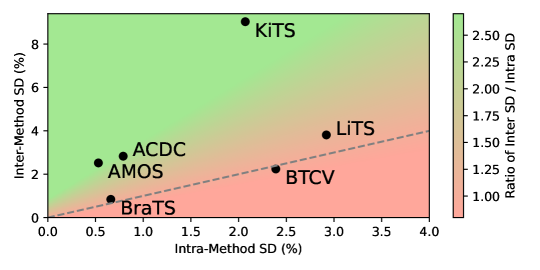
- 체계적인 데이터셋 적합성 분석은 KiTS, AMOS, ACDC를 벤치마킹에 가장 적합한 데이터셋으로 식별하고 BraTS 및 BTCV는 덜 적합하다고 판단한다.
이 논문 읽기
누빈트 뷰어에서 원문을 열고, 읽으면서 궁금한 곳을 바로 물어보세요.
누빈트에서 이 논문 읽기이 리뷰는 AI가 논문 원문을 바탕으로 만들었습니다. 인용하기 전에 원문을 확인해 주세요.