
[논문 리뷰] No Tension: JWST Galaxies at $z > 10$ Consistent with Cosmological Simulations
이 연구는 고해상도 류센트스 우주론적 시뮬레이션을 사용하여, JWST에 의해 관측된 z > 10에서 가장 질량이 큰 은하들 — 예를 들어 GS-z11-0과 메이지의 은하 — 가 ΛCDM 모델의 예측과 일치함을 보여준다. 초기에 높은 항성 질량으로 인한 긴장이 우려되었지만, 시뮬레이션은 이러한 은하들의 항성 질량과 은하 형성률이 시간이 지남에 따라 외삽되었을 때 이론적 기대와 일치함을 보여주어 명백한 모순을 해결한다.
Recent observations by JWST have uncovered galaxies in the very early universe via the JADES and CEERS surveys. These galaxies have been measured to have very high stellar masses with substantial star formation rates. There are concerns that these observations are in tension with the $Λ$CDM model of the universe, as the stellar masses of the galaxies are relatively high for their respective redshifts. Recent studies have compared the JWST observations with large-scale cosmological simulations. While they were successful in reproducing the galaxies seen in JADES and CEERS, the mass and spatial resolution of these simulations were insufficient to fully capture the early assembly history of the simulated galaxies. In this study, we use results from the Renaissance simulations, which are a suite of high resolution simulations designed to model galaxy formation in the early universe. We find that the most massive galaxies in Renaissance have stellar masses and star formation rates that are entirely consistent with the observations from the JADES and CEERS surveys. The exquisite resolution afforded by Renaissance allows us to model the build-up of early galaxies from stellar masses as low as 10$^4$ M$_\odot$ up to a maximum stellar mass of a few times 10$^{7}$ M$_\odot$. Within this galaxy formation paradigm, we find excellent agreement with JADES and CEERS. We find no tension between the $Λ$CDM model and current JWST measurements. As JWST continues to explore the high redshift universe, high resolution simulations, such as Renaissance, will continue to be crucial in understanding the formation history of early embryonic galaxies.
연구 동기 및 목표
- JWST로 관측된 z > 10 은하들의 높은 항성 질량이 ΛCDM 모델과 모순된다는 우려를 해결하기 위해.
- 고해상도 우주론적 시뮬레이션이 초기 은하의 관측된 항성 질량과 은하 형성률을 재현할 수 있는지 평가하기 위해.
- 이른 은하 형성에 초점을 맞춘 고해상도 시뮬레이션과 비교하여 이전의 저해상도 시뮬레이션의 신뢰성을 평가하기 위해.
- JADES 및 CEERS 은하의 관측된 성질이 ΛCDM 우주에서 표준 은하 형성 물리학과 일치하는지 평가하기 위해.
- 시뮬레이션의 적색편이를 초월한 은하 진화를 시뮬레이션하기 위한 외삽 기법의 타당성을 검증하기 위해, 특정 은하 형성률(sSFR) 제약 조건을 사용하여.
제안 방법
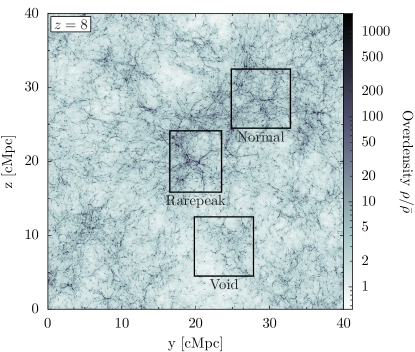
- 고해상도 질량 및 공간 해상도를 갖춘 류센트스 시뮬레이션 세트를 사용하여, 세 개의 과밀 지역(RP, Normal, High)에서 이른 은하 형성을 모델링하였다.
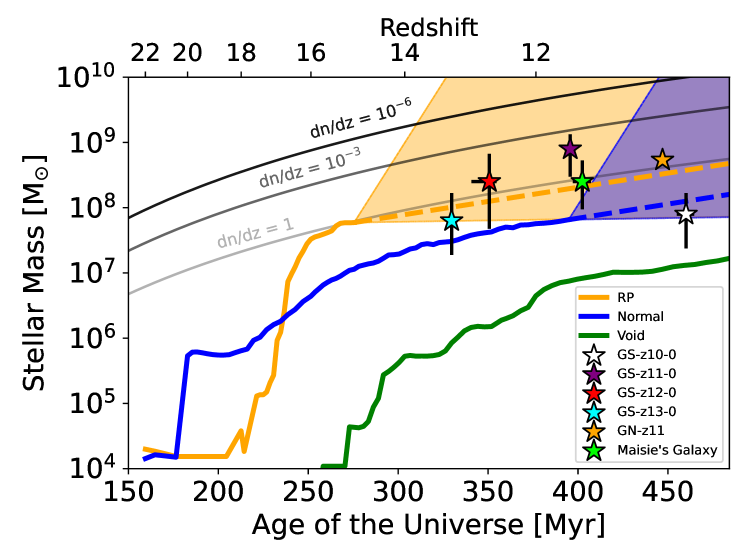
- 10⁴ M⊙의 낮은 항성 질량에서부터 약 3×10⁷ M⊙까지의 은하 형성 역사를 추적함으로써, 초기 형성 과정을 정확히 모델링할 수 있었다.
- 관측된 적색편이에 맞추기 위해 시뮬레이션에서 유도된 헬라 질량 범위에 따라 특정 은하 형성률(sSFR)을 시간이 지남에 따라 외삽하였다.
- 류센트스 시뮬레이션에서 가장 질량이 큰 은하들의 시뮬레이션 항성 질량과 은하 형성률(SFR)을 JADES 및 CEERS 조사에서의 관측값과 비교하였다.
- JWST의 광도 및 스펙트럼 데이터에서 유도된 관측된 SFR과 항성 질량을 직접 시뮬레이션 출력과 비교하기 위해 Beagle(Chevallard & Charlot, 2016)를 사용하였다.
- 시뮬레이션 헬라 질량 범위에 따른 sSFR 추세를 비교하고 고적색편이에서의 관측된 sSFR과의 일관성을 평가하여 결과를 검증하였다.
실험 결과
연구 질문
- RQ1JWST가 관측한 z > 10 은하들의 관측된 항성 질량과 은하 형성률은 ΛCDM 프레임워크 내 고해상도 우주론적 시뮬레이션의 예측과 일치하는가?
- RQ2고해상도 질량 및 공간 해상도를 갖춘 류센트스 시뮬레이션은 JWST에 의해 탐지된 가장 먼 은하들의 성질을 재현할 수 있는가?
- RQ3낮은 적색편이에서 유도된 외삽된 sSFR 값이 z > 10 은하의 관측 성질과 어느 정도 일치하는가?
- RQ4z > 10에서 관측된 고질량 은하들은 이질적 이례치인가, 아니면 ΛCDM 모델의 통계적 기대 내에 포함되는가?
- RQ5고해상도 시뮬레이션의 결과는 이전의 저해상도 시뮬레이션(EAGLE, TNG100 등)과 비교할 때 JWST 관측 결과와 어느 정도 일치하는가?
주요 결과
- 류센트스 시뮬레이션에서 가장 질량이 큰 은하들의 항성 질량은 sSFR을 시간이 지남에 따라 외삽한 후 JADES 및 CEERS에서 관측된 값과 일치한다.
- 가장 질량이 큰 시뮬레이션 은하들의 은하 형성률(SFR)은 특히 헬라 질량 범위에 따른 sSFR 추세를 고려할 때 관측된 z > 10 은하들의 SFR과 양호한 일치를 보인다.
- 시뮬레이션은 은하 질량이 관측된 수준과 유사할 때 은하 형성 효율이 향상되고 피드백에 의해 조절됨을 보여주며, 이는 관측 결과와 일치하는 몇 퍼센트 수준의 효율에 도달한다.
- GN-z11 및 GS-z11-0의 관측 항성 질량은 RP 영역에서의 최대 시뮬레이션 질량을 초과하지만, 이는 아마도 AGN 활동이나 천체적 변동성 때문일 것이며 ΛCDM와의 근본적인 불일치가 아니다.
- 고해상도 시뮬레이션(Renaissance)과 저해상도 시뮬레이션(K23)의 조합은 JWST 관측과 ΛCDM 모델 간의 긴장이 없다는 강력하고 일관된 증거를 제공한다.
- 이 연구는 빠른 초기 은하 형성이 ΛCDM 내에서 물리적으로 가능함을 확인하였으며, 은하 형성 효율이 낮은 질량에서 약 0.2%에서 고질량에서 몇 퍼센트로 증가함을 보여준다.
더 나은 연구,지금 바로 시작하세요
논문 읽기부터 검토까지, 연구 시간을 획기적으로 줄여보세요.
카드 등록 없음 · 무료 플랜 제공
이 리뷰는 AI가 만들고, 인간 에디터가 검토했습니다.