
[논문 리뷰] Nonlinear sigma models for monitored dynamics of free fermions
본 논문은 SO(N) 비선형 시그마 모델을 다중 맛 Majorana 체인의 모니터링 다이내믹스의 유효 장 이론으로 도출하고, replica 극한 N→1에서 엔탱글먼트 스케일링과 위상 구조를 분석한다.
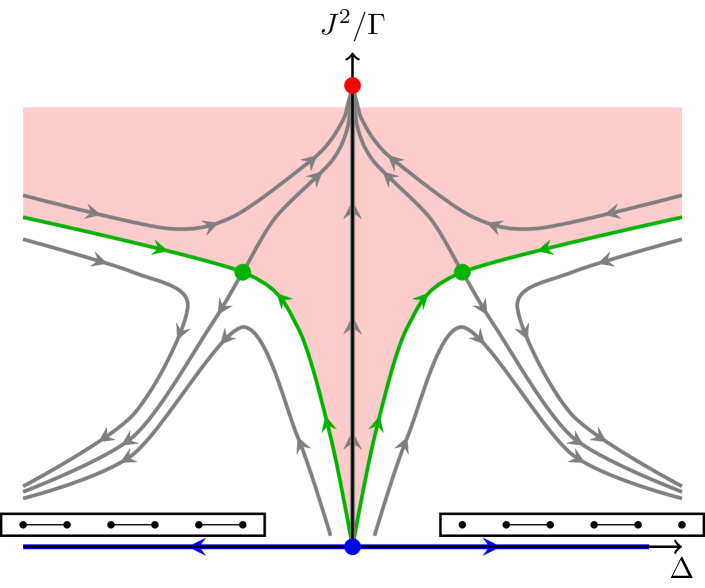
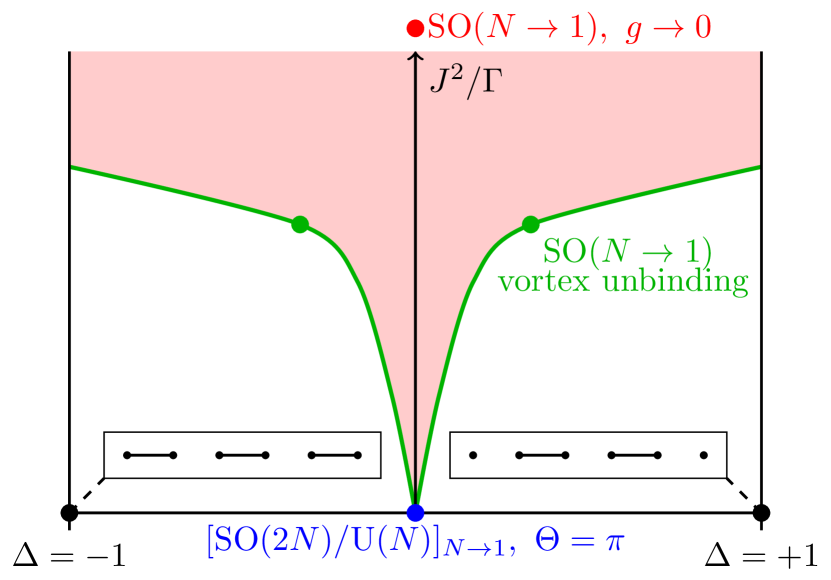
We derive field theory descriptions for measurement-induced phase transitions in free fermion systems. We focus on a multi-flavor Majorana chain, undergoing Hamiltonian evolution with continuous monitoring of local fermion parity operators. Using the replica trick, we map the dynamics to the imaginary time evolution of an effective spin chain, and use the number of flavors as a large parameter for a controlled derivation of the effective field theory. This is a nonlinear sigma model for an orthogonal $N imes N$ matrix, in the replica limit $N o 1$. (On a boundary of the phase diagram, another sigma model with higher symmetry applies.) Together with known results for the renormalization-group beta function, this derivation establishes the existence of stable phases -- nontrivially entangled and disentangled respectively -- in the physically-relevant replica limit $N o 1$. In the nontrivial phase, an asymptotically exact calculation shows that the bipartite entanglement entropy for a system of size $L$ scales as $(\log L)^2$, in contrast to findings in previously-studied models. Varying the relative strength of Hamiltonian evolution and monitoring, as well as a dimerization parameter, the model's phase diagram contains transitions out of the nontrivial phase, which we map to vortex-unbinding transitions in the sigma model, and also contains separate critical points on the measurement-only axis. We highlight the close analogies as well as the differences with the replica approach to Anderson transitions in disordered systems.
연구 동기 및 목표
- 자유 페르미온 시스템에서 측정에 의해 유도되는 위상 전이에 대한 보편적이고 장파장(롱-웨이브) 설명을 개발한다.
- 지속적인 로컬 파리티 측정 하에 다맛 Majorana 체인에 대한 유효한 비선형 시그마 모델을 도출한다.
- 물리적으로 관련된 replica 한계 N→1에서 엔탱글먼트 스케일링과 위상 구조를 확립한다.
- 위상 전이를 시그마 모델의 소용돌이-유사 결함에 매핑하고 이를 로컬라이제이션에서 영감을 받은 RG 흐름과 연관시킨다.]
- method:[
제안 방법
- 리플리카 트릭을 적용하여 측정 랜덤성과 해밀토니언 잡음을 평균화한다.
- 복제된 밀도-매트릭스 다이내믹스를 유효한 SO(2N) 스핀 체인으로 매핑한다.
- 유도된 SO(N) 비선형 시그마 모델을 얻기 위해 제어된 대규모 NF(Flavor index) 확장을 진행한다.
- 시그마 모델의 매니폴드와 replica 한계 N→1의 역할을 확인한다.
- 안정적 비자형 위상에서 보편적인 엔탱글먼트 스케일링을 계산하고 수치적으로 검증한다.
실험 결과
연구 질문
- RQ1복제 한계 N→1에서 모니터링된 자유 페르미온 다이내믹스의 보편적 장 이론 서술은 무엇인가?
- RQ2로컬 파리티 측정 하에 모니터링된 Majorana 체인의 위상 구조와 임계 특성은 어떻게 되는가?
- RQ3비자형 위상에서 엔탱글먼트 스케일링은 어떻게 나타나며, 다른 모니터링 시스템 모델과 어떻게 비교되는가?
- RQ4비트로/인스턴턴 같은 위상적 결함이 비자형 위상에서의 전이에서 어떤 역할을 하는가?
- RQ5경계 조건과 대칭 클래스가 유효 장 이론과 위상 다이어그램에 어떤 영향을 미치는가?
주요 결과
- SO(N) 타겟 매니폴드를 갖는 비선형 시그마 모델이 replica 한계 N→1에서 모니터링된 자유 페르미온 다이내믹스를 설명한다.
- 비자형 안정 위상에서 이분 엔탱글먼트 엔트로피는 시스템 크기 L에 대해 S_n ~ ((n+1)/(96 n)) (ln L)^2 로 스케일링된다.
- 위상 다이어그램은 시그마 모델 측의 소용돌이-인스턴턴 물리학을 통해 엔탈타이들 없는 영역으로의 전이를 특징으로 한다.
- 측정-전용 축(J=0)에서는 서로 다른 시그마 모델 설명을 갖는 분리된 임계점들이 존재한다.
- 결과는 모니터링 시스템에 대한 N→1 복제 설정으로의 localization 유형 RG 사고를 연결하고 확장한다.
- N=1의 경우(또는 동등하게 모니터링된 아이징 이중성)는 위상 다이어그램 경계에서 더 높은 대칭의 시그마 모델들과 경계 현상을 반영한다.
이 논문 읽기
누빈트 뷰어에서 원문을 열고, 읽으면서 궁금한 곳을 바로 물어보세요.
누빈트에서 이 논문 읽기이 리뷰는 AI가 논문 원문을 바탕으로 만들었습니다. 인용하기 전에 원문을 확인해 주세요.