
[논문 리뷰] OCRBench: On the Hidden Mystery of OCR in Large Multimodal Models
본 논문은 대형 다중모달 모델이 OCR 관련 작업에서 어떻게 성능을 내는지 평가하고, handwritten 및 다국어 텍스트를 포함한 LMM의 OCR 능력을 연구하기 위한 5개의 텍스트 중심 작업에 걸친 1000항 벤치마크인 OCRBench를 도입한다.
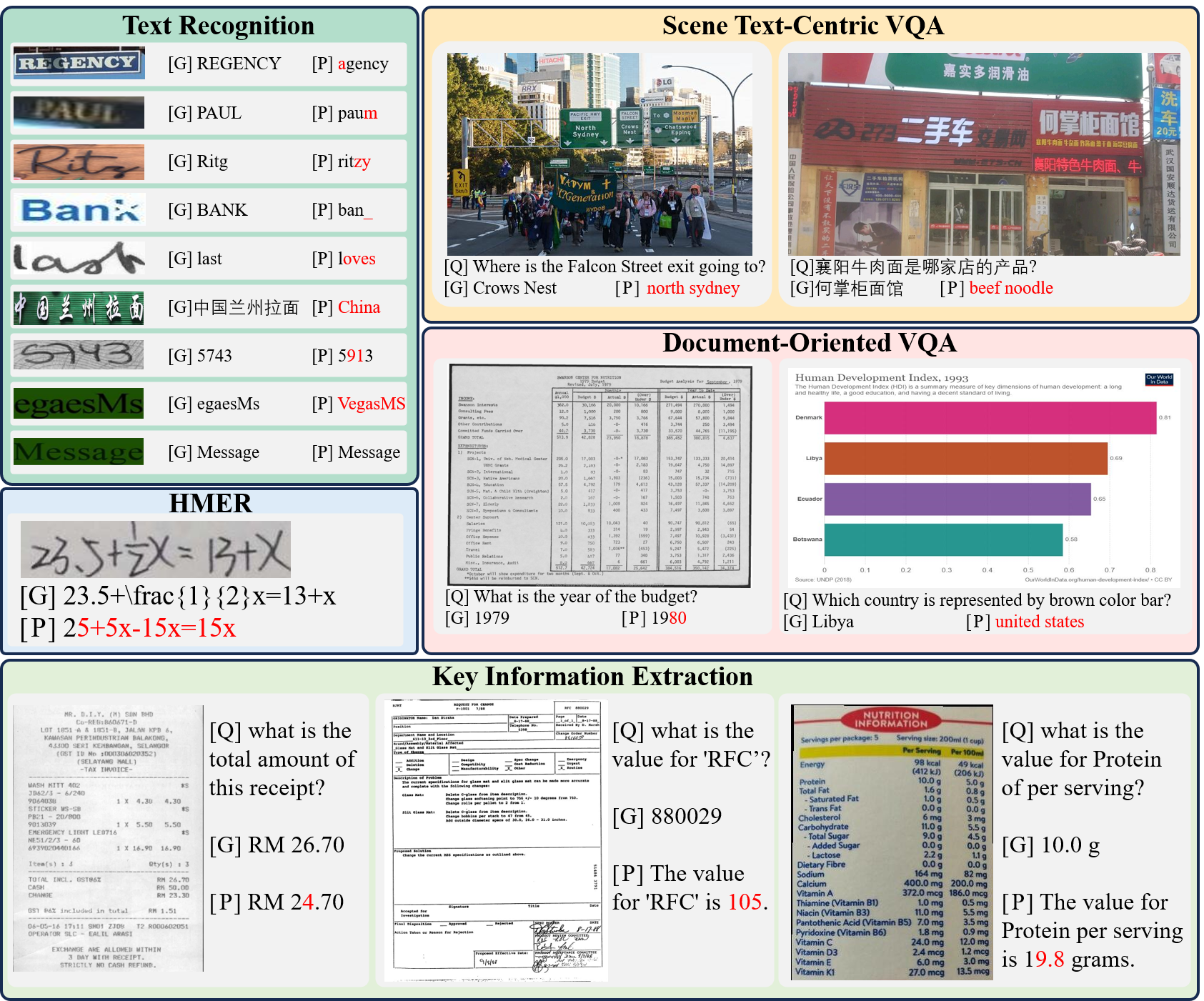
Large models have recently played a dominant role in natural language processing and multimodal vision-language learning. However, their effectiveness in text-related visual tasks remains relatively unexplored. In this paper, we conducted a comprehensive evaluation of Large Multimodal Models, such as GPT4V and Gemini, in various text-related visual tasks including Text Recognition, Scene Text-Centric Visual Question Answering (VQA), Document-Oriented VQA, Key Information Extraction (KIE), and Handwritten Mathematical Expression Recognition (HMER). To facilitate the assessment of Optical Character Recognition (OCR) capabilities in Large Multimodal Models, we propose OCRBench, a comprehensive evaluation benchmark. OCRBench contains 29 datasets, making it the most comprehensive OCR evaluation benchmark available. Furthermore, our study reveals both the strengths and weaknesses of these models, particularly in handling multilingual text, handwritten text, non-semantic text, and mathematical expression recognition. Most importantly, the baseline results presented in this study could provide a foundational framework for the conception and assessment of innovative strategies targeted at enhancing zero-shot multimodal techniques. The evaluation pipeline and benchmark are available at https://github.com/Yuliang-Liu/MultimodalOCR.
연구 동기 및 목표
- 대형 다중모달 모델(LMM)의 OCR 능력을 다양한 텍스트 관련 시각적 작업에서 평가한다.
- OCRBench를 구축하고 공개하여 LMM의 zero-shot OCR 성능에 대한 표준화되고 수작업으로 검증된 평가 도구를 제공한다.
- 손글씨, 다국어, HMER를 포함한 텍스트 관련 다중모달 이해의 강점, 한계 및 향후 개선 방향을 식별한다.
- 다양한 LMM들(GPT4V, Gemini, Monkey, BLIP 기반 모델 등)을 광범위한 OCR 작업 및 데이터셋에 대해 비교한다.
제안 방법
- 14개의 LMM을 다섯 가지 텍스트 관련 작업에 대해 평가한다: 텍스트 인식, Scene Text-Centric VQA, Document-Oriented VQA, Key Information Extraction (KIE), 및 Handwritten Mathematical Expression Recognition (HMER).
- 통일된 평가 기준을 사용한다: 정답이 모델 출력에 나타나는지 여부를 확인하고, 아주 짧은 답변(< 4 기호)은 제외한다.
- 작업 간 1000개의 수동으로 필터링/수정된 QA 쌍으로 OCRBench를 구성하고 강건성을 위해 대체 정답을 제공한다.
- 정규/비정규/가려짐/예술적 텍스트, 손글씨, 중국어 텍스트, 의미론적/비의미론적 텍스트 등 29개 OCR 데이터셋에서 성능을 분석한다.
- 각 모델별, 작업별로 상세한 결과를 제시하여 LMM이 잘하는 영역과 어려움을 식별한다(예: HMER, 손글씨/중국어 텍스트).
- LMM의 OCR 능력에 대한 잠재적 메커니즘을 논의하고 향후 개선 방향을 제시한다(정밀한 시각 특징, 다국어 데이터, 도메인에 맞춘 학습).
실험 결과
연구 질문
- RQ1현재의 대형 다중모달 모델이 다양한 데이터셋에 걸쳐 OCR 관련 작업에서 얼마나 잘 수행하는가?
- RQ2손글씨, 다국어, 비의미론적 텍스트 및 수식 인식을 포함한 OCR에서 LMM의 주요 강점과 약점은 무엇인가?
- RQ3더 높은 입력 해상도나 모델 설계가 미세한 텍스트 이해 작업에서 성능 향상과 상관관계가 있는가?
- RQ4OCRBench가 다중모달 모델의 제로샷 OCR 향상을 위한 안정적인 기준선을 제공할 수 있는가?
주요 결과
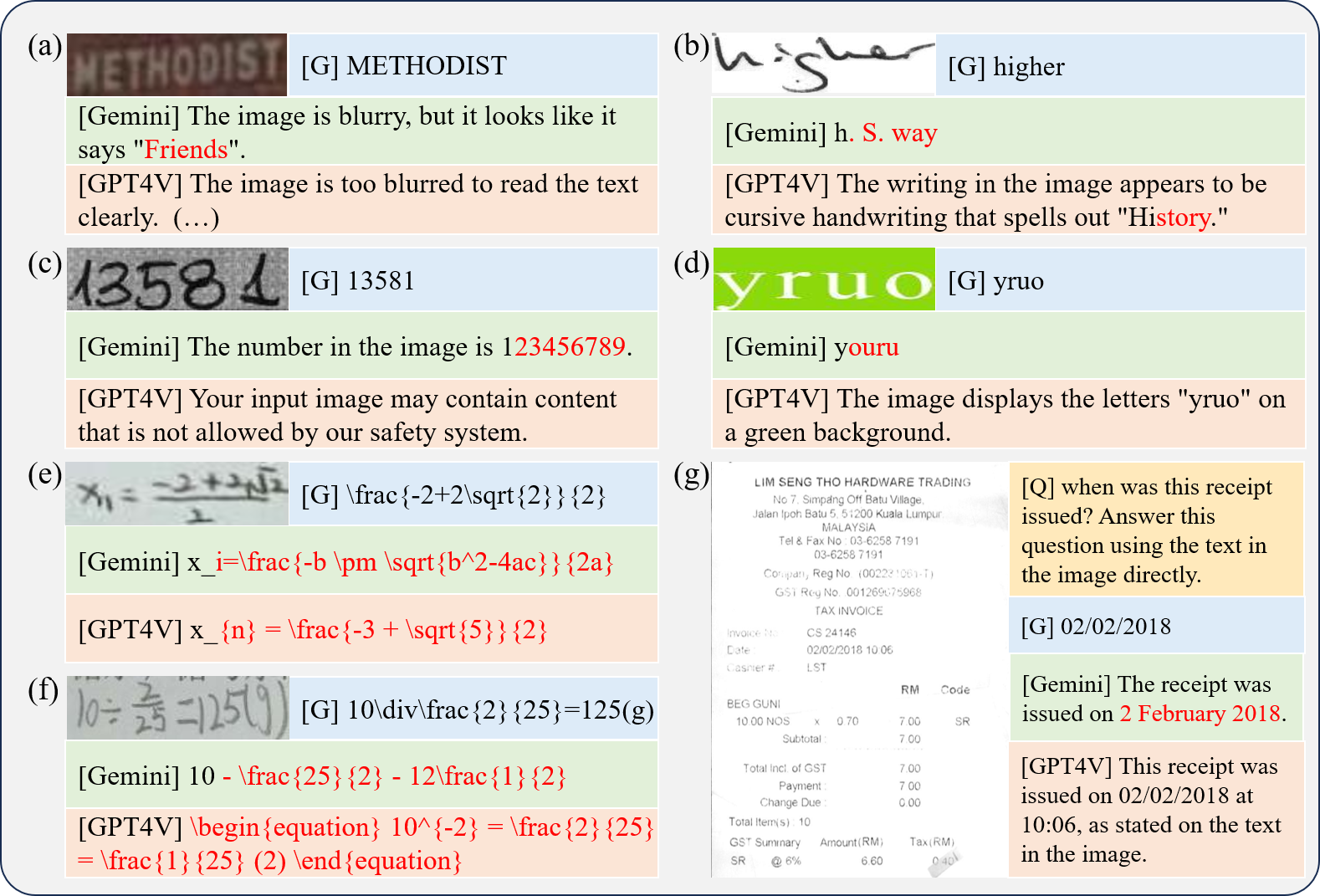
- LMM은 텍스트 인식에서 일반/비정규/가려진/ 예술적 텍스트에 대해 감독학습 모델과 경쟁력 있는 성능을 보이나, 손글씨 텍스트, 중국어 텍스트, 손글씨 문자열, 비의미론적 텍스트에서 현저히 어려움을 겪는다.
- 작은 입력 해상도는 Scene Text-Centric VQA, Document-Oriented VQA, KIE에서 일반적으로 더 나쁜 결과를 낳고, 반면 더 높은 해상도 모델(예: Monkey)은 이 작업들에서 성능을 향상시킬 수 있다.
- LMM의 Handwritten Mathematical Expression Recognition(HMER)에서 상당한 격차가 남아 있어 표준 OCR를 넘는 도메인 특화 도전과제를 시사한다.
- OCRBench 결과에서 Gemini가 1위, GPT4V가 2위이고 Monkey가 그 뒤를 바짝 추격하는 반면, 여러 베이스라인은 HMER 및 비의미론/손글씨 사례에서 뒤처진다.
- LMM은 단어 인식 시 의미적 단서에 의존하는 경향이 있어 문자 순서가 바뀌거나 의미가 없을 때 성능이 약해진다(NST vs ST).
- 본 연구는 정밀한 시각 특징 추출, 다국어 학습, 도메인별 OCR 적응에 대한 개선 기회를 강조한다.
이 논문 읽기
누빈트 뷰어에서 원문을 열고, 읽으면서 궁금한 곳을 바로 물어보세요.
누빈트에서 이 논문 읽기이 리뷰는 AI가 논문 원문을 바탕으로 만들었습니다. 인용하기 전에 원문을 확인해 주세요.