
[논문 리뷰] OpenChemIE: An Information Extraction Toolkit For Chemistry Literature
OpenChemIE는 텍스트, 표, 그림을 연결하여 문헌에서 상세한 화학 반응을 추출하는 오픈 소스 멀티모달 정보 추출 도구 키트로, 모듈 수준의 강력한 성능과 큐레이션된 기질 범위 데이터 세트에서 69.5% F1, Reaxys 대비 64.3% 정확도를 달성합니다.
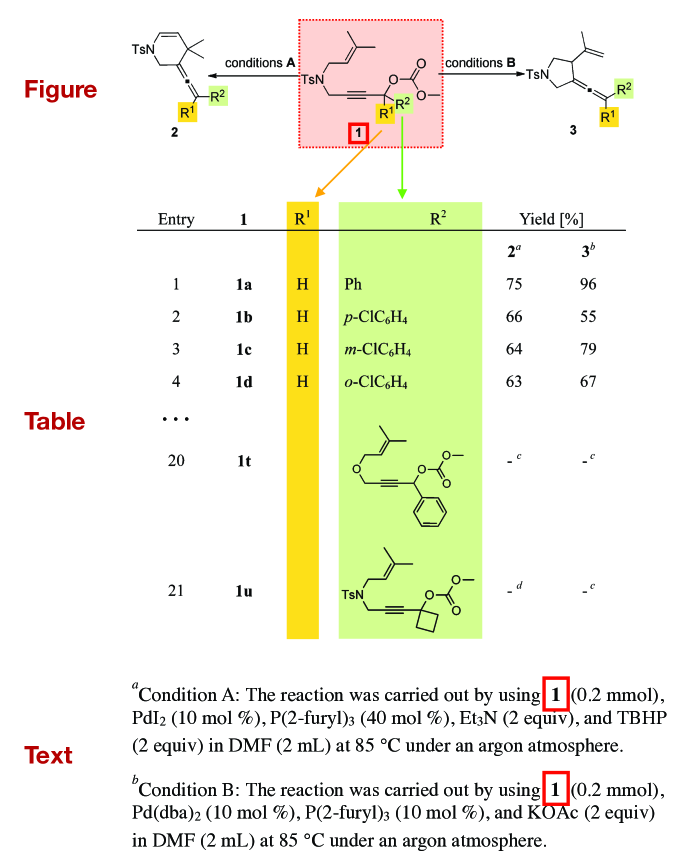
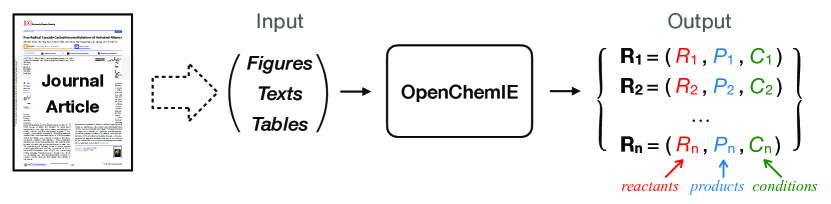
Information extraction from chemistry literature is vital for constructing up-to-date reaction databases for data-driven chemistry. Complete extraction requires combining information across text, tables, and figures, whereas prior work has mainly investigated extracting reactions from single modalities. In this paper, we present OpenChemIE to address this complex challenge and enable the extraction of reaction data at the document level. OpenChemIE approaches the problem in two steps: extracting relevant information from individual modalities and then integrating the results to obtain a final list of reactions. For the first step, we employ specialized neural models that each address a specific task for chemistry information extraction, such as parsing molecules or reactions from text or figures. We then integrate the information from these modules using chemistry-informed algorithms, allowing for the extraction of fine-grained reaction data from reaction condition and substrate scope investigations. Our machine learning models attain state-of-the-art performance when evaluated individually, and we meticulously annotate a challenging dataset of reaction schemes with R-groups to evaluate our pipeline as a whole, achieving an F1 score of 69.5%. Additionally, the reaction extraction results of \ours attain an accuracy score of 64.3% when directly compared against the Reaxys chemical database. We provide OpenChemIE freely to the public as an open-source package, as well as through a web interface.
연구 동기 및 목표
- 데이터 기반 화학의 최신 반응 데이터 큐레이션을 촉진하고 수동 추출 의존도를 줄인다.
- 다중 모달 정보를 결합한 문서 수준 추출 시스템을 개발하여 완전한 반응을 복구한다.
- 그림, 텍스트, 표 구문 분석을 위한 화학 지향 모듈을 구축하고 코어퍼런스, 정렬 및 R-그룹 해소를 통해 통합한다.
- 더 넓은 채택과 평가를 촉진하기 위한 오픈 소스 도구 키트와 공개 웹 인터페이스를 제공한다.
제안 방법
- 추출을 모달리티별 구성 요소로 분해한다: 그림 분석(분자 탐지, 코어퍼런스, 다이어그램 파싱, 분자 인식), 텍스트 분석(명명 엔티티 인식, 반응 추출), 다중 모달 통합(R-그룹 해소, 반응 조건 정렬).
- 반응의 최종 목록을 얻기 위해 산출물을 단일 파이프라인으로 표현하고 반응물, 생성물, 조건을 포함하는 최종 목록을 얻는다; 표에서의 조건을 그림과 정렬하고 기질 범위 정보를 사용하여 R-그룹을 대체한다.
- MolDetect, MolCoref, RxnScribe, MolScribe, ChemNER, ChemRxnExtractor를 전문 신경 모듈로 사용하고, 조건 정렬 및 R-그룹 해소를 위한 화학 정보를 반영한 알고리즘으로 출력을 융합한다.
- 엔드-투-엔드 파이프라인을 평가하기 위해 5개 저널의 78 기질 범위 그림에서 1007개의 반응 데이터 세트를 주석화한다; 외부 검증을 위해 Reaxys와 비교한다.
실험 결과
연구 질문
- RQ1멀티모달 통합이 그림, 표, 텍스트 각각의 추출보다 더 완전한 반응 데이터를 제공할 수 있는가?
- RQ2기질 범위 다이어그램에서 완전한 반응 구조를 회복하는 데 화학 정보 기반 정렬 및 R-그룹 해소 기법은 얼마나 효과적인가?
- RQ3수동으로 주석된 데이터 세트 및 외부 데이터베이스(예: Reaxys)에서 OpenChemIE의 엔드-투-엔드 성능은 어느 정도인가?
주요 결과
- OpenChemIE는 주석된 기질 범위 데이터 세트에서 엔드-투-엔드 F1 점수 69.5%를 달성한다.
- OpenChemIE는 추출된 반응을 Reaxys와 비교했을 때 64.3%의 정확도를 달성한다.
- 주석 데이터 세트는 78 기질 범위 그림에서 5개 저널에 걸친 1007개의 반응으로 구성되어 파이프라인의 커버리지를 보여준다.
- 개별 모듈은 강력한 벤치마크를 보인다: MolCoref F1 약 90.1%, RxnScribe F1 약 91.0%, MolDetect AP 86.0, MolScribe 정확도 71.9%, ChemNER F1 약 87.6–88.1%, ChemRxnExtractor F1 약 78.7%.
- 엔드-투-엔드 오류의 주요 원인은 주로 분자 인식 및 OCR에서 비롯되며, R-그룹 해소는 오류 기여도가 보통이다.
이 논문 읽기
누빈트 뷰어에서 원문을 열고, 읽으면서 궁금한 곳을 바로 물어보세요.
누빈트에서 이 논문 읽기이 리뷰는 AI가 논문 원문을 바탕으로 만들었습니다. 인용하기 전에 원문을 확인해 주세요.