
[논문 리뷰] OpenShape: Scaling Up 3D Shape Representation Towards Open-World Understanding
OpenShape는 언어 및 2D 이미지와 정렬된 3D 형태의 확장 가능한 멀티모달 임베딩을 학습하여 강력한 제로샷 오픈 월드 3D 인식 및 크로스모달 작업을 가능하게 한다.
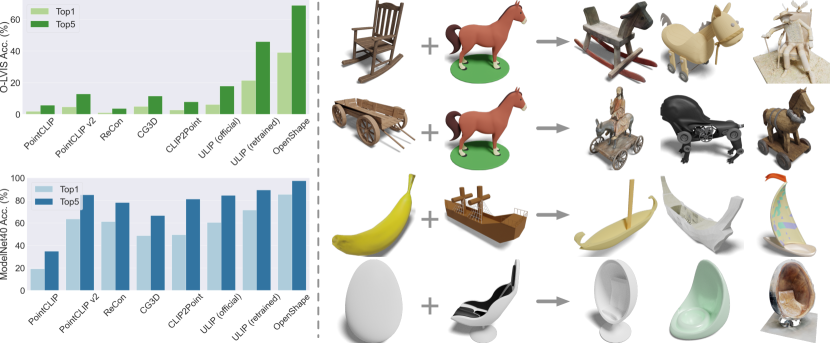
We introduce OpenShape, a method for learning multi-modal joint representations of text, image, and point clouds. We adopt the commonly used multi-modal contrastive learning framework for representation alignment, but with a specific focus on scaling up 3D representations to enable open-world 3D shape understanding. To achieve this, we scale up training data by ensembling multiple 3D datasets and propose several strategies to automatically filter and enrich noisy text descriptions. We also explore and compare strategies for scaling 3D backbone networks and introduce a novel hard negative mining module for more efficient training. We evaluate OpenShape on zero-shot 3D classification benchmarks and demonstrate its superior capabilities for open-world recognition. Specifically, OpenShape achieves a zero-shot accuracy of 46.8% on the 1,156-category Objaverse-LVIS benchmark, compared to less than 10% for existing methods. OpenShape also achieves an accuracy of 85.3% on ModelNet40, outperforming previous zero-shot baseline methods by 20% and performing on par with some fully-supervised methods. Furthermore, we show that our learned embeddings encode a wide range of visual and semantic concepts (e.g., subcategories, color, shape, style) and facilitate fine-grained text-3D and image-3D interactions. Due to their alignment with CLIP embeddings, our learned shape representations can also be integrated with off-the-shelf CLIP-based models for various applications, such as point cloud captioning and point cloud-conditioned image generation.
연구 동기 및 목표
- 작게 선별된 데이터셋을 넘어선 오픈 월드 3D 형태 이해를 촉진한다.
- 3D 데이터를 대폭 확장하고 노이즈가 많은 텍스트 설명을 풍부하게 하여 CLIP 공간과의 의미적 정렬을 개선한다.
- 3D 백본의 확장을 조사하고 데이터 불균형에 대응하기 위해 하드 네거티브 마이닝을 도입한다.
- CLIP 정렬 임베딩으로 강력한 제로샷 3D 분류 및 크로스모달 기능을 시연한다.
제안 방법
- 학습을 위해 네 개의 대형 공개 3D 데이터셋을 앙상블하여 876k 형상을 구성한다.
- CLIP 인코더를 고정한 채 3D 형태 임베딩을 CLIP 언어 및 이미지 공간과 정렬하기 위해 다중 모달 대조 학습을 사용한다.
- 3D–텍스트 정렬을 개선하기 위해 GPT-4 필터링, BLIP/Azure 캡션, 이미지 검색 캡션을 통해 텍스트 설명을 필터링하고 풍부하게 한다.
- 3D 백본(예: PointBERT, SparseConv)을 확장하고 학습 데이터 크기에 따른 성능 차이를 비교한다.
- 오프라인 하드 네거티브 마이닝을 도입하여 도전적인 배치 구성을 만들고 판별 학습을 향상시킨다.
- 교차 모달 작업을 가능하게 하고 CLIP 기반 모델과의 통합을 위한 공통 임베딩 공간을 활용한다.
실험 결과
연구 질문
- RQ1대규모 멀티모달 사전학습이 오픈월드 이해와 강력한 제로샷 성능을 달성할 수 있는가?
- RQ2데이터 규모, 텍스트 품질, 백본 확장, 하드 네거티브 마이닝이 제로샷 3D 인식에 어떤 영향을 미치는가?
- RQ33D 임베딩을 CLIP 언어 및 이미지 공간과 정렬하는 것이 크로스모달 작업에 미치는 영향은 무엇인가?
- RQ4OpenShape 임베딩이 모달리티 간 검색 및 생성 작업을 어떻게 가능하게 하는가?
- RQ5제로샷 3D 인식이 표준 벤치마크에서 완전한 감독 기반 기준선에 얼마나 근접하거나 이를 상회할 수 있는가?
주요 결과
- OpenShape은 Objaverse-LVIS(1,156개 카테고리)에서 제로샷 정확도 46.8%를 달성하여 이전 방법을 큰 폭으로 능가한다.
- ModelNet40에서 85.3% 제로샷 정확도를 달성하여 이전 제로샷 베이스라인보다 최소 20% 포인트 앞선다.
- OpenShape은 이미지나 텍스트에서 형상을 검색하고 형상 조건 생성이 가능한 강력한 파샷 및 크로스모달 검색 능력을 보여준다.
- OpenShape 임베딩을 CLIP 공간에 정렬하는 것은 포인트클라우드 자막화 및 포인트클라우드 조건 이미지 생성과 같은 CLIP 기반 모델과의 통합을 가능하게 한다.
- 백본 확장과 텍스트 보강 전략은 성능을 크게 높이며, 하드 네거티브 마이닝은 데이터 불균형 해소에 도움을 준다.

이 논문 읽기
누빈트 뷰어에서 원문을 열고, 읽으면서 궁금한 곳을 바로 물어보세요.
누빈트에서 이 논문 읽기이 리뷰는 AI가 논문 원문을 바탕으로 만들었습니다. 인용하기 전에 원문을 확인해 주세요.