
[논문 리뷰] Predicting the Initial Conditions of the Universe using a Deterministic Neural Network
이 논문은 비선형 중력 수축으로 인해 역문제가 본질적으로 다대일 매핑을 가지는 상황임에도 불구하고, 우주의 최종 비선형 상태(z=0)에서 초기 선형 이동장의 정확한 예측을 가능하게 하는 결정론적 컨volution 신경망(V-Net)을 소개한다. 이는 k ≈ 0.8–0.9 Mpc⁻¹h까지 1–2% 미만의 오차를 기록한다. 이 방법은 복잡한 생성 모델보다 우주론적 시뮬레이션의 결정론적 성격을 활용하여 우수한 일반화 성능을 보이며, 분포 외 우주론적 파rameter에 대해서도 잘 작동한다.
Finding the initial conditions that led to the current state of the universe is challenging because it involves searching over an intractable input space of initial conditions, along with modeling their evolution via tools such as N-body simulations which are computationally expensive. Recently, deep learning has emerged as a surrogate for N-body simulations by directly learning the mapping between the linear input of an N-body simulation and the final nonlinear output from the simulation, significantly accelerating the forward modeling. However, this still does not reduce the search space for initial conditions. In this work, we pioneer the use of a deterministic convolutional neural network for learning the reverse mapping and show that it accurately recovers the initial linear displacement field over a wide range of scales ($<1$-$2\%$ error up to nearly $k\simeq0.8$-$0.9 ext{ Mpc}^{-1}h$), despite the one-to-many mapping of the inverse problem (due to the divergent backward trajectories at smaller scales). Specifically, we train a V-Net architecture, which outputs the linear displacement of an N-body simulation, given the nonlinear displacement at redshift $z=0$ and the cosmological parameters. The results of our method suggest that a simple deterministic neural network is sufficient for accurately approximating the initial linear states, potentially obviating the need for the more complex and computationally demanding backward modeling methods that were recently proposed.
연구 동기 및 목표
- 관측된 비선형 구조가 z=0에서 나타나는 초기 조건을 복원하는 역문제를 다루는 것. 이는 고차원적이고 해석이 불가능한 검색 공간으로 인해 계산적으로 비현실적이다.
- 해밀토니안 몬테카를로와 같은 샘플링 기반 방법의 한계를 극복하는 것. 이러한 방법은 후보 확률 밀도를 하나 생성하기 위해 수천 시간의 CPU 시간이 소요된다.
- 간단한 결정론적 신경망이 N-body 시뮬레이션의 역매핑을 근사할 수 있는지 조사하는 것. 이를 통해 디퓨전 네트워크와 같은 복잡한 생성 모델이 필요 없어지는 것을 목표로 한다.
- Quijote 시뮬레이션 세트에서 분포 외 우주론적 파rameter에 대한 모델의 일반화 성능을 평가하는 것.
- 결정론적 신경망이 후속 고정밀 샘플링 기반 역모델링 방법에 효과적인 사전 확률로 작용할 수 있음을 보여주는 것.
제안 방법
- V-Net 아키텍처를 사용하여 z=0에서의 비선형 이동장과 우주론적 파rameter를 입력으로 받아 해당하는 선형 제르도비치 근사(za) 이동장을 출력하도록 훈련한다.
- 입력은 비선형 이동장, 출력은 선형 이동장인 대규모 N-body 시뮬레이션 데이터셋을 신경망 에미레이터를 통해 생성하여 훈련한다.
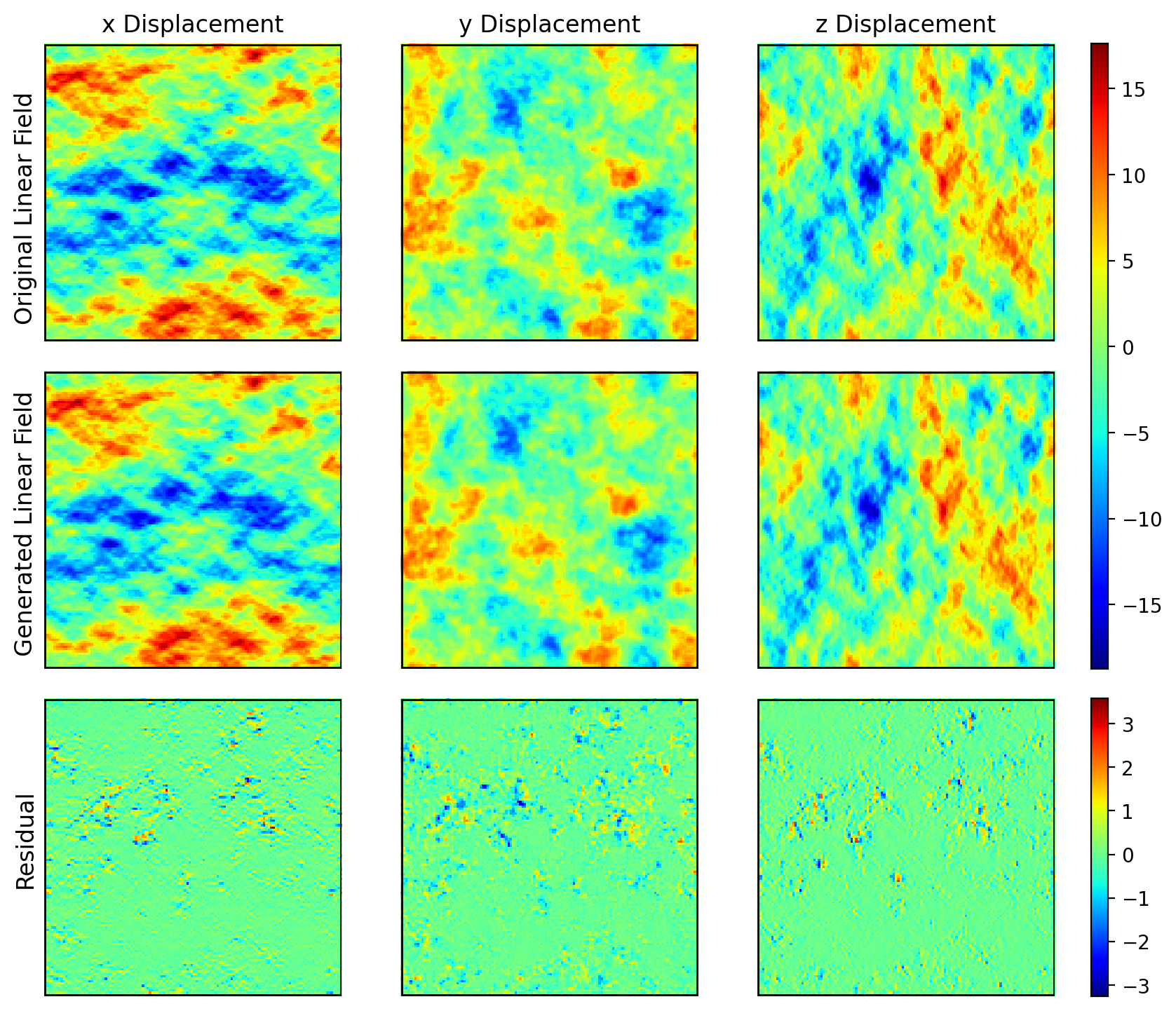
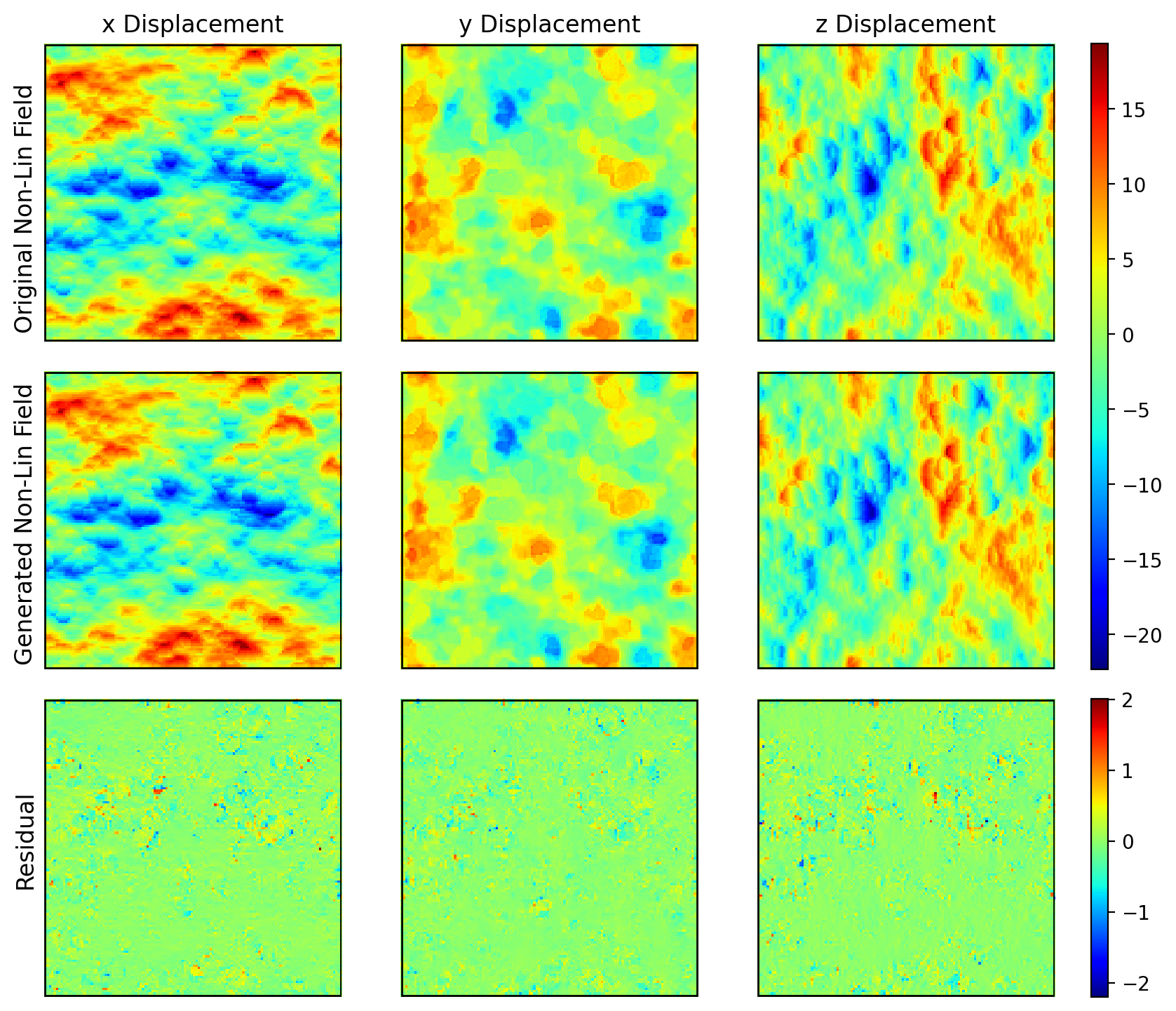
- 예측된 비선형 필드가 동일한 에미레이터를 사용하여 선형 필드에서 재생성됨으로써 전진 방향의 일관성을 검증한다.
- Quijote 시뮬레이션 세트에서 모델의 일반화 성능을 평가하기 위해 우주론적 파ram터의 비유사도(Ωₘ, σ₈) 기반으로 시뮬레이션을 순위 매기고, 0%에서 100%까지의 백분위수에서 성능을 평가한다.
- 스케일 전역에서 이동장의 파wer 스펙트럼 비교, 두점 상관 함수, 일점 통계를 사용하여 성능을 정량화한다.
- 미래 확장으로서 불확실성 정량화를 고려하며, 이는 가우시안 음수 로그우도 손실, 베이지안 신경망, 또는 콫포멀 예측과 같은 방법이 가능하다.
실험 결과
연구 질문
- RQ1결정론적 컨volution 신경망은 N-body 시뮬레이션의 최종 비선형 상태에서 초기 선형 이동장을 정확하게 복원할 수 있는가?
- RQ2특히 Quijote 시뮬레이션 세트에서 훈련 분포 외의 우주론적 파rameter에 대해 모델의 일반화 성능은 어떠한가?
- RQ3비선형 중력 역학이 支배하는 소규모 스케일(k > 0.1 Mpc⁻¹h)에서도 모델이 높은 정확도를 유지하는가?
- RQ4예측된 초기 조건은 후속 고정밀 샘플링 기반 역모델링 방법에 효과적인 사전 확률로 작용할 수 있는가?
- RQ5이 역문제에 대해 단순한 결정론적 네트워크로도 충분한가, 아니면 더 복잡한 생성 모델(예: 디퓨전 모델)이 필요한가?
주요 결과
- 모델은 다양한 스케일에서 선형 이동장을 예측할 때 1–2% 미만의 오차를 기록하며, k ≈ 0.8–0.9 Mpc⁻¹h까지 정확도가 유지된다.
- 모델은 분포 외 우주론적 파rameter에 대해 효과적으로 일반화되며, Quijote 시뮬레이션의 백분위수 순위(0%에서 100%)에 걸쳐 점진적으로 성능 저하가 발생한다.
- 예측된 필드와 실제 필드의 파워 스펙트럼 및 두점 상관 함수는 특히 큰 스케일과 중간 스케일(k < 0.5 Mpc⁻¹h)에서 강력한 일치를 보인다.
- 예측된 선형 필드에서 재생성된 비선형 필드는 실제 비선형 필드와 밀도적으로 유사하여, 모델의 전진 방향 일관성과 신뢰성을 확인한다.
- 속도와 계산 비용 측면에서 BORG와 같은 복잡한 샘플링 기반 방법보다 뛰어난 성능를 보이며, 경쟁 가능한 정확도를 유지한다.
- 결과적으로 결정론적 신경망이 초기 조건 복원에 충분하며, 이 분야에서 고비용 생성 모델의 필요성을 제거할 수 있음을 시사한다.
이 논문 읽기
누빈트 뷰어에서 원문을 열고, 읽으면서 궁금한 곳을 바로 물어보세요.
누빈트에서 이 논문 읽기이 리뷰는 AI가 논문 원문을 바탕으로 만들었습니다. 인용하기 전에 원문을 확인해 주세요.