
[논문 리뷰] Probing out-of-distribution generalization in machine learning for materials
이 논문은 재료 ML에서의 휴리스틱 OOD 테스트가 종종 보간(interpolation)을 탐지하며 진정한 외삽 extrapolation이 아님을 보여준다; 다양한 OOD 작업에서 많은 모델이 일반화에 우수하며, 대표적으로 스케일링은 표현적으로 OOD인 경우에 해를 줄 수 있다.
Scientific machine learning (ML) endeavors to develop generalizable models with broad applicability. However, the assessment of generalizability is often based on heuristics. Here, we demonstrate in the materials science setting that heuristics based evaluations lead to substantially biased conclusions of ML generalizability and benefits of neural scaling. We evaluate generalization performance in over 700 out-of-distribution tasks that features new chemistry or structural symmetry not present in the training data. Surprisingly, good performance is found in most tasks and across various ML models including simple boosted trees. Analysis of the materials representation space reveals that most tasks contain test data that lie in regions well covered by training data, while poorly-performing tasks contain mainly test data outside the training domain. For the latter case, increasing training set size or training time has marginal or even adverse effects on the generalization performance, contrary to what the neural scaling paradigm assumes. Our findings show that most heuristically-defined out-of-distribution tests are not genuinely difficult and evaluate only the ability to interpolate. Evaluating on such tasks rather than the truly challenging ones can lead to an overestimation of generalizability and benefits of scaling.
연구 동기 및 목표
- 재료 ML에서 OOD 작업이 정의되는 방식의 편향을 밝히다.
- 다양한 데이터셋과 모델에 걸쳐 >700 OOD 작업을 체계적으로 평가한다.
- 표현적(representational) OOD와 통계적(도메인) OOD를 구분하고 일반화에 미치는 영향을 분석한다.
- 학습 크기(데이터 양)와 시간이 OOD 성능과 신경망 스케일링 주장에 미치는 영향을 조사한다.
제안 방법
- JARVIS, Materials Project(MP), Open Quantum Materials Database(OQMD) 전반에 걸쳐 여섯 가지 OOD 기준을 평가한다.
- Matminer 특징(descriptors)을 사용한 랜덤 포레스트 및 XGBoost 등 대표 모델을 학습; GMP Gaussian multipole 신경망; ALIGNN 그래프 신경망; 결정 구조 텍스트 설명을 사용하는 LLM 기반 LLM-Prop를 활용한다.
- 원소, 그룹, 공간군 등 대상에서 leave-one-X 태스크에 대해 MAE와 R^2 지표로 성능을 평가한다.
- 바이어스의 조성적 요인과 구조적 요인으로부터의 편향을 분리하기 위해 SHAP 기반 보정을 사용한다.
- 표현 공간을 시각화하기 위해 UMAP을 적용하고 커널 밀도 기반 도메인 식별을 수행한다.
- OOD와 ID 데이터에 대해 학습 시간과 데이터셋 크기를 바꿔 신경망 스케일링을 검토한다.
실험 결과
연구 질문
- RQ1훈련 데이터 밖의 진정한 외삽에 어떻게 일반적으로 OOD 작업을 정의하는 휴리스틱이 관련되는가?
- RQ2학습에서 제외되었을 때 ML 모델이 화학적 및 구조적 그룹 간 일반화가 가능한가?
- RQ3OOD 예측에 체계적인 편향이 존재하는가, 그리고 그것이 조성적 또는 구조적 요인으로 설명될 수 있는가?
- RQ4임베딩 공간에서의 표현 도메인(ID 대 OOD)이 관찰된 스케일링 법칙에 어떤 영향을 미치는가?
- RQ5강인한 일반화를 위한 재료 ML 모델의 평가 및 설계에 어떤 시사점이 있는가?
주요 결과
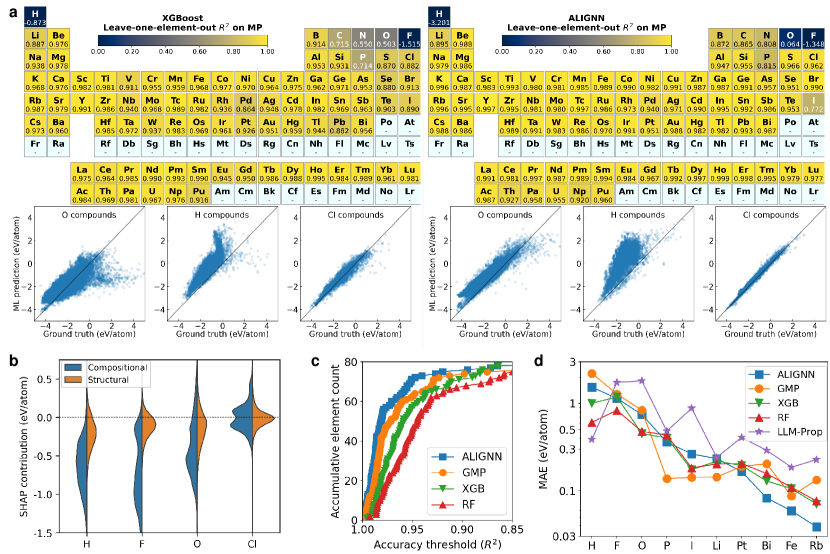
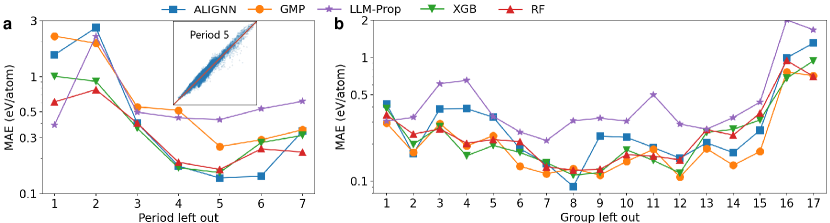
- 단순 트리 앙상블을 포함한 많은 모델이 화학적 및 구조 기반의 대부분의 OOD 작업에서 일반화에 우수하다.
- OOD 테스트 데이터의 큰 부분이 표현 공간에서 학습 분포 내에 위치하여 진정한 외삽이 아니라 보간임을 시사한다.
- H, F, O와 같은 비금속은 화학적 비유사성으로 인해 OOD 성능이 낮고, 데이터 부족 때문이 아니라 조성 편향이 식별된다.
- 구조 기반 OOD 작업은 화학 기반보다 도전적이지만 중대칭에서 고대칭 클래스까지 여전히 강한 일반화를 보이며; triclinic 결정계는 더 어렵다.
- 표현적으로 ID 일반화에 대해 신경망 스케일링 법칙이 성립하지만, 표현적으로 OOD인 경우에는 자주 실패하거나 역전되며, 진정한 OOD 일반화에 대한 스케일링 이점이 과대평가될 수 있음을 시사한다.
- 밀도 기반 도메인 식별(UMAP 및 커널 밀도)을 통해 표현적으로 ID/OOD 포인트를 구분하고 예측 오차와 상관관계가 있지만 완벽하진 않다.
이 논문 읽기
누빈트 뷰어에서 원문을 열고, 읽으면서 궁금한 곳을 바로 물어보세요.
누빈트에서 이 논문 읽기이 리뷰는 AI가 논문 원문을 바탕으로 만들었습니다. 인용하기 전에 원문을 확인해 주세요.