
[논문 리뷰] Progress in Direct Measurements of the Hubble Constant
두 십년간의 H0의 직접 지역 측정에 대한 리뷰로, Cepheids, TRGB, 및 JAGB에 중점을 두고 JWST 결과와 체계적 불확실성을 다루며 H0 긴장을 해결하려는 노력에 대한 평가이다.
One of the most exciting and pressing issues in cosmology today is the discrepancy between some measurements of the local Hubble constant and other values of the expansion rate inferred from the cosmic microwave background (CMB) radiation. Resolving these differences holds the potential for the discovery of new physics beyond the standard model of cosmology: Lambda Cold Dark Matter (LCDM), a successful model that has been in place for more than 20 years. Given both the fundamental significance of this outstanding discrepancy, and the many-decades-long effort to increase the accuracy of the extragalactic distance scale, it is critical to demonstrate that the local measurements are convincingly free from residual systematic errors. We review the progress over the past quarter century in measurements of the local value of the Hubble constant, and discuss remaining challenges. Particularly exciting are new data from the James Webb Space Telescope (JWST). JWST is delivering high-resolution near-infrared imaging data to both test for and to address directly several of the systematic uncertainties that have historically limited the accuracy of the extragalactic distance scale. We present an overview of our new JWST program to observe Cepheids, TRGB and JAGB stars. For the first galaxy in our program, NGC 7250, the high-resolution JWST images demonstrate that many of the Cepheids observed with the Hubble Space Telescope (HST) are significantly crowded by nearby neighbors. Avoiding the more significantly crowded variables, the scatter in the JWST near-infrared (NIR) Cepheid period-luminosity relation is decreased by a factor of two compared to those from HST, illustrating the power of JWST for improvements to local measurements of Ho. Ultimately, these data will either confirm the standard model, or provide robust evidence for the inclusion of additional new physics.
연구 동기 및 목표
- 지역 H0 측정의 과거와 현재 상태 및 정밀도를 평가한다.
- Cepheid- 및 TRGB 기반 거리의 지배적 시스템오차를 식별하고 평가한다.
- JWST 데이터의 등장과 그것이 crowding 및 먼지 관련 불확실성을 줄이는 영향 요약.
- 대체 거리 표지자(JAGB)와 거리 스케일의 독립적 앵커를 논의한다.
- H0에서 퍼센트 수준의 정확도를 달성하기 위한 전망과 남은 과제를 개요한다.
제안 방법
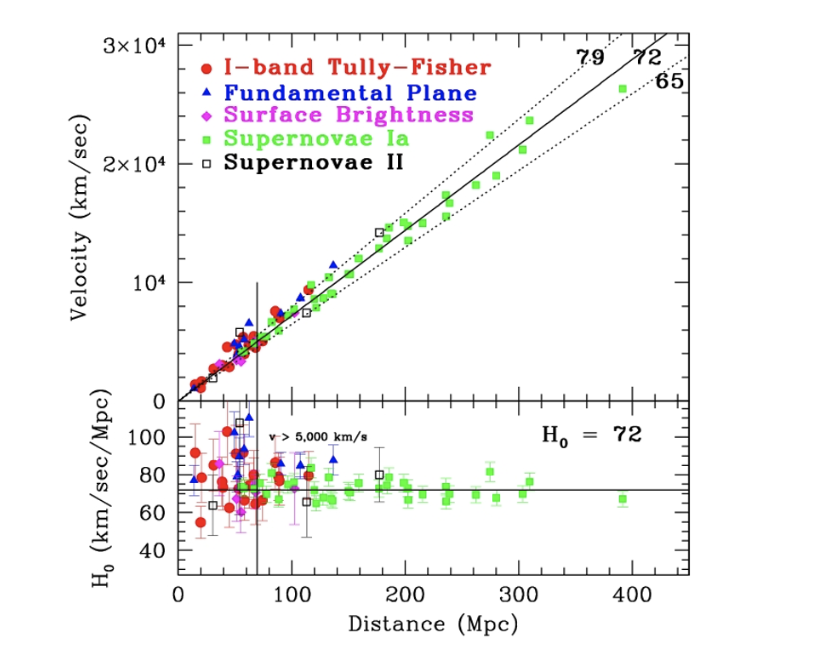
- 허블 키 프로젝트와 그 10% 총 불확실성 목표를 검토한다.
- 가장 정밀한 지역 거리 방법 두 가지로 Cepheid와 TRGB 거리 척도를 논의한다.
- 거리 척도의 앵커(LMC, MW parallaxes, NGC 4258)의 평가와 그것이 H0에 미치는 영향을 분석한다.
- SN Ia 보정 및 H0에 대한 SHoES, CCHP, CSP, Pantheon+ 연구를 요약한다.
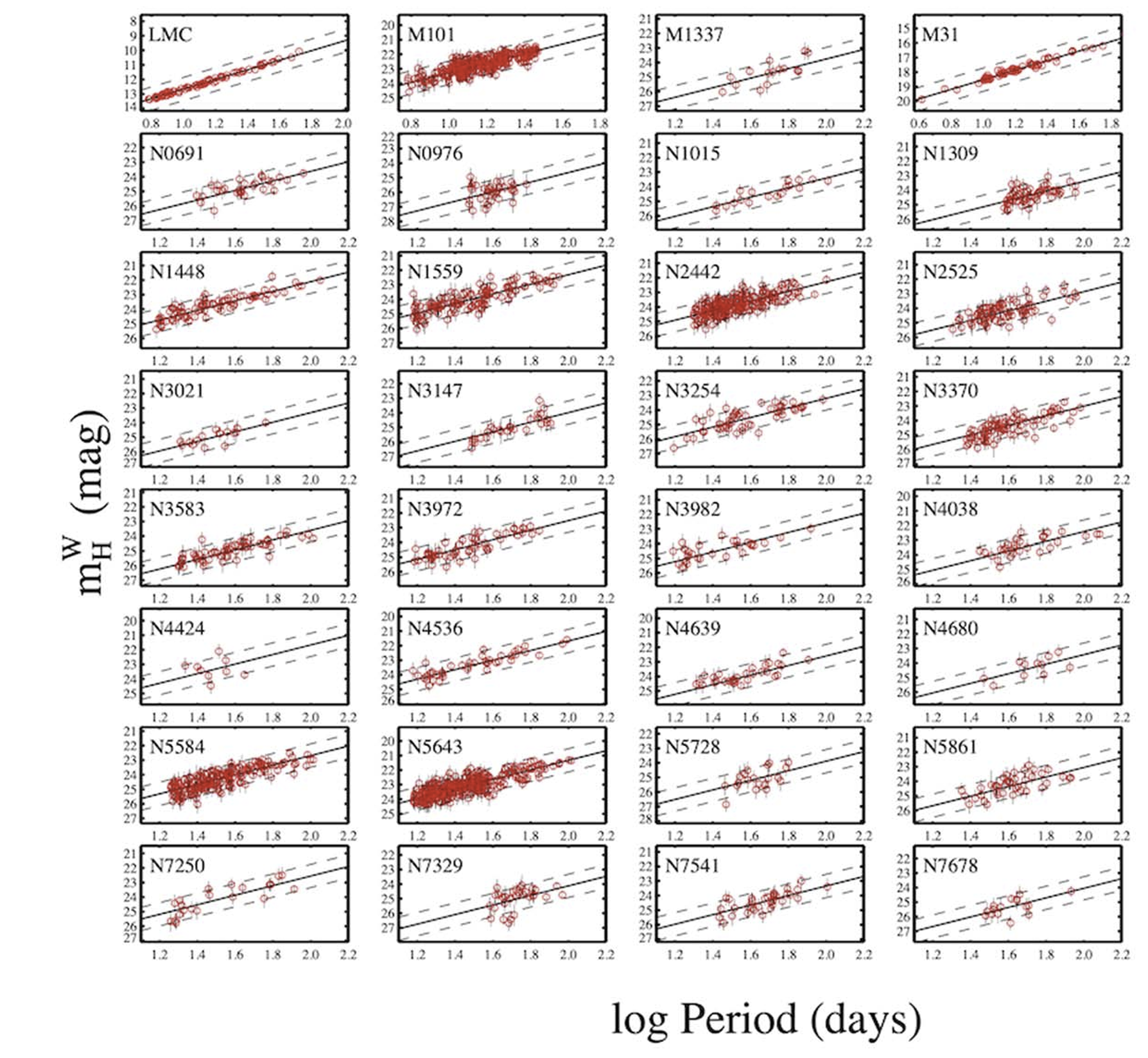
- crowding 및 reddening을 다루기 위한 JWST의 능력과 첫 결과들(예: NGC 7250)을 제시한다.
실험 결과
연구 질문
- RQ1H0의 직접 지역 측정의 현재 상태와 그 정밀도는 무엇인가?
- RQ2Cepheid 및 TRGB 거리 척도에서 지배적인 시스템오차는 무엇이며 어떻게 완화되었는가?
- RQ3독립적인 보정(앵커)이 도출된 H0 및 그 불확실성에 어떻게 영향을 미치는가?
- RQ4JWST 데이터가 알려진 시스템오차를 어느 정도까지 줄이고 H0를 더 제약할 수 있는가?
- RQ5대체 거리 지시자(예: JAGB)가 Cepheid/TRGB 척도와 일치하며 H0에 미치는 영향은 무엇인가?
주요 결과
- Cepheid 기반 보정은 H0를 약 73 km s-1 Mpc-1 수준으로 산출하는 반면 TRGB 기반 보정은 약간 더 낮은 경향을 보인다 (~70 km s-1 Mpc-1).
- JWST 근적외선 영상은 Cepheid crowding을 줄여 첫 JWST 결과에서 Cepheid PL 관계의 산란을 HST 대비 절반으로 감소시켰다.
- 독립 앵커(NGC 4258, LMC, SMC)와 함께한 TRGB 보정은 maser 및 halo TRGB 측정과의 일치성을 보여 주며 거 리 스케일의 견고함을 뒷받침한다.
- 앵커(LMC 거리 모듈러스, MW parallaxes, NGC 4258 masers)가 현재의 체계적 오차 예산을 지배하며 전역 H0 정밀도에 결정적 영향을 미친다.
- CCHP 및 SHoES 프로그램은 적외선 Cepheids, 적색편/colors 보정, 및 시차 기준선을 강조하여 2% 미만의 체계적 불확실성에 다가가도록 한다.
- JAGB는 금속적 요소 및 적색편광 민감도가 작아 경쟁력 있는 표준시계로 부상하며 독립적인 교차 검증을 제공한다.
이 논문 읽기
누빈트 뷰어에서 원문을 열고, 읽으면서 궁금한 곳을 바로 물어보세요.
누빈트에서 이 논문 읽기이 리뷰는 AI가 논문 원문을 바탕으로 만들었습니다. 인용하기 전에 원문을 확인해 주세요.