
[논문 리뷰] ProRes: Exploring Degradation-aware Visual Prompt for Universal Image Restoration
ProRes는 ViT 백본 기반의 제어 가능한 범용 이미지 복원 프레임워크를 가능하게 하는 degradations-aware 시각 프롬프트를 도입하고, 새로운 작업/데이터셋에 적응하기 위한 프롬프트 튜닝을 제공합니다.
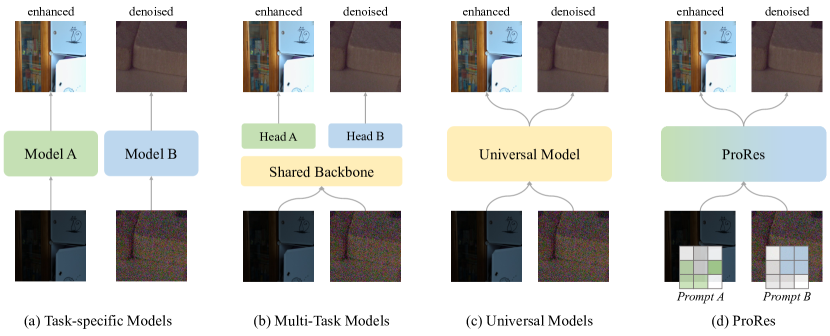
Image restoration aims to reconstruct degraded images, e.g., denoising or deblurring. Existing works focus on designing task-specific methods and there are inadequate attempts at universal methods. However, simply unifying multiple tasks into one universal architecture suffers from uncontrollable and undesired predictions. To address those issues, we explore prompt learning in universal architectures for image restoration tasks. In this paper, we present Degradation-aware Visual Prompts, which encode various types of image degradation, e.g., noise and blur, into unified visual prompts. These degradation-aware prompts provide control over image processing and allow weighted combinations for customized image restoration. We then leverage degradation-aware visual prompts to establish a controllable and universal model for image restoration, called ProRes, which is applicable to an extensive range of image restoration tasks. ProRes leverages the vanilla Vision Transformer (ViT) without any task-specific designs. Furthermore, the pre-trained ProRes can easily adapt to new tasks through efficient prompt tuning with only a few images. Without bells and whistles, ProRes achieves competitive performance compared to task-specific methods and experiments can demonstrate its ability for controllable restoration and adaptation for new tasks. The code and models will be released in \url{https://github.com/leonmakise/ProRes}.
연구 동기 및 목표
- 다양한 고장( deteriorations )를 작업별 아키텍처 없이 처리하는 범용 이미지 복원을 목표로 한다.
- 다양한 왜곡을 이미지 유사 프롬프트로 인코딩하는 degradations-aware 시각 프롬프트를 제안한다.
- 프롬 프레임을 프롬프트 기반 제어를 활용한 간단한 ViT 기반의 범용 복원 프레임워크로 구축한다.
- 프롬프트 튜닝을 통해 새로운 작업/데이터셋에 ProRes를 효율적으로 적응시키는 방법을 입증한다.
제안 방법
- 입력 이미지와 동일한 높이/너비를 갖는 degradations-aware 시각 프롬프트를 정의하여 특정 왜곡을 인코딩한다.
- degraded 이미지에 단일 왜곡 프롬프트를 추가하고 vanilla ViT 인코더와 간단한 픽셀 디코더로 처리한다.
- 최적화를 안정시키기 위해 프롬프트를 학습시키고 나머지 사전 학습된 복원 모델은 고정한다.
- 전체 모델 미세조정 없이 새로운 작업/데이터셋에 ProRes를 적응시키기 위한 경량 프롬프트 튜닝 프로토콜을 사용한다.
- 프롬프트 초기화 전략과 학습 손실을 탐구하고, 안정성과 성능을 위해 사전 학습된 프롬프트와 Smooth-L1 손실을 선택한다.
실험 결과
연구 질문
- RQ1 degradations-aware 시각 프롬프트가 여러 작업에 걸쳐 제어 가능한 범용 복원 능력을 제공할 수 있는가?
- RQ2denoising, deraining, enhancement, deblurring에서 ProRes가 작업별/버전 없는 일반 모델과 비교하여 어떤 차이가 있는가?
- RQ3프롬프트 튜닝이 전체 모델 재학습 없이도 새로운 왜곡 작업이나 데이터셋에 ProRes를 효율적으로 적응시키는가?
- RQ4프롬프트 초기화의 영향은 무엇이며 네트워크의 어디에 프롬프트를 통합해야 하는가?
주요 결과
- ProRes는 간단한 ViT 기반 아키텍처에서 여러 벤치마크에서 작업별 방법에 비견되는 성능을 달성한다.
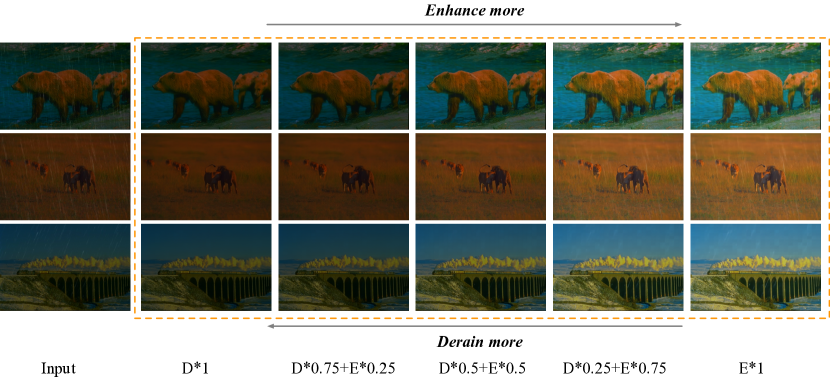
- degradations-aware 프롬프트는 복잡한 왜곡에 대한 프롬프트의 가중 합산을 통해 제어 가능한 복원을 제공한다.
- 프롬프트 튜닝은 전체 모델 미세조정 없이 새로운 작업/데이터셋(예: 저광 대비 FiveK, 대기 현상 RESIDE-6K)으로의 효과적인 전달을 가능하게 한다.
- 사전 학습된 프롬프트와 분리된 최적화를 사용하면 안정적인 학습과 다양한 작업에서 좋은 결과를 얻을 수 있다.
- 이 접근법은 시각화 기반 제어와 전달 가능성을 시연하며, 프롬프트를 통한 더 큰 규모의 범용 복원으로의 확장 가능성을 시사한다.
이 논문 읽기
누빈트 뷰어에서 원문을 열고, 읽으면서 궁금한 곳을 바로 물어보세요.
누빈트에서 이 논문 읽기이 리뷰는 AI가 논문 원문을 바탕으로 만들었습니다. 인용하기 전에 원문을 확인해 주세요.