
[논문 리뷰] Quantum-enhanced sensing on an optical transition via emergent collective quantum correlations
이 논문은 51개의 포획된 이온으로 구성된 1차원 체인에서 상태에 따라 변하는 상호작용이 거듭 제곱 법칙에 따라 감쇠되는 것을 이용해 집합적 양자 얽힘을 생성함으로써 양자 향상된 센싱을 구현한다. 이는 스피너 스트레칭을 −3.9 ± 0.3 dB(윈랜드 파라미터)로 달성하고, 라마치 간섭계에서 표준 양자 한계 이하로 측정 불확도를 −3.2 ± 0.5 dB 감소시켜, 완전한 전지구적 연결 없이도 확장 가능한 얽힘을 실현한다.
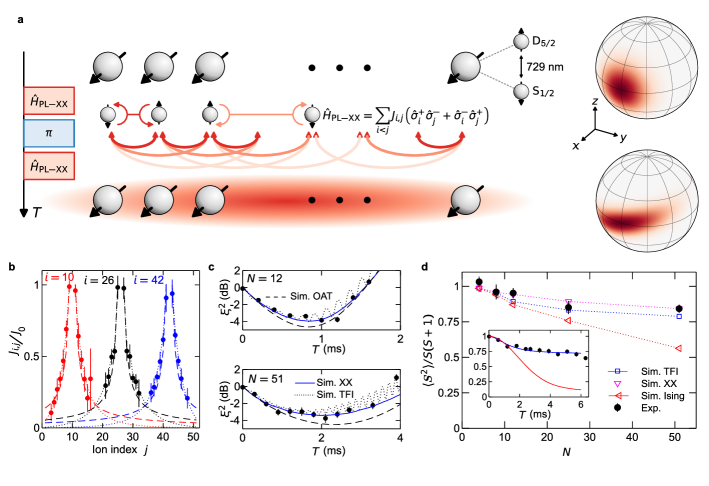
The control over quantum states in atomic systems has led to the most precise optical atomic clocks to date. Their sensitivity is currently bounded by the standard quantum limit, a fundamental floor set by quantum mechanics for uncorrelated particles, which can nevertheless be overcome when operated with entangled particles. Yet demonstrating a quantum advantage in real world sensors is extremely challenging and remains to be achieved aside from two remarkable examples, LIGO and more recently HAYSTAC. Here we illustrate a pathway for harnessing scalable entanglement in an optical transition using 1D chains of up to 51 ions with state-dependent interactions that decay as a power-law function of the ion separation. We show our sensor can be made to behave as a one-axis-twisting (OAT) model, an iconic fully connected model known to generate scalable squeezing. The collective nature of the state manifests itself in the preservation of the total transverse magnetization, the reduced growth of finite momentum spin-wave excitations, the generation of spin squeezing comparable to OAT (a Wineland parameter of $-3.9 \pm 0.3$ dB for only N = 12 ions) and the development of non-Gaussian states in the form of atomic multi-headed cat states in the Q-distribution. The simplicity of our protocol enables scalability to large arrays with minimal overhead, opening the door to advances in timekeeping as well as new methods for preserving coherence in quantum simulation and computation. We demonstrate this in a Ramsey-type interferometer, where we reduce the measurement uncertainty by $-3.2 \pm 0.5$ dB below the standard quantum limit for N = 51 ions.
연구 동기 및 목표
- 완전한 전지구적 연결 없이 유한한 범위의 상호작용을 사용하여 대규모 포획된 이온 배열에서 양자 향상된 센싱을 구현하는 것.
- 거듭 제곱 법칙에 따라 감쇠되는 XX 상호작용을 가진 1차원 이온 체인에서 확장 가능한 스피너 스트레칭과 얽힘을 달성하는 것.
- 집합적 양자 상관관계—예를 들어 유지된 총 횡방향 자화 및 비가우시안 다중 머리 고양이 상태—가 이러한 시스템에서 자연스럽게 나타나는지 보여주는 것.
- 라마치 유형 간섭계에서 측정 불확도를 표준 양자 한계 이하로 줄여 측정된 양자 우위를 달성하는 것.
- 코herence를 유지하면서 저비용으로 구현 가능한 확장 가능한 프로토콜을 확립하여 시간 측정 및 양자 시뮬레이션 발전을 가능하게 하는 것.
제안 방법
- 고유한 양자 상태 유지 시간을 확보하기 위해 광학 전이(D5/2 → D3/2)에 의해 큐비트를 인코딩한 최대 51개의 40Ca+ 포획된 이온으로 구성된 1차원 체인을 사용한다.
- 이온 간 거리에 따라 거듭 제곱 법칙에 따라 감쇠되는 레이저 구동 스피너 교환(XX 유형) 상호작용을 통해 상태에 따라 변하는 상호작용을 시행한다(α ≈ 0.9–1.0).
- 일축 휘감기(OAT)-유사 진화를 구현하기 위해 전역 레이저 펄스 시퀀스를 적용하여 스피너 코herent 상태(스피너 코herent 상태, SCS)에서 스피너 스트레칭 상태를 생성한다.
- 윈랜드 파라미터를 통한 스피너 스트레칭 측정 및 총 횡방향 자화와 스피너 웨이브 진동수를 통한 집합적 스피너 동역학 모니터링.
- Q-분포 분석을 통해 비가우시안 특징(예: 다중 머리 고양이 상태)을 탐지하고, 다체 얽힘의 발생을 확인한다.
- 스트레칭된 상태를 사용한 라마치 간섭계를 수행하여 측정 불확도의 표준 양자 한계 대비 감소 정도를 정량화한다.
실험 결과
연구 질문
- RQ1유한한 범위의 거듭 제곱 법칙 감쇠 상호작용을 가진 1차원 포획된 이온 체인에서 완전한 전지구적 연결 없이도 확장 가능한 스피너 스트레칭을 달성할 수 있는가?
- RQ2이러한 시스템에서 집합적 양자 상관관계—예를 들어 유지된 총 횡방향 자화 및 비가우시안 상태—는 어느 정도의 정도로 자연스럽게 나타나는가?
- RQ3지역 제어와 거듭 제곱 법칙 상호작용만을 사용하여도 라마치 유형 간섭계에서 표준 양자 한계 이하의 측정 불확도를 달성할 수 있는가?
- RQ4비편향 및 분산에 의해 영향을 받는 상황에서 이 시스템의 성능은 이상적인 OAT 모델과 어떻게 비교되는가?
- RQ5실제 비편향 조건 하에서 시스템 크기 증가(N = 12에서 N = 51)에 따라 스피너 스트레칭과 측정 불확도 감소의 스케일링 한계는 무엇인가?
주요 결과
- N = 12 이온에서 스피너 스트레칭이 −3.9 ± 0.3 dB로 달성되었으며, 유사한 비편향 조건에서 이상적인 OAT 모델의 성능에 가까워졌다.
- N = 51 이온에서 라마치 간섭계에서 측정 불확도가 표준 양자 한계 이하로 −3.2 ± 0.5 dB 감소하여 측정된 양자 우위를 입증했다.
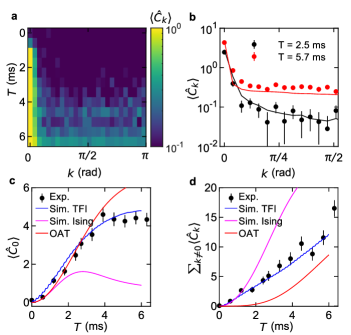
- 진화 중 총 횡방향 자화가 유지되어 유한한 범위 상호작용에도 불구하고 강건한 집합적 행동이 나타남을 확인했다.
- 비집합적 모델 대비 유한한 운동량 스피너 웨이브 진동수가 더 천천가게 증가하여 집합적 동역학의 발생을 확인했다.
- Q-분포에서 다중 머리 고양이 상태로 나타난 비가우시안 상태가 관측되어 복잡한 다체 얽힘 생성을 확인했다.
- 스케일링 분석에서 대규모 N에 대해 스피너 스트레칭이 포화되는 것으로 나타났으며, 이는 느린 얽힘 생성과 분산에 의해 제한되었지만, N = 12일 때 J₀를 두 배로 증가시키면 성능 향상을 관측했다.
이 논문 읽기
누빈트 뷰어에서 원문을 열고, 읽으면서 궁금한 곳을 바로 물어보세요.
누빈트에서 이 논문 읽기이 리뷰는 AI가 논문 원문을 바탕으로 만들었습니다. 인용하기 전에 원문을 확인해 주세요.