
[논문 리뷰] REBELS-IFU: Dust Build-up in Massive Galaxies at Redshift 7
이 논문은 JWST/NIRSpec 금속성 및 ALMA의 먼지와 가스 측정을 이용해 z~6.5–7.7의 12개의 REBELS 은하에서 먼지-가스, 먼지-금속, 먼지-별질량 관계를 초기 우주에서 제약한다.
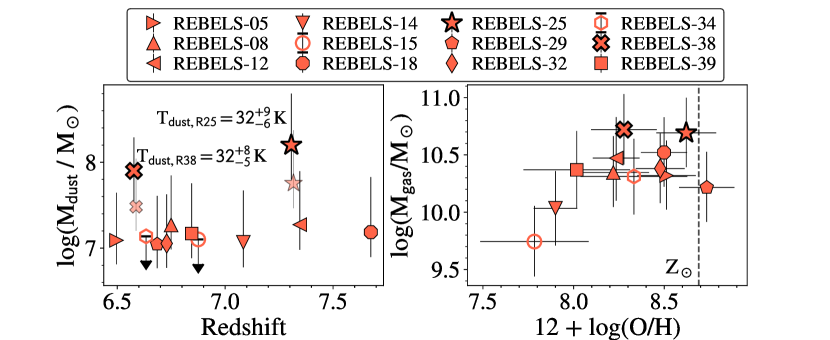
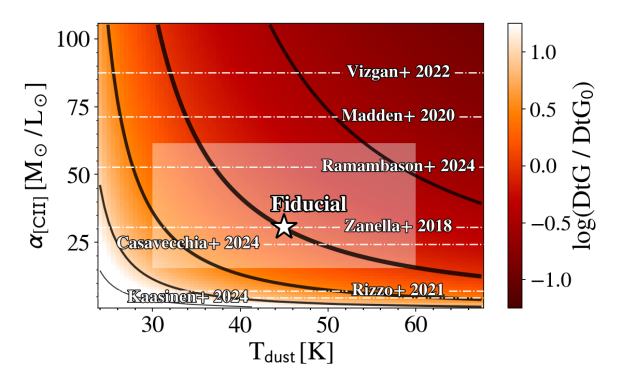
In recent years, observations with the JWST have started to map out the rapid metal enrichment of the early Universe, while (sub)millimeter observations have simultaneously begun to reveal the ubiquity of dust beyond $z\gtrsim6$. However, the pathways that led to the assembly of early dust reservoirs remain poorly quantified, and require pushing our understanding of key scaling relations between dust, gas and metals into the early Universe. We investigate the dust build-up in twelve $6.5 \lesssim z \lesssim 7.7$ galaxies drawn from the REBELS survey that benefit from (i) JWST/NIRSpec strong-line metallicity measurements, (ii) ALMA [CII]-based redshifts and gas masses, and (iii) dust masses from single- or multi-band ALMA continuum observations. Combining these measurements, we investigate the dust-to-gas (DtG), dust-to-metal (DtM), and dust-to-stellar mass (DtS) ratios of our sample as a function of metallicity. While our analysis is limited by systematic uncertainties related to the [CII]-to-H$_2$ conversion factor and dust temperature, we explore a wide range of possible values, and carefully assess their impact on our results. Under a fiducial set of assumptions, we find an average $\log(\mathrm{DtG}) = -3.02 \pm 0.23$, only slightly below that of local metal-rich galaxies. On the other hand, at fixed metallicity our average $\log(\mathrm{DtS}) = -2.15 \pm 0.42$ is significantly larger than that of low-redshift galaxies. Finally, through a comparison to various theoretical models of high-redshift dust production, we find that assembling the dust reservoirs in massive galaxies at $z\approx7$ likely requires the combination of rapid supernova enrichment and efficient ISM dust growth.
연구 동기 및 목표
- 6을 초과하는 질량 대 은하들의 먼지, 가스, 금속 함량을 합성 JWST/NIRSpec 및 ALMA 데이터로 정량화한다.
- 금속성에 따른 먼지-가스, 먼지-금속, 먼지-별질량 간의 스케일링 관계를 조사한다.
- 초기 먼지 저장고를 형성하는 SN 증가와 ISM 먼지 성장이 차지하는 역할을 평가한다.
- 가능한 매개변수 범위에서 [C II]-to-H2 변환과 먼지 온도 등 체계적 불확실성을 평가한다.
제안 방법
- ALMA [C II]-기반 가스 질량과 연속관측에서의 먼지 질량을 결합하여 DtG, DtM, DtS 비를 도출한다.
- Zanella et al. (2018) [C II]-to-H2 보정치를 이용해 [C II] 발광도에서 분자 가스 질량을 추정한다.
- JWST/NIRSpec 강한 선 진단(R23, O32, R3 가능 시)을 통한 금속성을 채택하고 대체 보정과 교차검증한다.
- fiducial 가정 하에서 먼지-가스, 먼지-금속, 먼지-별질량 비를 계산하고 광범위한 먼지 온도와 다른 불확실 매개변수를 탐색한다.
- 초기 은하에서 분자 가스가 지배적 가스 성분이라고 가정하고( HI 무시) 먼지 성장 모델에 대한 함의를 살핀다.
실험 결과
연구 질문
- RQ1z~6.5–7.7 은하에서 관측된 DtG, DtM, DtS 비는 무엇이며 가스상의 금속성에 따라 어떻게 스케일링되는가?
- RQ2빠른 SN 증가와 ISM 먼지 성장이 함께 초기 대형 은하의 추정 먼지 저장고를 설명할 수 있는가?
- RQ3[C II]-to-H2 변환, 먼지 온도, 먼지 특성에 대한 가정이 추정된 먼지 스케일링 관계에 어떤 영향을 미치는가?
- RQ4관측된 먼지와 금속 함량이 고적위대 먼지 생성 이론 모델 중 어느 것을 선호하는가?
주요 결과
- 평균 DtG는 log(DtG) ≈ -3.02로 요동치고 약 0.23 덧셈의 산포를 보이며, 로컬 금속풍부 은하보다 약간 낮다.
- 고정 금속성에서의 평균 DtS는 log(DtS) ≈ -2.15로 약 0.42 덧셈의 산포를 보이며, 일반적인 저적위의 은하보다 높다.
- DtM 및 DtS 관계는 z~7 시스템에서 금속 함량에 비해 상당한 먼지 질량을 시사하며, 효율적인 먼지 처리 가능성을 암시한다.
- 결과는 [C II]-to-H2 변환과 가정된 먼지 온도에 민감하며, 영향을 정량화하기 위한 광범위한 매개변수 탐색이 수행되었다.
- 이론 모델과의 비교는 z~7까지 관측된 먼지 저장고를 구축하려면 빠른 SN 증가와 효율적인 ISM 먼지 성장이 필요하다고 시사한다.
이 논문 읽기
누빈트 뷰어에서 원문을 열고, 읽으면서 궁금한 곳을 바로 물어보세요.
누빈트에서 이 논문 읽기이 리뷰는 AI가 논문 원문을 바탕으로 만들었습니다. 인용하기 전에 원문을 확인해 주세요.