
[논문 리뷰] SENSEI: First Direct-Detection Results on sub-GeV Dark Matter from SENSEI at SNOLAB
SENSEI가 SNOLAB에서 six Skipper-CCDs를 사용하여 sub-GeV 다크 매터에 대한 최초의 직접 검출 결과를 보고하며, DM-전자 산란, Migdal 기반 DM-핵 산란, 및 다크-포톤 DM 흡수에 대한 세계적 선두 제약을 제공합니다. 노출은 534.9 g-days이며, 상세한 배경 저감 분석이 포함됩니다.
We present the first results from a dark matter search using six Skipper-CCDs in the SENSEI detector operating at SNOLAB. We employ a bias-mitigation technique of hiding approximately 46% of our total data and aggressively mask images to remove backgrounds. Given a total exposure after masking of 100.72 gram-days from well-performing sensors, we observe 55 two-electron events, 4 three-electron events, and no events containing 4 to 10 electrons. The two-electron events are consistent with pileup from one-electron events. Among the 4 three-electron events, 2 appear in pixels that are likely impacted by detector defects, although not strongly enough to trigger our "hot-pixel" mask. We use these data to set world-leading constraints on sub-GeV dark matter interacting with electrons and nuclei.
연구 동기 및 목표
- 서브-GeV 다크 매터를 지하 연구실 환경에서 서브-전자 임계치 검출기로 탐색하도록 동기를 부여한다.
- SENSEI at SNOLAB의 최초 결과를 six Skipper-CCDs와 534.9 g-days 노출로 제시한다.
- 잠재 DM 신호를 고립하기 위해 배경 저감 마스크의 일련의 도구를 개발하고 적용한다.
- 가능한 한계 프레임워크를 사용하여 DM-전자 산란, Migdal 기반 DM-핵 산란, 및 다크-포톤 DM 흡수에 대한 한계를 정량화한다.]
- method':['단일 전자 해상도를 갖는 six Skipper-CCD 센서를 사용하여 저에너지 전자-정공 쌍을 탐지한다.','픽셀당 임계 전하를 정의하고 군집을 0이 아닌 픽셀의 연속적인 그룹으로 식별한다.','다단계 배경 마스킹 전략(hot images, readout noise, bad pixels/columns, full-well events, low-energy cluster radius, cluster shape, horizontal clusters)을 적용하여 깨끗한 데이터 세트를 구성한다.','마스킹 후 유효 노출을 계산하기 위해 확산 및 오식별 효율을 모델링한다.','1 e- 이벤트에서의 pileup 배경을 추정하고 노출 및 배경의 불확실성을 한계 설정 절차로 전달(전파)한다.','알려진 pileup 배경을 포함하여 가능도 비율 검정을 수행하고 다양한 DM 상호작용 가설에 대한 90% C.L. 한계를 도출한다.]
- research_questions':['SNOLAB의 Skipper-CCD 기술로 실리콘에서 전자와의 상호작용을 하는 서브-GeV 다크 매터에 대한 제약은 무엇인가?','SENSEI SNOLAB 데이터로 Migdal 효과 기반 DM-핵 산란 및 다크-포톤 DM 흡수를 탐색할 수 있는가?','배경 저감 전략이 Skipper-CCDs의 저질량 DM 신호에 대한 민감도에 어떤 영향을 미치는가?','분석된 노출에 대해 빛/무거운 매개자를 가진 DM-전자 산란과 Migdal 효과를 통한 DM-핵 산란 및 다크-포톤 흡수의 90% C.L. 상한은 각각 무엇인가?','관측된 저에너지 2e 및 3e 이벤트는 예상 배경이나 검출기 특정 효과의 신호와 일치하는가?'],
제안 방법
- 노력
실험 결과
연구 질문
- RQ1What are the constraints on sub-GeV dark matter interacting with electrons in silicon with Skipper-CCD technology at SNOLAB?
- RQ2Can Migdal effect-based DM-nucleus scattering and dark-photon DM absorption be probed with the SENSEI SNOLAB data?
- RQ3How do background-mitigation strategies affect sensitivity to low-mass DM signals in Skipper-CCDs?
- RQ4What are the resulting 90% C.L. upper limits for DM-electron scattering with light/heavy mediators, DM-nucleon scattering via Migdal effect, and dark-photon absorption for the analyzed exposure?
- RQ5Are the observed low-energy 2e and 3e events compatible with expected backgrounds or hints of detector-specific effects?
주요 결과
- 관측된 마스킹 이후 2 e-에서 55건, 3 e-에서 4건의 이벤트가 관측되었으며, 2 e-의 경우 pileup 배경과 일치하고 3 e-의 경우 검출기 효과와 일치한다.
- 4–10 e-의 이벤트는 없음; 26-e- 이벤트가 관측되었으나 콤프턴 배경과 일치(특이한 고에너지 이벤트 하나 포함).
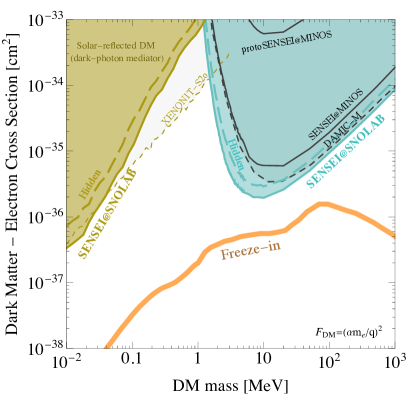
- 은하핵 DM-전자 산란에 대한 세계 최고 수준의 90% C.L. 한계 설정, 경량 및 중량 매개자에 대해, Migdal 효과를 통한 Migdal-based DM-nucleus 산란 및 다크-포톤 DM 흡수에 대한 한계 설정, 여러 질량/매개자 영역에서 이전 SENSEI 한계보다 개선.
- 결합된 데이터는 이전 결과보다 더 타이트한 한계를 제공하며, 예를 들어 최대 우도 추정 2e- 비율: 8.57×10^-2 g^-1-day^-1 (숨겨진 데이터) 및 90% C.L. 상한 3.25×10^-1 g^-1-day^-1; 3e-의 경우 최대-가능도 6.85×10^-2 g^-1-day^-1 및 90% C.L. 상한 1.49×10^-1 g^-1-day^-1.
- 분석은 시스템atics를 통제하고 잠재 DM 신호를 분리하기 위해 배경 모델링, 사분면 기반 핫 이미지 마스킹, 및 저에너지 군집 마스킹을 강조한다.
- 더 큰 데이터 세트와 개선된 마스킹을 통해 향후 실행에서 저질량 DM에 대한 감도를 더 향상시킬 것으로 기대된다.
이 논문 읽기
누빈트 뷰어에서 원문을 열고, 읽으면서 궁금한 곳을 바로 물어보세요.
누빈트에서 이 논문 읽기이 리뷰는 AI가 논문 원문을 바탕으로 만들었습니다. 인용하기 전에 원문을 확인해 주세요.