
[논문 리뷰] SN2023ixf in Messier 101: A Variable Red Supergiant as the Progenitor Candidate to a Type II Supernova
이 연구는 M101 은하의 타입 II 초신성 SN 2023ixf의 원천으로서 질량이 크고 먼지로 이루어진 별주위 화살판을 지닌 변형 빨간 초거성(의)을 특정하였다. 허블, 스피itzer 및 지상 기반 관측을 통한 폭발 이전 이미징을 통해 저자들은 원천의 빛의 세기를 log(L/L☉) = 4.74 ± 0.07, 효율 온도를 3920 K로 확인하였으며, 8600 R☉ 에서 5×10⁻⁵ M☉ 의 먼지 화살판이 존재함을 밝혀내어 약 11 M☉ 의 빨간 초거성 원천과 일치함을 확인하였다. 원천은 9년 간 70%의 변동성을 보였으며, κ-기구의 진동에 기인한 것으로 여겨진다.
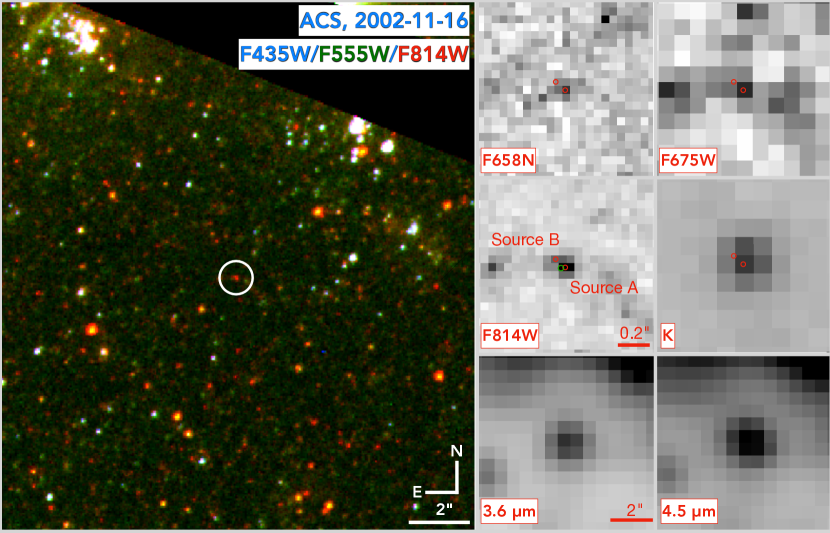
We present pre-explosion optical and infrared (IR) imaging at the site of the type II supernova (SN II) 2023ixf in Messier 101 at 6.9 Mpc. We astrometrically registered a ground-based image of SN 2023ixf to archival Hubble Space Telescope (HST), Spitzer Space Telescope (Spitzer), and ground-based near-IR images. A single point source is detected at a position consistent with the SN at wavelengths ranging from HST $R$-band to Spitzer 4.5 $μ$m. Fitting to blackbody and red supergiant (RSG) spectral-energy distributions (SEDs), we find that the source is anomalously cool with a significant mid-IR excess. We interpret this SED as reprocessed emission in a 8600 $R_{\odot}$ circumstellar shell of dusty material with a mass $\sim$5$ imes10^{-5} M_{\odot}$ surrounding a $\log(L/L_{\odot})=4.74\pm0.07$ and $T_{ m eff}=3920\substack{+200\\-160}$ K RSG. This luminosity is consistent with RSG models of initial mass 11 $M_{\odot}$, depending on assumptions of rotation and overshooting. In addition, the counterpart was significantly variable in pre-explosion Spitzer 3.6 $μ$m and 4.5 $μ$m imaging, exhibiting $\sim$70% variability in both bands correlated across 9 yr and 29 epochs of imaging. The variations appear to have a timescale of 2.8 yr, which is consistent with $κ$-mechanism pulsations observed in RSGs, albeit with a much larger amplitude than RSGs such as $α$ Orionis (Betelgeuse).
연구 동기 및 목표
- 폭발 이전 이미징 데이터를 활용하여 메시에 101의 타입 II 초신성 SN 2023ixf의 원천 항성 식별하기.
- 고질량 빨간 초거성(>20 M☉)이 초신성 II의 원천으로서 부족한 현상인 '빨간 초거성 문제'를 해결하기 위해, 이들이 왜 초신성 II 원천으로서 부족한지 조사하기.
- 빛의 세기, 온도, 별주위 환경을 포함한 원천의 물리적 성질 기술하기.
- 원천의 변동성 성질을 조사하고, 이가 진동 불안정성과 질량 방출에 미치는 영향 분석하기.
- 원천의 성질이 빨간 초거성 진화 및 핵붕괴 초신성 이론 모델과 일치하는지 시험하기.
제안 방법
- 폭발 이전 지상 기반, 허블 우주망원경(HST), 스피처 우주망원경 이미지를 정밀하게 천체좌표 정렬하여 초신성 위치 정확하게 특정하기.
- 흑체 및 빨간 초거성 모델을 사용한 스펙트럼 에너지 분포(SED) 피팅을 통해 원천의 효율 온도와 빛의 세기 유도하기.
- 3차원 복사전달 방법을 사용해 중간 적외선 초과를 별주위 먼지 화살판에 의해 재방출된 복사로 모델링하기.
- 9년 간의 장기적 스피처 3.6 μm 및 4.5 μm 광도 곡선(29개의 에포크) 분석을 통해 변동성의 진폭과 시간 스케일 측정하기.
- 원천의 빛의 세기와 온도를 이론적 빨간 초거성 진화 모델과 비교하여 초기 질량 추정하기.
- 베이지안 추론(emcee)을 사용해 SED 피팅 및 변동성 파rameter의 불확실성 제약하기.
실험 결과
연구 질문
- RQ1SN 2023ixf의 원천 항성은 무엇이며, 빨간 초거성의 기대되는 성질과 일치하는가?
- RQ2왜 원천의 SED에 중간 적외선 초과가 존재하는가? 이는 별주위 환경에 대해 무엇을 드러내는가?
- RQ3원천의 광도 곡선에서 관측된 장기적 광학적 변동성은 어떤 진동 불안정성 메커니즘과 관련이 있는가?
- RQ4원천의 초기 질량는 얼마이며, 이는 초신성 II 원천에 대한 이론적 기대와 어떻게 비교되는가?
- RQ5원천의 변동성과 질량 방출 역사가 고질량 빨간 초거성의 핵붕괴 직전 상태일 가능성을 지지하는가?
주요 결과
- 광학에서 중간 적외선에 이르기까지의 파장에서 SN 2023ixf 위치에 단일 점원천이 관측되어 높은 빛의 세기와 낮은 온도의 원천임을 확인하였다.
- 원천의 빛의 세기는 log(L/L☉) = 4.74 ± 0.07, 효율 온도는 3920 K로, 빨간 초거성과 일치한다.
- 중간 적외선 초과는 반경 8600 R☉, 질량 약 5×10⁻⁵ M☉ 인 별주위 먼지 화살판에서 별빛이 재방출된 것으로 가장 잘 설명된다.
- 원천은 9년 간 스피처 3.6 μm 및 4.5 μm 대역에서 각각 70%의 변동성을 보였으며, 특징적인 시간 스케일은 2.8년이었다.
- 이 변동성은 κ-기구 진동에 기인한 것으로 일치하지만, 베텔게우즈와 같은 일반적인 빨간 초거성보다 훨씬 큰 진폭을 보였다.
- 원천의 빛의 세기와 온도는 자전과 초과혼합의 가정에 따라 11 M☉의 초기 질량 빨간 초거성과 일치한다.

이 논문 읽기
누빈트 뷰어에서 원문을 열고, 읽으면서 궁금한 곳을 바로 물어보세요.
누빈트에서 이 논문 읽기이 리뷰는 AI가 논문 원문을 바탕으로 만들었습니다. 인용하기 전에 원문을 확인해 주세요.