
[논문 리뷰] SnapKV: LLM Knows What You are Looking for Before Generation
SnapKV는 관측 창에서 머리당 중요한 주의 특징을 식별하고 클러스터링하는 파인튜닝 없는 KV 캐시 압축 방법으로, 긴 컨텍스트 LLM 작업에서 해독 속도와 메모리 사용을 낮추고 정확도는 비슷하게 유지합니다.
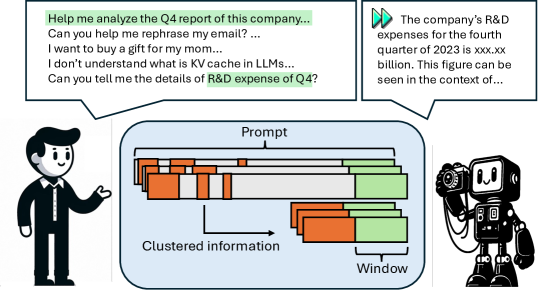
Large Language Models (LLMs) have made remarkable progress in processing extensive contexts, with the Key-Value (KV) cache playing a vital role in enhancing their performance. However, the growth of the KV cache in response to increasing input length poses challenges to memory and time efficiency. To address this problem, this paper introduces SnapKV, an innovative and fine-tuning-free approach that efficiently minimizes KV cache size while still delivering comparable performance in real-world applications. We discover that each attention head in the model consistently focuses on specific prompt attention features during generation. Meanwhile, this robust pattern can be obtained from an 'observation' window located at the end of the prompts. Drawing on this insight, SnapKV automatically compresses KV caches by selecting clustered important KV positions for each attention head. Our approach significantly reduces the growing computational overhead and memory footprint when processing long input sequences. Specifically, SnapKV achieves a consistent decoding speed with a 3.6x increase in generation speed and an 8.2x enhancement in memory efficiency compared to the baseline when processing inputs of 16K tokens. At the same time, it maintains comparable performance to the baseline models across 16 long sequence datasets. Moreover, SnapKV can process up to 380K context tokens on a single A100-80GB GPU using HuggingFace implementation with minor changes, exhibiting only a negligible accuracy drop in the Needle-in-a-Haystack test. Further comprehensive studies suggest SnapKV's potential for practical applications.
연구 동기 및 목표
- Investigate whether attention to prompt tokens follows consistent patterns during generation.
- Develop a KV cache compression method that reduces prompt KV size without sacrificing performance.
- Show that per-head feature clustering can preserve essential information while enabling efficient long-context processing.
- Evaluate SnapKV across multiple LLMs and long-context benchmarks to establish speed and memory benefits.
제안 방법
- 관측 창을 사용하여 일관된 중요한 KV 위치를 식별하기 위해 프롬프트-프리픽스 주의를 분석합니다.
- 주의 가중치를 투표하고 집계하여 머리당 상위-K 개의 중요한 위치를 선택합니다 (풀링된 가중치에서의 Top-k).
- 세밀한 압축을 위해 근처의 중요한 위치를 클러스터링하기 위해 1D 풀링(kernel_size)을 적용합니다.
- 생성용 수정된 KV 캐시를 저장하기 전에 선택된 특징을 관측 창과 결합합니다.
- 일반 프레임워크와 통합되는 실용적이고 최소 코드 구현의 SnapKV를 제공합니다.
- 장문 컨텍스트 데이터셋과 모델 전반에서 정확도와 효율성을 평가하고 병렬 디코딩과의 호환성을 테스트합니다.
실험 결과
연구 질문
- RQ1생성 맥락 전반에 걸쳐 프롬프트 토큰에 할당된 주의에 일관된 패턴이 있나요?
- RQ2프롬프트 길이, 지시 위치, 태스크 유형이 식별된 중요한 KV 특징에 어떤 영향을 미치나요?
- RQ3맥락 인지 KV 압축이 KV 캐시 크기를 크게 줄이면서도 생성 품질을 유지할 수 있나요?
주요 결과
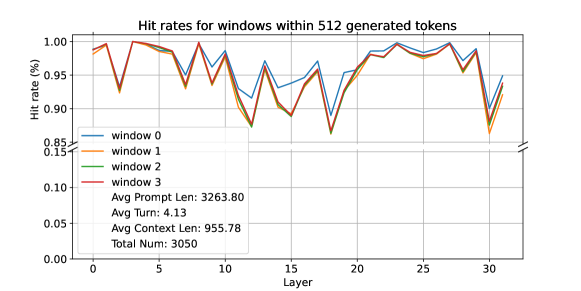
- 특정 프롬프트 키에 대한 주의 할당은 맥락에 걸쳐 생성 중에도 상당히 일관된 상태로 남아 있습니다.
- 지시 위치(맥락 이전 vs 이후)가 높은 적중률을 보이고, 서로 다른 지시는 어떤 접두 키가 중요한지의 판단을 바꿉니다.
- 풀링 기반 클러스터링은 KV 압축에서 단순한 top-K 선택보다 검색 정확도를 향상시킵니다.
- SnapKV는 기준선 대비 16K-토큰 입력에서 디코딩을 3.6배 빠르게 하고 메모리 효율을 8.2배 향상시킵니다.
- SnapKV는 단일 A100-80GB GPU에서 Needle-in-a-Haystack 테스트에서 정확도 저하 없이 최대 380K 컨텍스트 토큰을 처리할 수 있습니다.
- LongBench에서 프롬프트 KV 캐시를 1024/2048/4096 토큰으로 압축하면 성능 손실이 미미하며, 1024에서 평균 92% 압축, 4096에서 68% 입니다.
이 논문 읽기
누빈트 뷰어에서 원문을 열고, 읽으면서 궁금한 곳을 바로 물어보세요.
누빈트에서 이 논문 읽기이 리뷰는 AI가 논문 원문을 바탕으로 만들었습니다. 인용하기 전에 원문을 확인해 주세요.