
[논문 리뷰] Spanning the full range of neutron star properties within a microscopic description
이 연구는 비선형 벡터 메손 상호작용을 포함한 상대론적 평균장 모형 내에서 베이지안 추론 프레임워크를 활용하여 중성자별의 전반적인 성질을 체계적으로 탐색한다. 비선형 벡터 상호작용 강도에 따라 세 가지의 구분된 상태방정식 유형을 식별하였으며, 주요 결과로는 약한 비선형 상호작용을 가진 모형에서 2.75 M⊙의 최대 질량을 도출할 수 있으며, 이는 GW190814의 보조 물체와 일치하고, pQCD 제약 조건은 강한 비선형 벡터 항 또는 초입자를 포함한 모형을 선호함을 보여준다.
The high-density behavior of nuclear matter is analyzed within a relativistic mean-field description with non-linear meson interactions. To assess the model parameters and their output, a Bayesian inference technique is used. The Bayesian setup is limited only by a few nuclear saturation properties, the neutron star maximum mass larger than 2 M$_\odot$, and the low-density pure neutron matter equation of state (EOS) produced by an accurate N$^3$LO calculation in chiral effective field theory. Depending on the strength of the non-linear scalar vector field contribution, we have found three distinct classes of EOSs, each one correlated to different star properties distributions. If the non-linear vector field contribution is absent, the gravitational maximum mass and the sound velocity at high densities are the greatest. However, it also gives the smallest speed of sound at densities below three times saturation density. On the other hand, models with the strongest non-linear vector field contribution predict the largest radii and tidal deformabilities for 1.4 M$_\odot$ stars, together with the smallest mass for the onset of the nucleonic direct Urca processes and the smallest central baryonic densities for the maximum mass configuration. These models have the largest speed of sound below three times saturation density, but the smallest at high densities, in particular, above four times saturation density the speed of sound decreases approaching approximately $\sqrt{0.4}c$ at the center of the maximum mass star. On the contrary, a weak non-linear vector contribution gives a monotonically increasing speed of sound. A 2.75 M$_\odot$ NS maximum mass was obtained in the tail of the posterior with a weak non-linear vector field interaction. We found that pQCD favors models with a large non-linear vector field contribution or hyperons.
연구 동기 및 목표
- 미세한 핵물리 다체 모형을 사용하여 중성자별 성질의 전반적인 범위를 체계적으로 탐색하기 위해.
- 비선형 벡터 메손 상호작용이 중성자별 상태방정식 및 관측 가능한 성질에 미치는 영향을 평가하기 위해.
- GW170817, NICER, 그리고 카이랄 EFT 제약 조건을 포함한 천체물리학 및 핵물리학 데이터를 바탕으로 베이지안 추론을 활용해 모델 매개변수를 제약하기 위해.
- 고밀도 영역에서의 퍼트리뷰티브 QCD 제약 조건과 결과적으로 도출된 상태방정식의 호환성을 평가하기 위해.
- 초입자와 비선형 항이 속도의 제곱과 최대 질량 구성에 미치는 영향을 조사하기 위해.
제안 방법
- 밀도 높은 핵물질을 기술하기 위해 스칼라 및 벡터 메손의 비선형 자기 및 교차 상호작용을 포함한 상대론적 평균장 라그랑지안을 사용한다.
- 핵 포화 성질, 2 M⊙의 최대 중성자별 질량, N3LO 카이랄 유효장 이론에서 유도된 저밀도 순수 중성자 물질 데이터를 바탕으로 베이지안 추론을 적용하여 모델 매개변수를 제약한다.
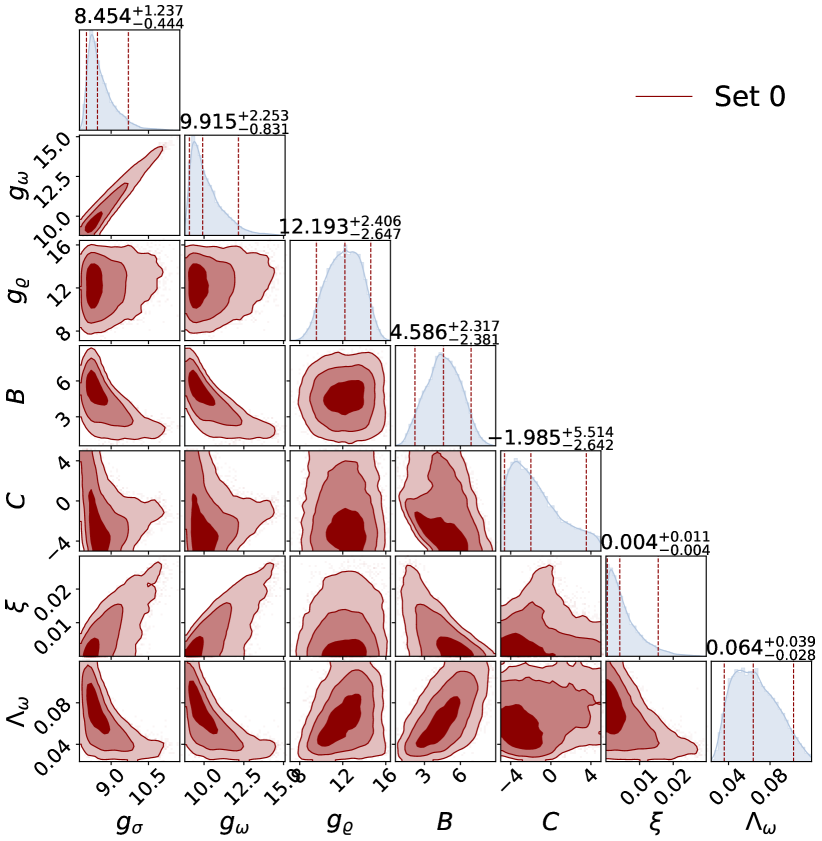
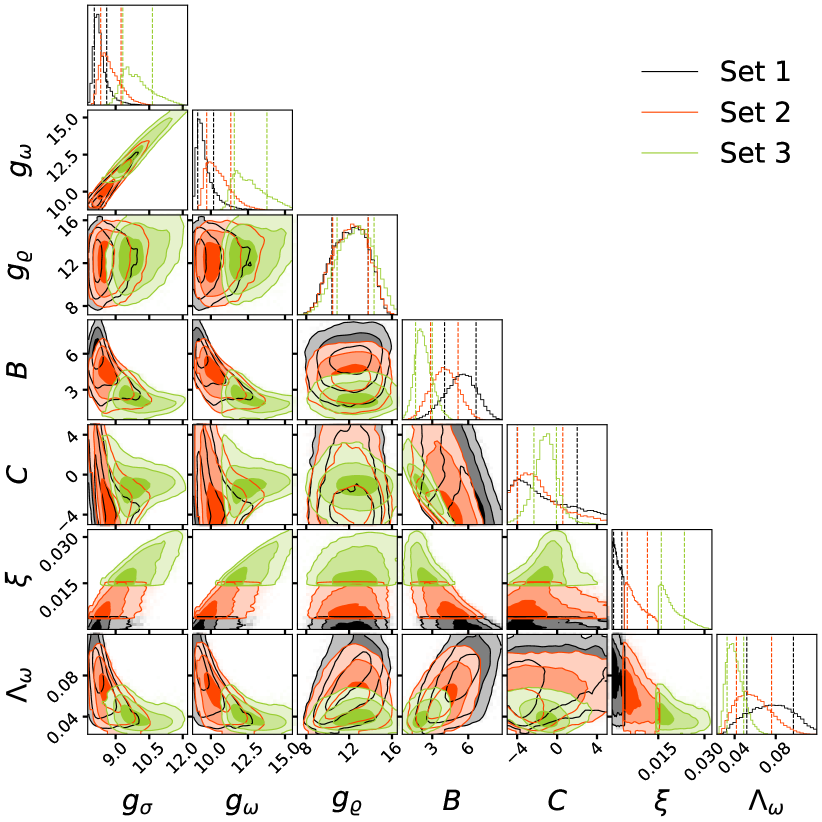
- 비선형 벡터(ω⁴) 상호작용 항의 강도에 따라 세 가지의 구분된 상태방정식 유형을 식별한다.
- 1.4 M⊙ 및 최대 질량 중성자별에 대해 속도의 제곱, 질량-반지름 관계, 조석 변형도, 직접 Urca 과정의 발생 조건을 계산한다.
- 다양한 QCD 스케일 매개변수 X ∈ [1,4] 범위에서 상태방정식이 퍼트리뷰티브 QCD 제약 조건과 호환되는지 평가한다.
- 초입자 기여를 포함하여 상태방정식의 연성 감소 및 관측 및 이론적 제약 조건과의 일치성에 영향을 평가한다.
실험 결과
연구 질문
- RQ1비선형 벡터 메손 상호작용(ω⁴ 항)의 강도가 상태방정식 및 질량, 반지름, 조석 변형도와 같은 중성자별 성질에 미치는 영향은 무엇인가?
- RQ2모델은 천체물리학적 및 핵물리학적 제약 조건을 만족하면서도 2.75 M⊙의 최대 중성자별 질량을 재현할 수 있는가?
- RQ3비선형 벡터 항은 다양한 밀도, 특히 포화 밀도의 네 배 이상에서 속도의 제곱에 어떤 영향을 미치는가?
- RQ4초입자 및 퍼트리뷰티브 QCD 제약 조건의 포함 여부는 다양한 상태방정식의 타당성에 어떤 영향을 미치는가?
- RQ5GW170817, NICER, 카이랄 EFT, pQCD의 복합 제약 조건을 가장 잘 만족하는 모델 구성은 무엇인가?
주요 결과
- 비선형 벡터 상호작용이 없는 모형(ξ=0)은 높은 밀도에서 가장 높은 최대 중성자별 질량과 가장 높은 속도의 제곱을 생성하며, 최대 질량 별 중심에서 약 √0.4 c에 도달한다.
- 약한 비선형 벡터 결합을 가진 경우 후행 분포의 尾부에서 2.75 M⊙의 최대 질량이 달성되며, 이는 GW190814의 보조 물체가 중성자별일 수 있음을 시사한다.
- 강한 비선형 벡터 결합을 가진 모형은 1.4 M⊙ 중성자별에 대해 가장 큰 반지름과 조석 변형도를 예측하며, 최대 질량 구성에서 가장 낮은 중심 기초 밀도를 가진다.
- 강한 비선형 벡터 항을 포함한 모형에서는 포화 밀도의 네 배 이상에서 속도의 제곱이 감소하며, 거대 별 중심에서 √0.4 c에 접근한다.
- pQCD 제약 조건은 약한 비선형 결합 모형(ξ < 0.004)에서 가장 엄격하게 위반되며, 이 경우 최대 40%의 모형이 X=4 조건을 충족하지 못한다.
- 초입자 또는 강한 비선형 벡터 항의 포함은 pQCD 제약 조건을 충족할 가능성을 높이며, 특히 X=1 및 X=4에서 두드러진다. 초입자 포함 모형은 거의 완전한 호환성을 보였다.
이 논문 읽기
누빈트 뷰어에서 원문을 열고, 읽으면서 궁금한 곳을 바로 물어보세요.
누빈트에서 이 논문 읽기이 리뷰는 AI가 논문 원문을 바탕으로 만들었습니다. 인용하기 전에 원문을 확인해 주세요.