
[논문 리뷰] Spatial gradient consistency for unsupervised learning of hyperspectral demosaicking: Application to surgical imaging
이 논문은 단일 샷 모자이크 영상만을 사용하여 고분광 영상의 모자이킹을 위한 완전히 비지도 학습 딥 러닝 방법을 제안한다. 이 방법은 스펙트럼 대역 간 공간적 기울기 일관성을 새로운 정규화 항으로 활용하여, 자연 장면의 스펙트럼 상관관계를 효과적으로 이용한다. 제안된 방법은 지도 학습 기반 방법과 유사한 성능을 달성하며 선형 모자이킹 방법보다도 뚜렷이 뛰어나, 쌍화된 고해상도 기준 데이터가 필요 없이 실시간 내시경 고분광 영상 촬영을 가능하게 한다.
Hyperspectral imaging has the potential to improve intraoperative decision making if tissue characterisation is performed in real-time and with high-resolution. Hyperspectral snapshot mosaic sensors offer a promising approach due to their fast acquisition speed and compact size. However, a demosaicking algorithm is required to fully recover the spatial and spectral information of the snapshot images. Most state-of-the-art demosaicking algorithms require ground-truth training data with paired snapshot and high-resolution hyperspectral images, but such imagery pairs with the exact same scene are physically impossible to acquire in intraoperative settings. In this work, we present a fully unsupervised hyperspectral image demosaicking algorithm which only requires exemplar snapshot images for training purposes. We regard hyperspectral demosaicking as an ill-posed linear inverse problem which we solve using a deep neural network. We take advantage of the spectral correlation occurring in natural scenes to design a novel inter spectral band regularisation term based on spatial gradient consistency. By combining our proposed term with standard regularisation techniques and exploiting a standard data fidelity term, we obtain an unsupervised loss function for training deep neural networks, which allows us to achieve real-time hyperspectral image demosaicking. Quantitative results on hyperspetral image datasets show that our unsupervised demosaicking approach can achieve similar performance to its supervised counter-part, and significantly outperform linear demosaicking. A qualitative user study on real snapshot hyperspectral surgical images confirms the results from the quantitative analysis. Our results suggest that the proposed unsupervised algorithm can achieve promising hyperspectral demosaicking in real-time thus advancing the suitability of the modality for intraoperative use.
연구 동기 및 목표
- 내시경 환경에서 쌍화된 고해상도 고분광 영상의 부족으로 인해 지도 학습 기반 모자이킹에 어려움이 존재하는 문제를 해결하기 위해.
- 비용이 많이 들거나 물리적으로 구현이 어려운 기준 데이터가 필요 없이, 단지 단일 샷 모자이크 영상으로만 학습하는 완전히 비지도 모자이킹 방법을 개발하기 위해.
- 자연 장면의 스펙트럼 상관관계를 활용하여 새로운 공간적 기울기 일관성 정규화 항을 도입함으로써 모자이킹 품질을 향상시키기 위해.
- 내시경 수술 지도에 적합한 실시간 고성능 고분광 영상 복원을 가능하게 하기 위해.
- 실제 수술 고분광 데이터를 바탕으로 한 정량적 평가 지표와 전문가 사용자 연구를 통해 제안된 방법의 임상적 유용성을 검증하기 위해.
제안 방법
- 모자이킹 문제를 깊이 신경망을 통해 해결하는 불안정한 선형 역문제로 설정한다.
- 자연 장면의 스펙트럼 상관관계를 활용하여, 공간적 기울기 일관성 기반의 새로운 스펙트럼 간 정규화 항을 도입한다.
- 손실 함수는 공간적 기울기 일관성 정규화 항과 표준 티콘وف 및 총 변동성 정규화 항, 그리고 데이터 일치 항을 조합한다.
- 비지도 손실 함수를 통해 쌍화된 고해상도 고분광 영상이 없더라도, 단지 단일 샷 모자이크 영상으로만 엔드 투 엔드 학습이 가능하다.
- 세 가지 딥 뉴럴 네트워크(Res2-Unet, Enhanced HAN, NLRAN)와 세 가지 데이터셋(실제 수술용 NeuroHSI 데이터셋 포함)을 대상으로 평가를 수행한다.
- 12명의 뇌신경외과 전문가를 대상으로 쌍대 비교 방식의 강제 선택 사용자 연구를 실시하여 영상 품질 인식을 평가한다.

실험 결과
연구 질문
- RQ1쌍화된 고해상도 학습 데이터가 필요 없이도 완전히 비지도 딥 러닝 방법이 고성능 고분광 모자이킹을 달성할 수 있는가?
- RQ2스펙트럼 대역 간 모자이킹 성능 향상에 있어 공간적 기울기 일관성이 얼마나 효과적인 정규화 항이 되는가?
- RQ3제안된 비지도 방법이 정량적 및 정성적 평가에서 지도 학습 기반 모자이킹 모델의 성능을 따라잡는가?
- RQ4단지 단일 샷 모자이크 영상만을 사용하여 실시간 내시경 환경에서 임상적으로 사용 가능한 결과를 생성할 수 있는가?
- RQ5전문 수술의사들은 제안된 방법으로 복원된 모자이킹 영상의 품질을 선형 및 지도 학습 기반 기준 대비 어떻게 평가하는가?
주요 결과
- 제안된 비지도 방법은 공개 고분광 영상 데이터셋에서 지도 학습 기반 기준 모델과 유사한 정량적 성능을 달성하였으며, PSNR 및 SSIM 값이 지도 학습 기반 모델과 1-2% 이내로 유사하다.
- 모든 정량적 평가 지표에서 선형 모자이킹 방법보다 뚜렷이 뛰어나, 공간적 및 스펙트럼 복원 품질이 향상됨을 입증하였다.
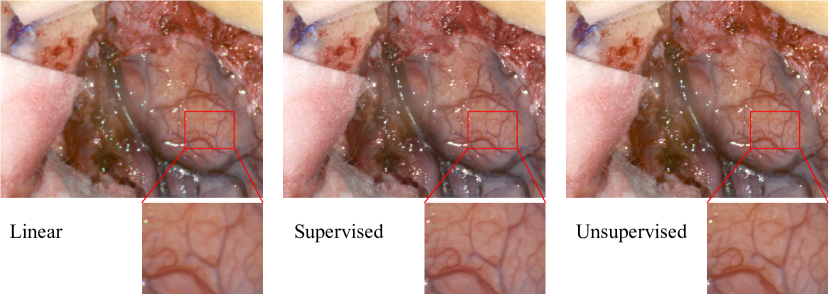
- 12명의 뇌신경외과 전문가를 대상으로 한 정성적 사용자 연구에서, 비지도 방법은 지도 학습 모델과 동일한 영상 품질로 평가되었으며, 쌍대 비교 평가에서 110개의 투표 중 63표가 비지도 결과를 지도 기반 기준보다 선호하였다.
- Bradley-Terry 모델을 통해 비지도 방법의 선호도 점수는 0.505로 추정되었고, 지도 학습 방법은 0.445로 나타나 전문가의 선호도가 거의 동일함을 시사하였다.
- 효율적인 신경망과 하드웨어와 조합할 경우 실시간 모자이킹이 가능하여 내시경 적용에 적합하다.
- 공간적 기울기 일관성 정규화 항은 스펙트럼 상관관계를 효과적으로 포착하여 기준 데이터 없이도 잡음과 아티팩트를 감소시키고 복원 정밀도를 향상시켰다.
이 논문 읽기
누빈트 뷰어에서 원문을 열고, 읽으면서 궁금한 곳을 바로 물어보세요.
누빈트에서 이 논문 읽기이 리뷰는 AI가 논문 원문을 바탕으로 만들었습니다. 인용하기 전에 원문을 확인해 주세요.