
[논문 리뷰] StyleDrop: Text-to-Image Generation in Any Style
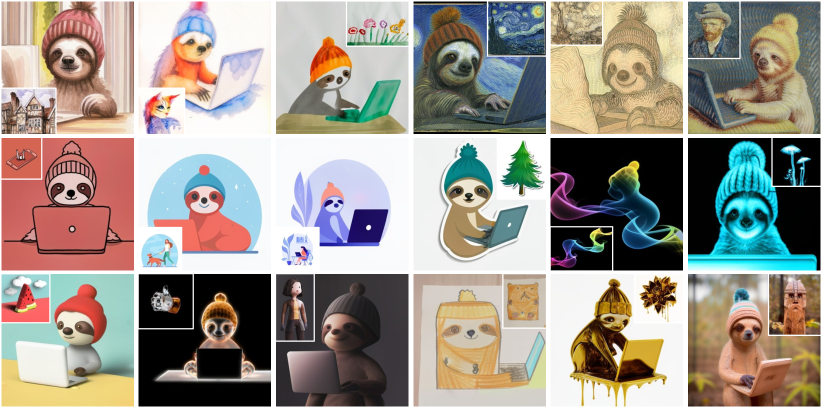
StyleDrop은 어댑터를 사용하여 텍스트-이미지 변환기를 미세 조정하고 최소 한 장의 참고 이미지로도 사용자가 지정한 스타일의 이미지 학습 및 생성을 가능하게 하며, 스타일 충실도와 콘텐츠-스타일 분리(disentanglement)를 개선하기 위한 반복 피드백을 제공합니다.
Pre-trained large text-to-image models synthesize impressive images with an appropriate use of text prompts. However, ambiguities inherent in natural language and out-of-distribution effects make it hard to synthesize image styles, that leverage a specific design pattern, texture or material. In this paper, we introduce StyleDrop, a method that enables the synthesis of images that faithfully follow a specific style using a text-to-image model. The proposed method is extremely versatile and captures nuances and details of a user-provided style, such as color schemes, shading, design patterns, and local and global effects. It efficiently learns a new style by fine-tuning very few trainable parameters (less than $1\%$ of total model parameters) and improving the quality via iterative training with either human or automated feedback. Better yet, StyleDrop is able to deliver impressive results even when the user supplies only a single image that specifies the desired style. An extensive study shows that, for the task of style tuning text-to-image models, StyleDrop implemented on Muse convincingly outperforms other methods, including DreamBooth and textual inversion on Imagen or Stable Diffusion. More results are available at our project website: https://styledrop.github.io
연구 동기 및 목표
- 광범위하거나 모호한 프롬프트를 넘어 텍스트-이미지 생성에서 충실한 스타일링을 동기 부여하고 가능하게 한다.
- 매우 작은 미세 조정 풋프린트가 최소 데이터로도 복잡한 스타일 뉘앙스를 포착할 수 있음을 시연한다.
- 과적합과 콘텐츠 누출을 줄이기 위한 피드백이 포함된 반복 학습 프레임워크를 제안한다.
- 스타일과 콘텐츠를 결합하고 스타일 및 콘텐츠 개인화를 위한 여러 어댑터를 혼합하는 합성 가능성을 보여준다.
제안 방법
- 마스크된 시각 토큰 모델링을 갖춘 기본 텍스트-이미지 변환기로 Muse를 사용한다.
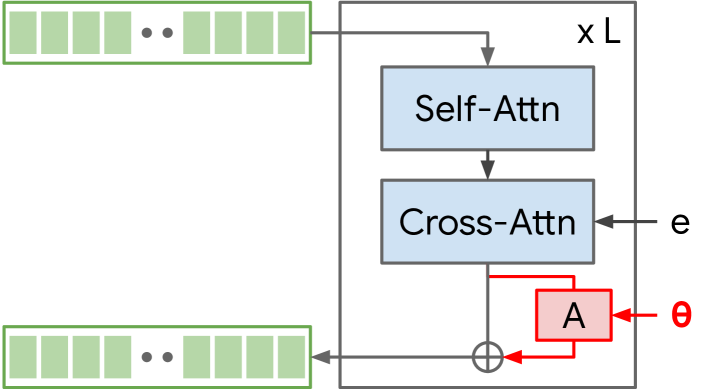
- 기준 모델을 고정한 채 스타일 특화 매개변수를 학습하기 위해 어댑터를 통한 매개변수 효율적인 미세 조정을 적용한다.
- 콘텐츠 설명과 명시적 스타일 디스크립터를 결합해 스타일 프롬트를 구성하고 콘텐츠-스타일 분리를 촉진한다.
- 재학습을 위해 고품질 합성 이미지를 선택하기 위한 피드백(CLIP 기반 또는 인간 기반)의 반복 학습을 도입한다.
- 스타일과 콘텐츠의 두 어댑터로 샘플링하여 스타일과 별도의 주체 표현을 혼합하도록 한다.
- 스타일-적응 파생 생성기와 콘텐츠-적응 생성기로부터의 분포를 혼합하는 샘플링 방정식을 제공한다.
실험 결과
연구 질문
- RQ1StyleDrop은 매우 적은 수의 참고 이미지로 임의의 시각적 스타일을 포착하고 전이할 수 있는가?
- RQ2어댑터 기반 미세 조정이 텍스트-이미지 모델의 스타일 전이에서 전체 미세 조정이나 확산 기반 기준선보다 우수한가?
- RQ3반복 피드백(CLIP 기반 또는 인간 기반)이 스타일 충실도와 콘텐츠 분리에 어떤 영향을 미치는가?
- RQ4StyleDrop이 스타일 어댑터와 콘텐츠 어댑터를 분리하여 유연한 개인화가 가능한 합성 생성을 가능하게 하는가?
주요 결과
- StyleDrop은 단 하나의 참고 이미지로도 높은 스타일 충실도와 콘텐츠-스타일 분리를 달성한다.
- Imagen 또는 Stable Diffusion에서 DreamBooth와 텍스트 역전(textual inversion) 대비 Muse에서의 StyleDrop은 CLIP 및 인간 연구에 따라 더 우수한 스타일 일관성과 경쟁력 있거나 더 나은 텍스트 정렬을 보인다.
- 피드백(HF 또는 CF)에 의한 반복 학습은 합성 데이터 드리프트로 인한 스타일 충실도의 일부 손해를 감수하더라도 재현성(텍스트 충실도)을 향상시킨다.
- 묘사형 스타일 프롬프트는 희귀 토큰 기반 접근법을 넘어 미세한 스타일 편집과 속성 수준 제어를 가능하게 한다.
- 두 어댑터로 샘플링하면 콘텐츠와 스타일의 공동 최적화 없이도 선택된 스타일의 주제를 조합한 이미지를 생성할 수 있다.
이 논문 읽기
누빈트 뷰어에서 원문을 열고, 읽으면서 궁금한 곳을 바로 물어보세요.
누빈트에서 이 논문 읽기이 리뷰는 AI가 논문 원문을 바탕으로 만들었습니다. 인용하기 전에 원문을 확인해 주세요.