
[논문 리뷰] Take a Step Back: Evoking Reasoning via Abstraction in Large Language Models
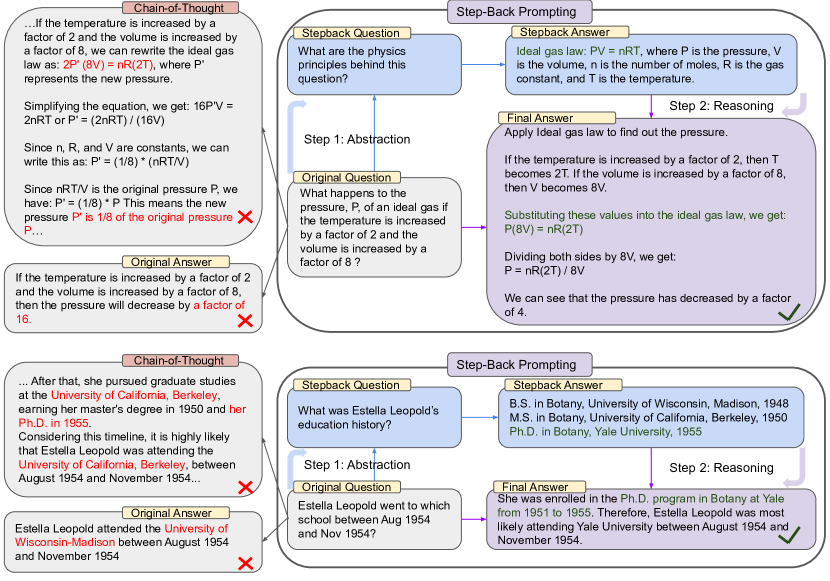
Step-Back Prompting은 추상화를 활용하여 고수준 개념과 기본 원리를 도출하고, 이를 바탕으로 추론을 확고히 하여 STEM, 지식 질의 응답(Knowledge QA), 다중-홉 추론에서 다중작업 성능을 향상시키며, 기본선(baselines) 및 CoT 프롬프트 대비 눈에 띄는 성과를 달성합니다.
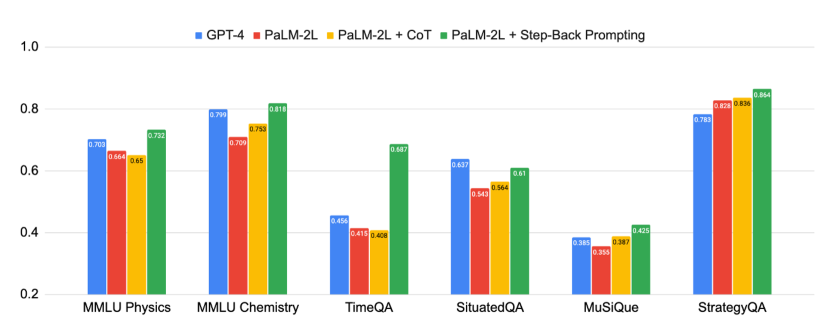
We present Step-Back Prompting, a simple prompting technique that enables LLMs to do abstractions to derive high-level concepts and first principles from instances containing specific details. Using the concepts and principles to guide reasoning, LLMs significantly improve their abilities in following a correct reasoning path towards the solution. We conduct experiments of Step-Back Prompting with PaLM-2L, GPT-4 and Llama2-70B models, and observe substantial performance gains on various challenging reasoning-intensive tasks including STEM, Knowledge QA, and Multi-Hop Reasoning. For instance, Step-Back Prompting improves PaLM-2L performance on MMLU (Physics and Chemistry) by 7% and 11% respectively, TimeQA by 27%, and MuSiQue by 7%.
연구 동기 및 목표
- 대형 언어 모델의 복잡하고 세부가 풍부한 추론의 도전 과제를 제시합니다.
- 문제를 해결하기 전에 상위 수준의 추상화를 도출하기 위해 Step-Back Prompting을 제안합니다.
- 추상화 기반 추론이 STEM, 지식 QA, 다중 홉 태스크 전반의 정확도를 개선함을 보여줍니다.
제안 방법
- 두 단계의 추상화-추론: 먼저 고수준 개념 또는 원리를 도출한 다음 이러한 추상화에 기초해 해결을 grounding합니다.
- LLM에 추상화 단계를 가르치기 위해 few-shot 시演를 사용합니다.
- 적절한 경우 고수준 개념을 뒷받침하는 사실로 grounding하기 위한 검색 보강(RAG)을 활용합니다.
- 탐색적 분류가 가능한 다양한 데이터셋(STEM, Knowledge QA, Multi-Hop)에서 탐욕적 디코딩과 예측의 점수 기반 평가로 평가합니다.
- 적용 가능한 경우 CoT, TDB 및 RAG를 포함한 PaLM-2L 및 GPT-4와 비교합니다.
실험 결과
연구 질문
- RQ1Step-Back Prompting이 표준 프롬프트와 Chain-of-Thought 프롬프트에 비해 STEM, Knowledge QA, 다중 홉 과제의 정확도를 향상시키나요?
- RQ2추상화 단계가 시演의 수에 얼마나 강건한가요?
- RQ3추상화 기반 추론으로 가장 영향을 받는 오류 유형은 무엇인가요(예: 추론, 수학, 맥락 손실)?
주요 결과
- Step-Back Prompting은 MMLU Physics에서 PaLM-2L의 성능을 7퍼센트 포인트 향상시키고 MMLU Chemistry에서 11퍼센트 포인트 향상시켜 두 하위 과제에서 GPT-4를 능가합니다.
- Step-Back Prompting은 TimeQA에서 PaLM-2L 대비 27%의 개선, MuSiQue에서 7%의 개선을 제공합니다.
- 태스크 전반에 걸쳐 Step-Back은 일부 분석에서 CoT 및 TDB를 최대 36%까지 능가하고, 기초 모델의 오류를 상당 부분(약 40%까지) 수정하며 새로운 오류의 비율은 더 작게(약 12%) 나타납니다.
- 컷오프(ablations) 분석은 Step-Back이 few-shot 시演의 수에 강건하며, 추상화를 가르치기 위해 단 하나의 예시만 필요한 경우가 많음을 보여줍니다.
- 오류 분석에 따르면 남은 대부분의 오류는 Abstraction 단계가 아니라 Reasoning 단계에서 발생하며, Reasoning이 주요 병목 현상임을 강조합니다.
이 논문 읽기
누빈트 뷰어에서 원문을 열고, 읽으면서 궁금한 곳을 바로 물어보세요.
누빈트에서 이 논문 읽기이 리뷰는 AI가 논문 원문을 바탕으로 만들었습니다. 인용하기 전에 원문을 확인해 주세요.