
[논문 리뷰] The metallicity dependence of the stellar initial mass function
이 연구는 복사장-마그네토유체역학 시뮬레이션을 사용하여 금속성의 별의 초기 질량 함수(IMF)에 미치는 영향을 조사하며, 금속성이 IMF 이동에 미치는 영향은 미미하다는 것을 발견한다. 금속 농도가 낮은 환경에서는 복사 피드백 감소로 인해 약간 더 많은 저질량 별이 형성되지만, 이러한 변화는 초기형 은하에서 관측된 IMF 변화를 설명하기에는 너무 작다. 표면 밀도가 IMF 변화의 주요 원인이며, 높은 표면 밀도에서는 피드백 효율성이 향상되어 더 많은 저질량 별이 형성된다.
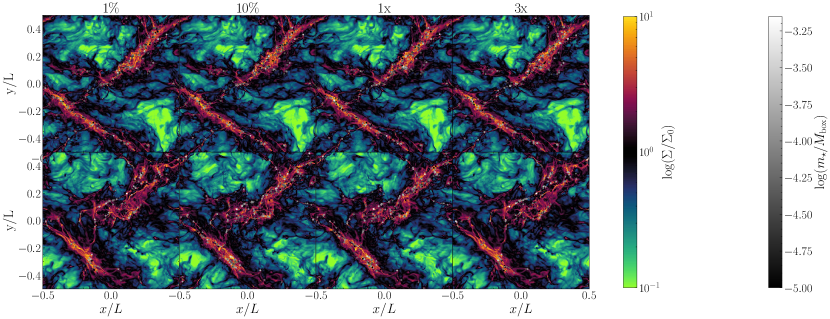
Dust is important for star formation because it is the crucial component that couples gas to stellar radiation fields, allowing radiation feedback to influence gas fragmentation and thus the stellar initial mass function (IMF). Variations in dust abundance therefore provide a potential avenue by which variation in galaxy metallicity might affect the IMF. In this paper we present a series of radiation-magnetohydrodynamic simulations in which we vary the metallicity and thus the dust abundance from 1% of Solar to 3$ imes$ Solar, spanning the range from the lowest metallicity dwarfs to the most metal-rich early-type galaxies found in the local Universe. We design the simulations to keep all dimensionless parameters constant so that the interaction between feedback and star-forming environments of varying surface density and metallicity is the only factor capable of breaking the symmetry between the simulations and modifying the IMF, allowing us to cleanly isolate and understand the effects of each environmental parameter. We find that at a fixed surface density more metal-rich clouds tend to form a slightly more bottom-heavy IMF than metal-poor ones, primarily because in metal-poor gas radiation feedback is able to propagate further, heating somewhat larger volumes of gas. However, shifts in IMF with metallicity at a fixed surface density are much smaller than shifts with surface density at fixed metallicity; metallicity-induced IMF variations are too small to explain the variations in mass-to-light ratio reported in galaxies of different mass and metallicity. We, therefore, conclude that metallicity variations are much less important than variations in surface density in driving changes in the IMF and that the latter rather than the former are most likely responsible for the IMF variations found in early-type galaxies.
연구 동기 및 목표
- 모든 다른 무차원 매개변수를 고정함으로써 시뮬레이션에서 금속성이 별의 초기 질량 함수(IMF)에 미치는 영향을 분리하는 것.
- 먼지 농도를 통한 금속성 변화가 초기형 은하와 나선파고 은하 간 관측된 IMF 차이를 설명할 수 있는지 판단하는 것.
- 다양한 금속성과 표면 밀도에서 복사 피드백과 원별운류 피드백의 역할을 분리하여 IMF 형성에 미치는 영향을 규명하는 것.
- 금속성에 의한 IMF 이동이 다양한 금속성의 은하에서 관측된 질량-광도비 변화를 설명하기에 충분한지 평가하는 것.
제안 방법
- 모든 무차원 매개변수(예: 비르발 수, 마흐 수 등)를 동일하게 유지하면서 태양 금속성의 1%에서 300%까지 다양한 금속성을 가진 복사장-마그네토유체역학(RMHD) 시뮬레이션을 수행한다.
- 표면 밀도와 금속성을 체계적으로 변화시켜 IMF에 대한 각각의 영향을 분리하며, 구름의 광학적 두께 변화 외에는 다른 요소가 변하지 않도록 보장한다.
- 일관된 피드백 모델을 사용하여 원별운류와 복사 피드백을 포함하고, 먼지가 기체와 복사장에 결합되도록 한다.
- 등기수 이소클론을 사용하여 질량-광도비를 계산하고, 태양 금속성에서의 Chabrier IMF와 비교하여 IMF의 편차를 정량화한다.
- 다양한 별 집단 연령에서 IMF 형태와 불일치 파라미터를 분석하여 시간에 따라 변화하는 영향을 평가한다.
- 시뮬레이션된 IMF 이동을 초기형 은하에서 관측된 질량-광도비 변화와 비교하여 설명력 평가
실험 결과
연구 질문
- RQ1먼지 농도 변화를 통한 금속성 변화가 별 형성 영역의 별의 초기 질량 함수(IMF)에 유의미하게 영향을 미치는가?
- RQ2복사 피드백과 원별운류 피드백이 금속성과 상호작용하여 IMF 형성에 어떻게 영향을 미치는가?
- RQ3금속성에 의한 IMF 변화가 초기형 은하와 나선파고 은하 간 질량-광도비의 관측된 차이를 설명하기에 충분한가?
- RQ4모든 다른 무차원 매개변수를 동일하게 유지할 때, 표면 밀도 변화와 금속성 변화에 따른 IMF 반응은 어떻게 다른가?
주요 결과
- 고정된 표면 밀도에서 금속 농도가 높은 환경은 금속 농도가 낮은 환경보다 약간 더 많은 저질량 별을 형성하는 IMF를 생성하며, 주로 높은 금속성에서 원별운류에 의해 빛나는 기체의 냉각 효율이 높아지기 때문이다.
- IMF의 고질량 부분은 원별운류 피드백에 더 민감하며, 높은 금속성에서 고질량 별 형성이 더 효과적으로 억제된다.
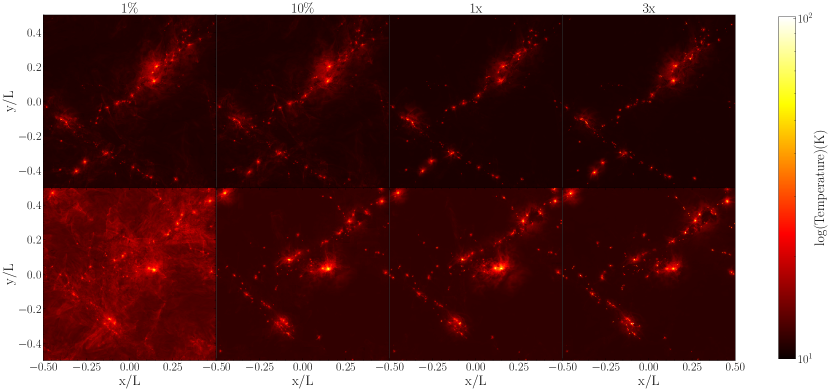
- IMF의 저질량 부분은 복사 피드백에 의해 결정되며, 금속 농도가 낮은 환경에서는 복사 결합이 약해져서 분열 억제 효과가 더 크다.
- 금속성에 따른 순수한 IMF 이동은 미미하며, 초기형 은하에서 관측된 질량-광도비 변화를 설명하기에는 부족하다.
- 표면 밀도 변화에 의한 IMF 이동은 금속성에 의한 것보다 훨씬 크며, 이는 IMF 변화의 주요 원인이다.
- 연구는 표면 밀도가 초기형 은하와 나선파고 은하 간 관측된 IMF 차이의 주요 원인이며, 금속성은 아님을 결론지었다.
이 논문 읽기
누빈트 뷰어에서 원문을 열고, 읽으면서 궁금한 곳을 바로 물어보세요.
누빈트에서 이 논문 읽기이 리뷰는 AI가 논문 원문을 바탕으로 만들었습니다. 인용하기 전에 원문을 확인해 주세요.