
[논문 리뷰] Toward a Theory of Causation for Interpreting Neural Code Models
이 논문은 신경망 기반 코드 모델(Neural Code Models, NCMs)의 후행적 해석 가능성 해법인 do code를 소개한다. do code는 코드의 구문과 구조를 원인 변수로 모델링하여 모델 예측을 설명하는 인과 추론 기반 프레임워크이다. 구조적 인과 모델(Structural Causal Models, SCMs)과 반사적 간섭을 적용함으로써, NCMs가 문법적 변화에 민감하며, 혼동 요인의 영향을 줄여가며 코드 블록(예: 중괄호, 세미콜론)을 예측하는 경향을 보임을 드러낸다. 이는 모델의 편향과 한계를 탐지하는 데 효과적인 강력한 방법을 제공한다.
Neural Language Models of Code, or Neural Code Models (NCMs), are rapidly progressing from research prototypes to commercial developer tools. As such, understanding the capabilities and limitations of such models is becoming critical. However, the abilities of these models are typically measured using automated metrics that often only reveal a portion of their real-world performance. While, in general, the performance of NCMs appears promising, currently much is unknown about how such models arrive at decisions. To this end, this paper introduces $do_{code}$, a post hoc interpretability method specific to NCMs that is capable of explaining model predictions. $do_{code}$ is based upon causal inference to enable programming language-oriented explanations. While the theoretical underpinnings of $do_{code}$ are extensible to exploring different model properties, we provide a concrete instantiation that aims to mitigate the impact of spurious correlations by grounding explanations of model behavior in properties of programming languages. To demonstrate the practical benefit of $do_{code}$, we illustrate the insights that our framework can provide by performing a case study on two popular deep learning architectures and ten NCMs. The results of this case study illustrate that our studied NCMs are sensitive to changes in code syntax. All our NCMs, except for the BERT-like model, statistically learn to predict tokens related to blocks of code (\eg brackets, parenthesis, semicolon) with less confounding bias as compared to other programming language constructs. These insights demonstrate the potential of $do_{code}$ as a useful method to detect and facilitate the elimination of confounding bias in NCMs.
연구 동기 및 목표
- 상용 도구에서 점점 더 널리 사용되고 있지만 여전히 투명하지 않은 블랙박스 시스템인 신경망 기반 코드 모델(Neural Code Models, NCMs)의 해석 가능성 부족 문제를 해결하기 위해.
- BLEU나 ROUGE와 같은 자동화된 메트릭이 모델의 한계와 편향을 포착하지 못하므로, 이를 넘어서기 위해.
- 언어학적 및 문법적 특성에 중점을 두어, NCMs의 예측 방식을 체계적이고 인과 기반의 방법론으로 설명하는 데 목적이 있다.
- 반사적 추론을 통해 비현실적인 상관관계와 혼동 요인 편향을 식별할 수 있는 디버깅 도구를 제공하기 위해.
- 딥러닝 소프트웨어 공학 응용 분야에서의 인과적 해석 가능성에 대한 재사용 가능한 프레임워크를 구축하기 위해.
제안 방법
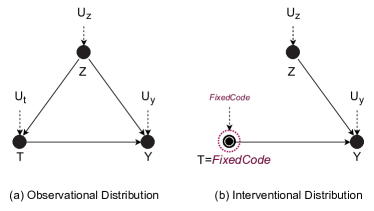
- 이 방법은 펄의 구조적 인과 모델(Structural Causal Model, SCM) 프레임워크에 기반하여, 코드 구조를 치료 요소로, 모델 예측을 결과로, 공통된 코드 패턴을 혼동 요인으로 모델링한다.
- do-연산자를 적용하여 코드 블록을 교체하거나 문법을 변경하는 등의 간섭을 시뮬레이션하면서 모델 예측의 변화를 관찰한다.
- 평균 치료 효과(Average Treatment Effect, ATE)를 사용하여 문법적 및 구조적 변화가 모델 행동에 미치는 인과적 영향을 정량화한다.
- 인과 추정의 정확성과 신뢰성을 검증하고 비현실적인 연관성을 탐지하기 위해 반복 검증(refutation) 방법을 통합한다.
- 공격적이거나 합성된 변형을 피하기 위해 대규모로 수집한 실제 세계의 코드 분포를 활용하여 프레임워크를 구현한다.
- 연구자들이 해석 가능성 함수를 구성하고, SCM을 정의하며, 데이터를 수집하고, 인과 효과를 추정하고, 가정을 검증하는 데 도움이 되는 다섯 단계 체크리스트를 제공한다.
실험 결과
연구 질문
- RQ1NCMs는 코드의 문법적 및 구조적 변화에 어떻게 반응하며, 이러한 변화가 유도하는 인과 효과는 무엇인가?
- RQ2NCMs는 예측에서 문법적 표식(예: 중괄호, 세미콜론)에 비해 의미적 구성요소(예: 조건문, 반복문)에 얼마나 의존하는가?
- RQ3인과 추론 방법은 코드 토큰 예측 시 NCMs의 혼동 요인 편향을 탐지하고 정량화할 수 있는가?
- RQ4다양한 아키텍처(예: RNN, Transformers)는 문법적 변형에 대해 어떤 정도의 민감도를 보이는가?
- RQ5SCM에서 유도된 반사적 설명은 표준 메트릭이 드러내지 못한 NCMs의 숨겨진 편향이나 한계를 드러낼 수 있는가?
주요 결과
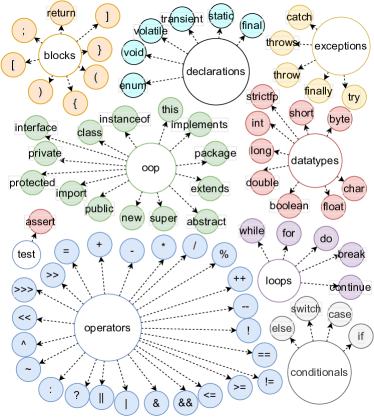
- NCMs는 중괄호, 괄호, 세미콜론과 같은 문법적 토큰 예측에서 특히 문법적 변화에 민감한 것으로 나타났다.
- 코드 블록 예측을 학습할 때 혼동 요인 편향이 감소함을 보여, 구조적 패턴에 대한 더 견고한 이해를 보이고 있음을 시사한다.
- 평균 치료 효과를 통해, 문법적 변형이 모델 예측에 측정 가능한 영향을 미치며, 이는 잠재적 편향을 드러낸다.
- 반복 검증 방법은 비현실적인 상관관계를 성공적으로 탐지하여, 프레임워크가 생성한 인과 추정의 신뢰성을 검증한다.
- RNN, GRU, Transformers에 대한 사례 연구를 통해 do code는 조건문과 반복문에서 오류 발생이 많은 코드 개념 예측을 폭 드러내는 것으로 확인되었다.
- 이 프레임워크는 특정 코드 구성요소의 인과적 영향을 분리함으로써 NCMs의 체계적 디버깅을 가능하게 하여, 더 신뢰할 수 있고 해석 가능한 코드 생성으로 나아가는 길을 제시한다.
더 나은 연구,지금 바로 시작하세요
논문 읽기부터 검토까지, 연구 시간을 획기적으로 줄여보세요.
카드 등록 없음 · 무료 플랜 제공
이 리뷰는 AI가 만들고, 인간 에디터가 검토했습니다.