
[논문 리뷰] Towards Expressive Spectral-Temporal Graph Neural Networks for Time Series Forecasting
이 논문은 시계열 예측에서 스펙트럼-시간 그래프 신경망(SPTGNN)에 대한 이론적 프레임워크를 수립하며, 약한 가정 하에 선형 SPTGNN이 보편적임을 증명하고 시간적 1-WL 테스트로 제한됨을 보여준다. 또한 정규직교 스펙트럼 필터와 개별 주파수 도메인 모듈을 사용하는 간단하고 효율적인 구현인 TGC(Temporal Graph GegenConv)를 제안하며, 선형 성분만을 사용함에도 기존 모델을 능가한다.
Time series forecasting has remained a focal point due to its vital applications in sectors such as energy management and transportation planning. Spectral-temporal graph neural network is a promising abstraction underlying most time series forecasting models that are based on graph neural networks (GNNs). However, more is needed to know about the underpinnings of this branch of methods. In this paper, we establish a theoretical framework that unravels the expressive power of spectral-temporal GNNs. Our results show that linear spectral-temporal GNNs are universal under mild assumptions, and their expressive power is bounded by our extended first-order Weisfeiler-Leman algorithm on discrete-time dynamic graphs. To make our findings useful in practice on valid instantiations, we discuss related constraints in detail and outline a theoretical blueprint for designing spatial and temporal modules in spectral domains. Building on these insights and to demonstrate how powerful spectral-temporal GNNs are based on our framework, we propose a simple instantiation named Temporal Graph Gegenbauer Convolution (TGGC), which significantly outperforms most existing models with only linear components and shows better model efficiency. Our findings pave the way for devising a broader array of provably expressive GNN-based models for time series.
연구 동기 및 목표
- 시계열 예측에서 스펙트럼-시간 그래프 신경망(SPTGNN)의 이론적 표현 능력을 이해하는 것.
- SPTGNN의 보편성, 한계, 설계 원칙에 관한 근본적인 질문을 다루는 것.
- 이론적 통찰을 바탕으로 증명 가능한 표현력과 효율성을 갖춘 SPTGNN 아키텍처를 개발하는 것.
- 적절한 스펙트럼 필터링을 갖춘 선형 SPTGNN이 복잡한 비선형 모델을 능가할 수 있음을 보여주는 것.
제안 방법
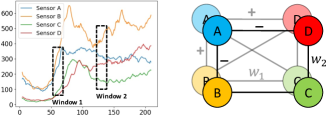
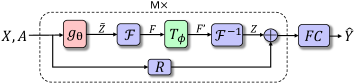
- 이산 시간 동적 그래프(DTDG)와 스펙트럼 GNN을 기반으로 한 SPTGNN의 일반적 프레임워크를 수립한다.
- DTDG의 시각을 통해 약한 가정 하에 선형 SPTGNN의 보편성을 증명한다.
- SPTGNN의 표현 능력을 제한하기 위해 시간적 1-WL 테스트를 도입한다.
- 정규직교 함수 기저와 그래프 및 시간 주파수 도메인의 개별 스펙트럼 필터를 사용하는 TGC(Temporal Graph GegenConv)를 제안한다.
- 스펙트럼 필터링을 위해 게겐바우어 다항식을 활용하고, 저랭크 투영을 통해 모델 복잡도를 감소시킨다.
- 합성 및 실세계 데이터셋에서의 추론 및 비교를 통해 설계 원리를 검증한다.
실험 결과
연구 질문
- RQ1스펙트럼-시간 그래프 신경망(SPTGNN)의 일반적 형태는 무엇인가요?
- RQ2SPTGNN은 복잡하고 변화하는 시계열 의존성을 얼마나 잘 모델링할 수 있나요?
- RQ3SPTGNN이 잘 일반화되지 않는 조건은 무엇인가요?
- RQ4선형 성분을 갖는 증명 가능한 표현력 있는 SPTGNN은 어떻게 설계할 수 있나요?
주요 결과
- 약한 가정 하에 선형 SPTGNN은 시계열 표현에 대해 보편적이며, 임의의 시계열 패턴을 모델링할 수 있다.
- 제안된 시간적 1-WL 테스트로 인해 SPTGNN의 표현 능력은 이론적으로 제한되며, 이는 동적 그래프에서 비동형 노드를 식별한다.
- 간단한 선형 SPTGNN인 TGC는 여러 벤치마크에서 최고 성능을 기록하며, 현저히 향상된 효율성을 보인다.
- 비교 실험 결과에 따르면, 정규직교 함수 기저와 개별 스펙트럼 필터링이 뛰어난 성능을 내기 위해 필수적임을 입증하였다.
- TGC는 STGCN과 Graph WaveNet과 같은 MP-STGNN 모델보다 다양한 공간 상관관계(양성 및 음성 관계 포함)를 학습하는 데 뛰어난 성능을 보였다.
- 단기 및 장기 예측 과제 전반에서 일반화 능력이 뛰어나며, PeMS, Electricity, Weather, Solar 데이터셋에서 일관된 개선 효과를 보였다.
이 논문 읽기
누빈트 뷰어에서 원문을 열고, 읽으면서 궁금한 곳을 바로 물어보세요.
누빈트에서 이 논문 읽기이 리뷰는 AI가 논문 원문을 바탕으로 만들었습니다. 인용하기 전에 원문을 확인해 주세요.