
[논문 리뷰] ULIP-2: Towards Scalable Multimodal Pre-training for 3D Understanding
ULIP-2은 3D 멀티모달 사전학습에서 언어 감독을 자동화하기 위해 BLIP-2를 사용하여 렌더링된 2D 뷰에서 언어를 생성하고, 인간의 3D 주석 없이 강력한 제로샷 및 표준 3D 분류를 달성하며 대형 삼모달 트리플을 공개한다.
Recent advancements in multimodal pre-training have shown promising efficacy in 3D representation learning by aligning multimodal features across 3D shapes, their 2D counterparts, and language descriptions. However, the methods used by existing frameworks to curate such multimodal data, in particular language descriptions for 3D shapes, are not scalable, and the collected language descriptions are not diverse. To address this, we introduce ULIP-2, a simple yet effective tri-modal pre-training framework that leverages large multimodal models to automatically generate holistic language descriptions for 3D shapes. It only needs 3D data as input, eliminating the need for any manual 3D annotations, and is therefore scalable to large datasets. ULIP-2 is also equipped with scaled-up backbones for better multimodal representation learning. We conduct experiments on two large-scale 3D datasets, Objaverse and ShapeNet, and augment them with tri-modal datasets of 3D point clouds, images, and language for training ULIP-2. Experiments show that ULIP-2 demonstrates substantial benefits in three downstream tasks: zero-shot 3D classification, standard 3D classification with fine-tuning, and 3D captioning (3D-to-language generation). It achieves a new SOTA of 50.6% (top-1) on Objaverse-LVIS and 84.7% (top-1) on ModelNet40 in zero-shot classification. In the ScanObjectNN benchmark for standard fine-tuning, ULIP-2 reaches an overall accuracy of 91.5% with a compact model of only 1.4 million parameters. ULIP-2 sheds light on a new paradigm for scalable multimodal 3D representation learning without human annotations and shows significant improvements over existing baselines. The code and datasets are released at https://github.com/salesforce/ULIP.
연구 동기 및 목표
- 다중모달 3D 학습에서 언어 감독의 확장성 병목 문제를 해결한다.
- 수동 주석 없이 3D 객체로부터 포괄적 언어 설명을 생성하는 완전 자동화 파이프라인을 제안한다.
- 3D 포인트 클라우드, 렌더링된 이미지, 그리고 언어 설명을 미리 정렬된 비전-언어 공간에 고정된 방식으로 정렬한다.
- Objaverse와 ShapeNet에서 공개된 삼모달 트리플과 함께 확장성과 효과를 시연한다.
제안 방법
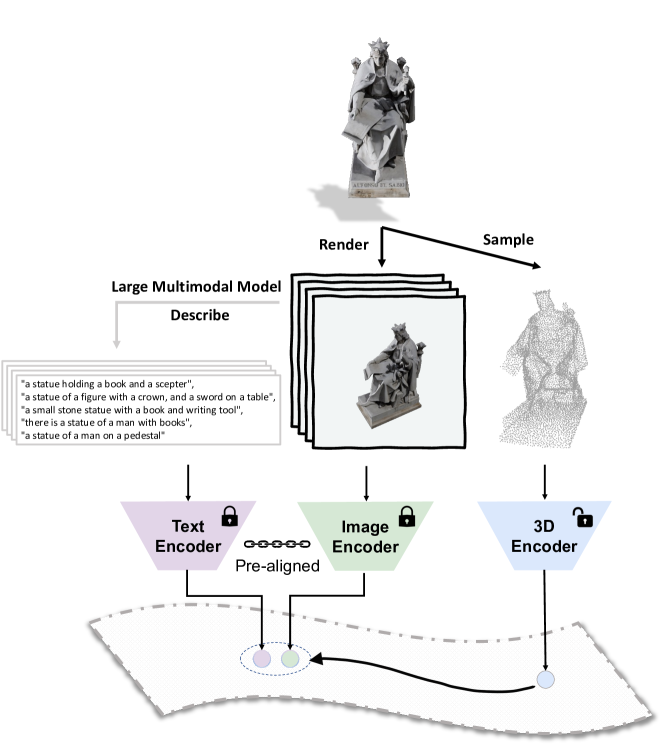
- 각 3D 객체에서 고정된 전체적인 2D 뷰를 렌더링하여 이미지 데이터를 제공한다.
- 렌더링된 각 이미지에 대해 Descriptive sentences를 생성하기 위해 BLIP-2를 사용하고 상위 k개의 문장을 언어 모달리티로 집계한다.
- 3D 포인트 클라우드를 3D 모달리티 입력으로 추출하고, 미리 정렬된 이미지/텍스트 특징과 정렬되도록 3D 인코더를 학습한다.
- SLIP의 이미지/텍스트 인코더를 고정시켜 공통 비전-언어 특징 공간을 제공한다.
- 두 가지 대조 손실 L_P2I와 L_P2T로 학습하여 각각 3D와 이미지 특징, 3D와 텍스트 특징 간의 정렬을 촉진한다.
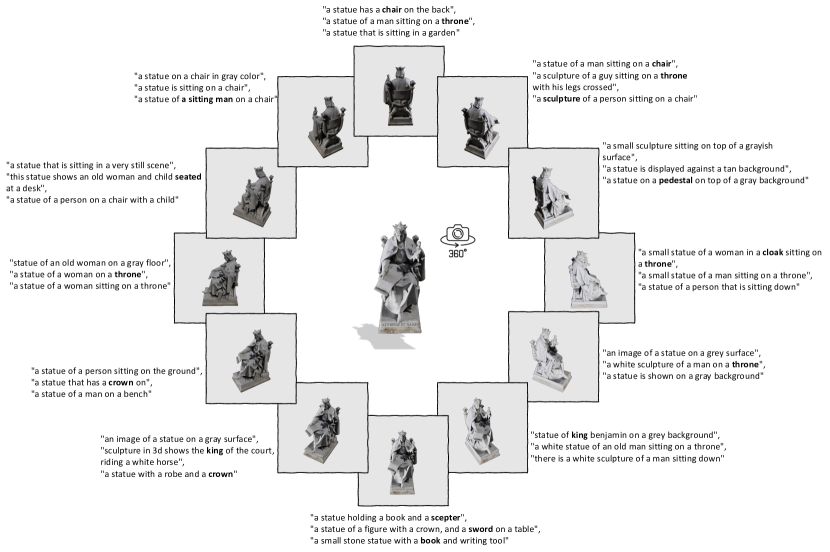
실험 결과
연구 질문
- RQ1대규모 멀티모달 모델에서 자동으로 생성된 확장 가능한 언어 설명이 3D 멀티모달 사전학습에 충분한 감독을 제공할 수 있는가?
- RQ2언어의 풍부함(전일적 시각 설명)이 제로샷 및 표준 분류 작업에서 3D 표현 품질에 미치는 영향은 무엇인가?
- RQ3ULIP-2가 대규모 3D 데이터셋과 서로 다른 백본에서 인간 3D 주석 없이 어떻게 작동하는가?
- RQ4기존 3D 데이터에서 파생된 삼모달 데이터세트를 공개하는 이점과 한계는 무엇인가?
주요 결과
- ULIP-2는 ModelNet40에서 74.0%의 top-1 제로샷 정확도를 달성한다(인간 3D 주석 없음).
- ScanObjectNN에서 ULIP-2는 겨우 1.4M 매개변수로 전체 정확도 91.5%에 도달한다.
- ULIP-2는 백본과 데이터셋 전반에서 ULIP를 능가하며, 전일적 시각의 언어 설명의 이점을 보여준다.
- ShapeNet과 Objaverse의 경우 ULIP-2는 대규모 삼모달 트리플(Objaverse/ShapeNet Triplets)을 공개할 수 있게 한다.
- 제로샷 및 표준 3D 분류 이득은 백본 선택(Point-BERT, PointNeXt) 및 뷰/설명의 수에 대해 강건하다.
- BLIP-2를 사용하는 것이 BLIP보다 더 강력한 결과를 내며, 더 강력한 대형 멀티모달 모델 선택의 타당성을 입증한다.
이 논문 읽기
누빈트 뷰어에서 원문을 열고, 읽으면서 궁금한 곳을 바로 물어보세요.
누빈트에서 이 논문 읽기이 리뷰는 AI가 논문 원문을 바탕으로 만들었습니다. 인용하기 전에 원문을 확인해 주세요.