
[논문 리뷰] Ultrabroadband thin-film lithium tantalate modulator for high-speed communications
이 논문은 리튬 tantalate-on-insulator (LTOI) 플랫폼에 구현된 110 GHz 초광대역 박막 리튬 탄탈레이트 (LiTaO₃) 매치-지너 모odulator를 제시하며, 176 GBd PAM8 신호를 사용하여 네트워크 데이터 전송 속도 405 Gbit/s를 달성한다. 장치는 마이크로파 손실을 줄이기 위해 Ag 전극을 활용하며, 리튬니오브산탄탈레이트 대비 뛰어난 DC 보정 안정성을 보이며, 고속·에너지 효율적인 광통신을 위한 확장 가능하고 저비용 대안으로 LTOI를 위치시킨다.
The continuous growth of global data traffic over the past three decades, along with advances in disaggregated computing architectures, presents significant challenges for optical transceivers in communication networks and high-performance computing systems. Specifically, there is a growing need to significantly increase data rates while reducing energy consumption and cost. High-performance optical modulators based on materials such as InP, thin-film lithium niobate (LiNbO3), or plasmonics have been developed, with LiNbO3 excelling in high-speed and low-voltage modulation. Nonetheless, the widespread industrial adoption of thin film LiNbO3 remains compounded by the rather high cost of the underlying 'on insulator' substrates -- in sharp contrast to silicon photonics, which can benefit from strong synergies with high-volume applications in conventional microelectronics. Here, we demonstrate an integrated 110 GHz modulator using thin-film lithium tantalate (LiTaO3) -- a material platform that is already commercially used for millimeter-wave filters and that can hence build upon technological and economic synergies with existing high-volume applications to offer scalable low-cost manufacturing. We show that the LiTaO3 photonic integrated circuit based modulator can support 176 GBd PAM8 transmission at net data rates exceeding 400 Gbit/s. Moreover, we show that using silver electrodes can reduce microwave losses compared to previously employed gold electrodes. Our demonstration positions LiTaO3 modulator as a novel and highly promising integration platform for next-generation high-speed, energy-efficient, and cost-effective transceivers.
연구 동기 및 목표
- 데이터 센터 및 통신 네트워크의 광송신수에서 더 높은 데이터 전송 속도, 더 낮은 에너지 소비, 더 낮은 비용을 충족하기 위한 수요 증가에 대응한다.
- 박막 리튬니오브산탄탈레이트 (LNOI) 모odulator의 뛰어난 성능에도 불구하고 산업적 도입을 제한하는 높은 기판 비용 장벽을 극복한다.
- 밀리미터 웨이브 필터 제조에 이미 널리 사용되는 리튬 탄탈레이트 (LiTaO₃)의 고량 생산 기반을 활용하여 비용 효율적이고 확장 가능한 광집적회로를 실현한다.
- 우수한 전극 및 장치 설계를 통해 박막 리튬 탄탈레이트 (LiTaO₃)를 기반으로 한 고속, 저손실, 안정적인 전기광학 모odulator를 구현한다.
- 성능, 안정성, 제조 용이성을 통합하여 LNOI 및 실리콘 포토닉스의 대안으로 LTOI를 다음 세대 광송신수에 적합하게 만든다.
제안 방법
- CMi 및 IPHYS 클린룸 시설을 활용하여 리튬 탄탈레이트-on-insulator (LTOI) 기반 박막 리튬 탄탈레이트 (LiTaO₃) 매치-지너 모odulator (MZM)를 제작하였다.
- 고주파 전기 신호 경로에서 마이크로파 손실을 줄이기 위해 금속 전극으로서 금 대신 Ag를 사용하였다.
- 고주파에서의 임피던스 매칭 향상과 신호 왜곡 감소를 위해 지지-단일-지지 (GSG) 전극 구성을 설계하였다.
- MZM에서 효율적인 광출력 분할 및 위상 제어를 구현하기 위해 Y-분할기 및 웨이브가이드 구조를 활용하였다.
- 최대 176 GBd의 심볼 속도로 PAM 신호 (PAM2, PAM4, PAM8)를 사용한 강도 변조 직접 검출 (IMDD) 전송 실험을 수행하였다.
- 로그-가능도 비율 (LLR) 및 가우시안 노이즈 채널 모델링 (AWGN)을 활용하여 비트 오류율 (BER), 획득 정보 전송 속도 (AIR), 네트워크 데이터 전송 속도 (NDR)를 분석하였다.
실험 결과
연구 질문
- RQ1LTOI 플랫폼에 구현된 박막 리튬 탄탈레이트 (LiTaO₃) 모odulator는 최신 기술 수준의 LNOI 장치와 동등한 고대역폭 및 저손실 성능을 달성할 수 있는가?
- RQ2LiTaO₃ 모odulator에서 금 전극을 은 전극으로 대체할 경우 마이크로파 전파 손실이 현저히 감소하는가?
- RQ3고속 동작 조건에서 LTOI 모odulator의 DC 보정 안정성은 LNOI 모odulator와 비교해 어떻게 되는가?
- RQ4고도로 발전한 신호 처리 기술을 적용한 LTOI 기반 MZM에서 PAM 신호를 사용해 도달 가능한 최대 네트워크 데이터 전송 속도는 얼마인가?
- RQ5기존 산업 인프라를 활용하여 LTOI 플랫폼이 고속 광모odulator의 확장 가능하고 저비용 제조를 가능하게 할 수 있는가?
주요 결과
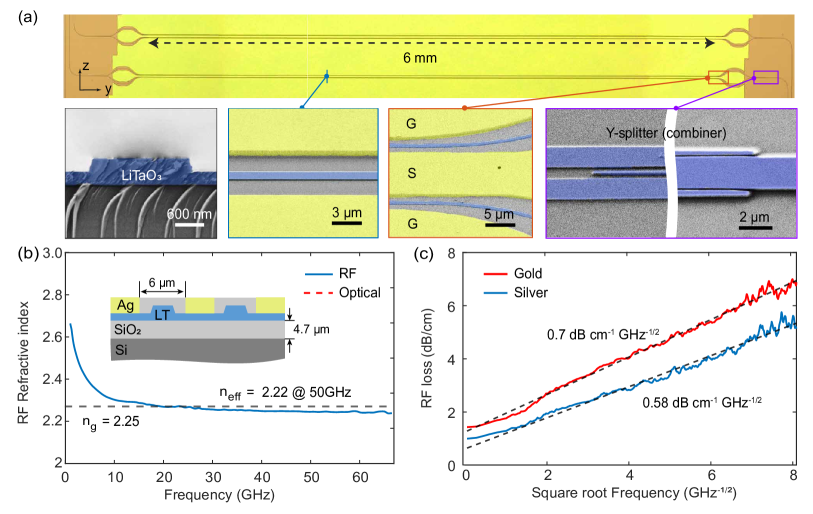
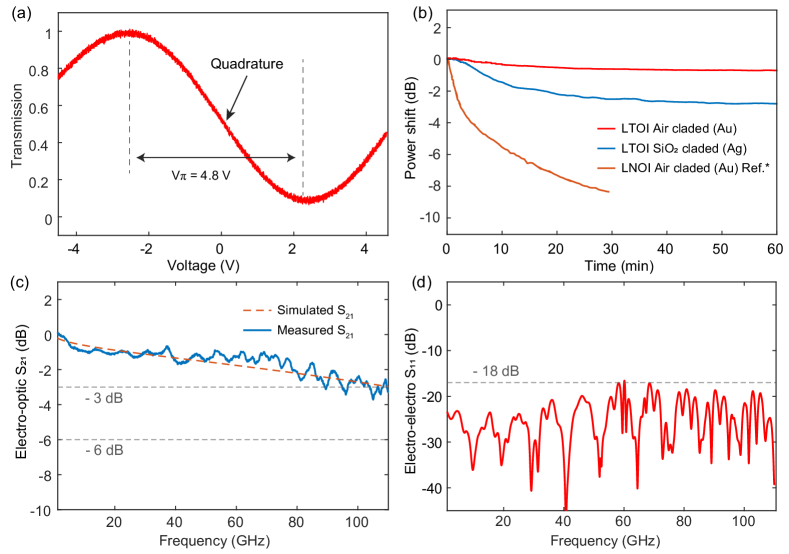
- LTOI 기반 MZM는 110 GHz의 전기광학 3 dB 대역폭을 확보하여 차세대 광링크에 적합한 고속 동작를 가능하게 하였다.
- Ag 전극을 사용함으로써 금 전극 대비 마이크로파 손실이 감소하여 고주파에서 신호 무결성이 향상되었다.
- 유사한 LNOI 모odulator 대비 상당히 낮은 DC 보정 이격을 보이며 장기적 안정성이 향상되었다.
- 176 GBd PAM8 신호를 사용하여 네트워크 데이터 전송 속도 405 Gbit/s를 달성하였으며, BER는 3.8×10⁻²로 소프트-디시전 FEC 임계값 이하를 유지하였다.
- 획득 정보 전송 속도 (AIR)의 최고 기록은 432 Gbit/s였으며, 이는 플랫폼이 테라비트 수준 전송에 가능성을 지닌다는 것을 보여주었다.
- 결과적으로 LTOI는 LNOI 및 실리콘 포토닉스의 대안으로서 확장 가능하고 비용 효율적인 솔루션으로서, 리튬 탄탈레이트 산업의 기존 제조 시너지 덕분에 산업적 도입 가능성이 매우 높아 보인다.
이 논문 읽기
누빈트 뷰어에서 원문을 열고, 읽으면서 궁금한 곳을 바로 물어보세요.
누빈트에서 이 논문 읽기이 리뷰는 AI가 논문 원문을 바탕으로 만들었습니다. 인용하기 전에 원문을 확인해 주세요.