
[Paper Review] A class of new high-order finite-volume TENO schemes for hyperbolic conservation laws with unstructured meshes
This paper proposes a new class of high-order finite-volume TENO schemes for unstructured meshes, enabling arbitrarily high-order accuracy and sharp shock-capturing with low numerical dissipation. By employing a novel ENO-like stencil selection strategy that favors a large central-biased stencil in smooth regions and smooth small stencils near discontinuities, the method achieves robust, high-fidelity simulations of compressible flows without parameter tuning.
The recently proposed high-order TENO scheme [Fu et al., Journal of Computational Physics, 305, pp.333-359] has shown great potential in predicting complex fluids owing to the novel weighting strategy, which ensures the high-order accuracy, the low numerical dissipation, and the sharp shock-capturing capability. However, the applications are still restricted to simple geometries with Cartesian or curvilinear meshes. In this work, a new class of high-order shock-capturing TENO schemes for unstructured meshes are proposed. Similar to the standard TENO schemes and some variants of WENO schemes, the candidate stencils include one large stencil and several small third-order stencils. Following a strong scale-separation procedure, a tailored novel ENO-like stencil selection strategy is proposed such that the high-order accuracy is restored in smooth regions by selecting the candidate reconstruction on the large stencil while the ENO property is enforced near discontinuities by adopting the candidate reconstruction from smooth small stencils. The nonsmooth stencils containing genuine discontinuities are explicitly excluded from the final reconstruction, leading to excellent numerical stability. Different from the WENO concept, such unique sharp stencil selection retains the low numerical dissipation without sacrificing the shock-capturing capability. The newly proposed framework enables arbitrarily high-order TENO reconstructions on unstructured meshes. For conceptual verification, the TENO schemes with third- to sixth-order accuracy are constructed. Without parameter tuning case by case, the performance of the proposed TENO schemes is demonstrated by examining a set of benchmark cases with broadband flow length scales.
Motivation & Objective
- To extend high-order TENO schemes, originally limited to structured meshes, to unstructured meshes for broader applicability in complex geometry flows.
- To overcome the limitations of WENO schemes in unstructured meshes, particularly their high dissipation and sensitivity to discontinuities.
- To develop a robust, parameter-free framework that maintains high-order accuracy in smooth regions and sharp shock resolution near discontinuities.
- To enable arbitrarily high-order TENO reconstructions on unstructured grids through a tailored stencil selection strategy.
- To validate the method on benchmark problems with broadband flow scales, demonstrating low dissipation and numerical stability.
Proposed method
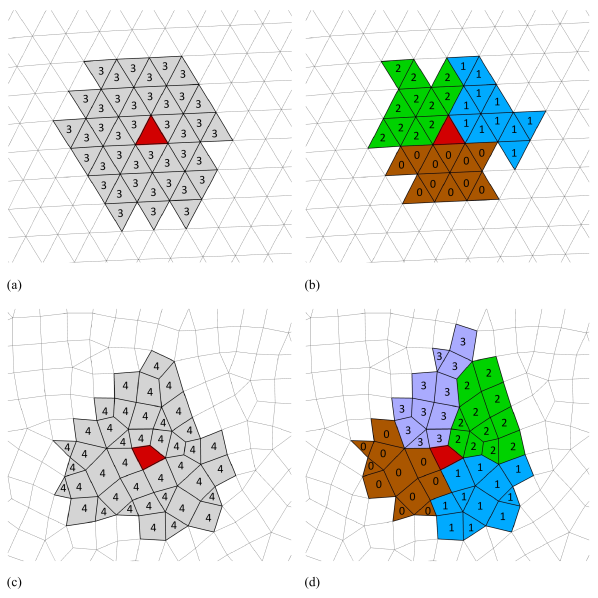
- Proposes a new candidate stencil framework consisting of one large central-biased stencil and multiple small directional stencils, each of third-order accuracy.
- Applies a strong scale-separation procedure to distinguish smooth regions from discontinuous regions based on smoothness indicators.
- Introduces a novel ENO-like stencil selection strategy that selects the large stencil for high-order accuracy in smooth regions and smooth small stencils near shocks.
- Explicitly excludes stencils containing genuine discontinuities from reconstruction, ensuring numerical stability and reducing dissipation.
- Uses a TENO-type weighting strategy that either fully includes a candidate stencil or discards it entirely, avoiding the smooth blending of WENO and thus minimizing numerical dissipation.
- Constructs TENO schemes of third- to sixth-order accuracy on unstructured meshes with a fixed set of parameters, avoiding case-specific tuning.
Experimental results
Research questions
- RQ1Can high-order TENO schemes be successfully extended to unstructured meshes while preserving their low-dissipation and sharp shock-capturing properties?
- RQ2How does the proposed ENO-like stencil selection strategy perform in maintaining high-order accuracy in smooth regions and suppressing oscillations near discontinuities on unstructured grids?
- RQ3What is the relative performance of the new TENO schemes compared to WENO and CWENO schemes in terms of dissipation, accuracy, and robustness for compressible flow simulations?
- RQ4Can the proposed framework achieve arbitrarily high-order reconstructions on unstructured meshes without requiring complex parameter tuning?
- RQ5How does the overall stencil width and computational cost of the new TENO schemes compare to existing high-order schemes on unstructured meshes?
Key findings
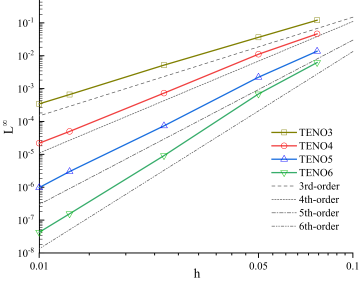
- The proposed TENO schemes achieve third- to sixth-order accuracy on unstructured meshes without case-specific parameter tuning, demonstrating robustness across diverse flow regimes.
- The schemes exhibit significantly lower numerical dissipation than WENO and CWENO schemes of the same order, preserving small-scale flow structures with high fidelity.
- The stencil width of the proposed TENO schemes is much more compact than that of WENO schemes with equal-size stencils, reducing computational cost and communication overhead.
- In the double Mach reflection and Kelvin-Helmholtz instability benchmarks, the TENO schemes captured shocks sharply and resolved small-scale vortices without oscillations, outperforming WENO in robustness and accuracy.
- The method demonstrated superior stability in strong discontinuity regions (e.g., DMR case), where WENO schemes exhibited oscillations or failure, highlighting the advantage of sharp stencil selection over smooth blending.
- Performance benchmarks on Intel Xeon E5-2690 with 56 threads showed efficient parallel scalability, supporting large-scale simulations with low dissipation and high resolution.
Read this paper
Open the full text in the Nubint reader and ask about any passage as you read.
Read this paper on NubintThis review was generated by AI from the original paper. Please check the paper before citing it.