
[Paper Review] A core in a star-forming disc as evidence of inside-out growth in the early Universe
This study presents JADES-GS+53.18343-27.79097, a high-redshift star-forming galaxy at z ≈ 7.43, which exhibits a compact core (144 pc half-light radius) and a more extended star-forming disc (468 pc), with distinct star-formation histories. The rising specific star-formation rate toward the outskirts provides the first direct evidence of inside-out growth in the early Universe, supporting hierarchical galaxy formation models in the Epoch of Reionization.
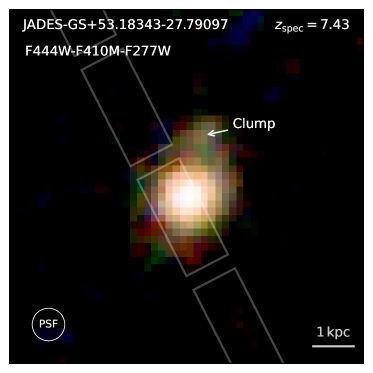
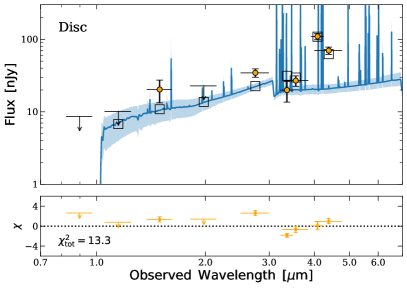
The physical processes that establish the morphological evolution and the structural diversity of galaxies are key unknowns in extragalactic astrophysics. Here we report the finding of the morphologically-mature galaxy JADES-GS+53.18343-27.79097, which existed within the first 700 million years of the Universe's history. This star-forming galaxy with a stellar mass of 400 million solar masses consists of three components, a highly-compact core with a half-light radius of less than 100 pc, an actively star-forming disc with a radius of about 400 pc, and a star-forming clump, which all show distinctive star-formation histories. The central stellar mass density of this galaxy is within a factor of two of the most massive present-day ellipticals, while being globally 1000 times less massive. The radial profile of the specific star-formation rate is rising toward the outskirts. This evidence suggests the first detection of inside-out growth of a galaxy as a proto-bulge and a star-forming disc in the Epoch of Reionization.
Motivation & Objective
- To investigate the structural and star-formation properties of high-redshift galaxies in the Epoch of Reionization.
- To determine whether morphological evolution and inside-out growth are already in progress at cosmic dawn.
- To test whether the observed structural diversity in local galaxies can be traced back to early formation processes.
- To constrain the role of feedback and gas inflow in shaping early galaxy structure.
Proposed method
- Utilized deep JWST/NIRSpec spectroscopy and imaging to resolve spatially the stellar and ionized gas components of JADES-GS+53.18343-27.79097.
- Applied dust-corrected emission-line diagnostics (BPT diagram) to distinguish between star formation and AGN activity.
- Employed SED fitting with Prospector and FSPS to derive stellar masses, star-formation histories, and stellar population parameters.
- Measured half-light radii and Sérsic indices from high-resolution photometry to characterize the compact core and extended disc.
- Analyzed radial profiles of specific star-formation rate to assess growth patterns.
- Used dynamical modeling and photometric deconvolution to resolve structural components despite source blending.
Experimental results
Research questions
- RQ1Does a compact, dense core exist in a vigorously star-forming disc at z ≈ 7.43, indicating early structural maturity?
- RQ2Is the specific star-formation rate in this galaxy radially increasing, as predicted by inside-out growth models?
- RQ3Can the observed morphology and star-formation history be explained by star formation alone, or is AGN activity required?
- RQ4How does the stellar mass density of this core compare to present-day massive ellipticals despite its low total mass?
- RQ5To what extent do feedback processes and gas inflow regulate the growth of early galaxies?
Key findings
- The galaxy JADES-GS+53.18343-27.79097 hosts a compact core with a deconvolved half-light radius of 144 pc and a Sérsic index of 2.5, indicating a classical stellar system.
- The core has a stellar mass density within a factor of two of the most massive present-day ellipticals, despite the galaxy’s total mass being only 10^8.6 solar masses.
- The galaxy exhibits a strongly star-forming disc with a radius of 468 pc, showing a distinct star-formation history from the core.
- The radial profile of the specific star-formation rate increases toward the outskirts, providing direct evidence for inside-out growth.
- Emission-line diagnostics (BPT and R2/R3 ratios) confirm that the ionized gas emission is consistent with star formation, not AGN activity.
- The galaxy’s structural and kinematic properties are consistent with hierarchical galaxy formation models, where high-angular-momentum gas settles into extended discs over time.
Read this paper
Open the full text in the Nubint reader and ask about any passage as you read.
Read this paper on NubintThis review was generated by AI from the original paper. Please check the paper before citing it.