
[Paper Review] A Fast Globally Linearly Convergent Algorithm for the Computation of Wasserstein Barycenters
This paper proposes a fast, globally linearly convergent algorithm based on symmetric Gauss-Seidel ADMM (sGS-ADMM) for computing Wasserstein barycenters of discrete probability distributions without entropy regularization. By exploiting the dual structure of the linear programming formulation, it achieves exact and efficient subproblem solutions, enabling high-precision computation on large-scale datasets with guaranteed convergence.
We consider the problem of computing a Wasserstein barycenter for a set of discrete probability distributions with finite supports, which finds many applications in areas such as statistics, machine learning and image processing. When the support points of the barycenter are pre-specified, this problem can be modeled as a linear programming (LP) problem whose size can be extremely large. To handle this large-scale LP, we analyse the structure of its dual problem, which is conceivably more tractable and can be reformulated as a well-structured convex problem with 3 kinds of block variables and a coupling linear equality constraint. We then adapt a symmetric Gauss-Seidel based alternating direction method of multipliers (sGS-ADMM) to solve the resulting dual problem and establish its global convergence and global linear convergence rate. As a critical component for efficient computation, we also show how all the subproblems involved can be solved exactly and efficiently. This makes our method suitable for computing a Wasserstein barycenter on a large-scale data set, without introducing an entropy regularization term as is commonly practiced. In addition, our sGS-ADMM can be used as a subroutine in an alternating minimization method to compute a barycenter when its support points are not pre-specified. Numerical results on synthetic data sets and image data sets demonstrate that our method is highly competitive for solving large-scale Wasserstein barycenter problems, in comparison to two existing representative methods and the commercial software Gurobi.
Motivation & Objective
- To develop an efficient, high-precision algorithm for computing Wasserstein barycenters of discrete probability distributions.
- To avoid the numerical instability and blurring effects introduced by entropy regularization in existing methods.
- To handle large-scale problems by leveraging the dual structure of the linear programming formulation.
- To establish global convergence and global linear convergence rate for the proposed sGS-ADMM method.
- To enable exact and efficient solution of subproblems in the ADMM framework for improved computational performance.
Proposed method
- The method reformulates the Wasserstein barycenter problem as a dual linear program with three block variables and a coupling equality constraint.
- It applies a symmetric Gauss-Seidel based ADMM (sGS-ADMM) to solve the dual problem, ensuring global convergence and global linear convergence rate.
- All subproblems in the sGS-ADMM are solved exactly and efficiently using closed-form expressions derived from the problem structure.
- The algorithm avoids entropy regularization, preserving the exactness of transport plans and avoiding numerical instability.
- The method is integrated as a subroutine in an alternating minimization framework for barycenter computation when support points are not pre-specified.
- The approach is designed to be memory-efficient and scalable for large-scale datasets, with computational complexity dominated by O(m∑ₜmₜ) operations per iteration.
Experimental results
Research questions
- RQ1Can a globally convergent and linearly convergent algorithm be developed for Wasserstein barycenter computation without entropy regularization?
- RQ2How can the dual structure of the linear programming formulation be exploited to enable efficient and exact subproblem solutions?
- RQ3What is the computational performance of the proposed sGS-ADMM method compared to entropy-regularized methods like IBP and commercial solvers like Gurobi?
- RQ4Can the method maintain high precision while scaling efficiently to large-scale datasets?
- RQ5How does the absence of entropy regularization affect the quality and interpretability of the transport plans?
Key findings
- The proposed sGS-ADMM method achieves global convergence and global linear convergence rate for the dual problem of Wasserstein barycenter computation.
- All subproblems in the sGS-ADMM are solved exactly and efficiently using closed-form solutions, avoiding iterative solvers and reducing computational overhead.
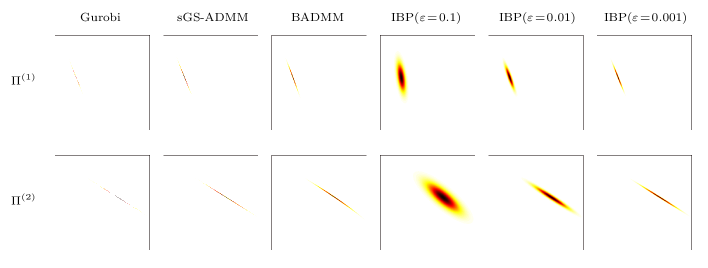
- The method computes exact Wasserstein barycenters without entropy regularization, avoiding the blurring of transport plans observed in regularized methods.
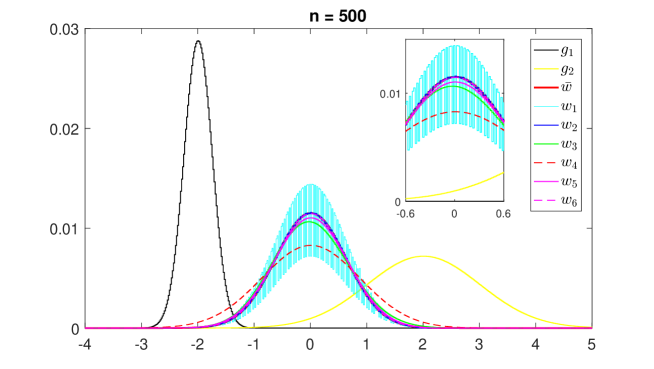
- Numerical experiments on synthetic and image datasets show the method outperforms two representative methods and the commercial solver Gurobi in terms of both accuracy and efficiency.
- The method maintains high precision even with small regularization parameters, where IBP suffers from slow convergence and numerical instability.
- The computational cost per iteration is O(m∑ₜmₜ), and the method scales well to large-scale problems due to efficient subproblem resolution.
Read this paper
Open the full text in the Nubint reader and ask about any passage as you read.
Read this paper on NubintThis review was generated by AI from the original paper. Please check the paper before citing it.