
[Paper Review] Absence of altermagnetic spin splitting character in rutile oxide RuO$_2$
This study uses spin- and angle-resolved photoemission spectroscopy (SARPES) to investigate the electronic and spin structure of rutile RuO₂, challenging its proposed d-wave altermagnetic state. Contrary to theoretical predictions of up to 1.4 eV spin splitting, the results show no momentum-dependent spin splitting, instead revealing in-plane spin polarization antisymmetric about the high-symmetry plane, indicating non-magnetic behavior and ruling out altermagnetism in RuO₂.
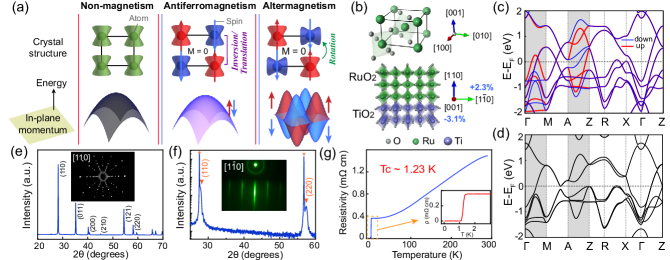
Rutile RuO$_2$ has been posited as a potential $d$-wave altermagnetism candidate, with a predicted significant spin splitting up to 1.4 eV. Despite accumulating theoretical predictions and transport measurements, direct spectroscopic observation of spin splitting has remained elusive. Here, we employ spin- and angle-resolved photoemission spectroscopy to investigate the band structures and spin polarization of thin-film and single-crystal RuO$_2$. Contrary to expectations of altermagnetism, our analysis indicates that RuO$_2$'s electronic structure aligns with those predicted under non-magnetic conditions, exhibiting no evidence of the hypothesized spin splitting. Additionally, we observe significant in-plane spin polarization of the low-lying bulk bands, which is antisymmetric about the high-symmetry plane and contrary to the $d$-wave spin texture due to time-reversal symmetry breaking in altermagnetism. These findings definitively challenge the altermagnetic order previously proposed for rutile RuO$_2$, prompting a reevaluation of its magnetic properties.
Motivation & Objective
- To experimentally verify the proposed d-wave altermagnetic state in rutile RuO₂, which predicts strong spin splitting up to 1.4 eV.
- To resolve the long-standing discrepancy between theoretical predictions and experimental observations of spin splitting in RuO₂.
- To determine whether time-reversal symmetry breaking and spin texture characteristic of altermagnetism are present in RuO₂’s electronic structure.
- To investigate the origin of observed spin polarization in RuO₂, particularly its symmetry properties and possible surface or defect contributions.
Proposed method
- Conducted spin- and angle-resolved photoemission spectroscopy (SARPES) on thin-film and single-crystal RuO₂ samples using a helium lamp with 21.2 eV photon energy.
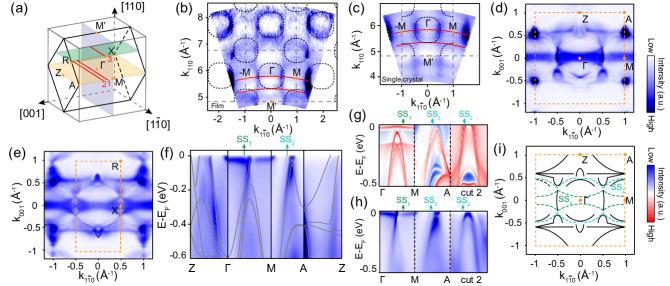
- Performed spin-integrated ARPES measurements along cuts near the X–R plane to map bulk band dispersions, identifying the α band as the primary feature.
- Analyzed spin-resolved photoemission intensity and polarization as a function of momentum and binding energy to extract spin texture and symmetry properties.
- Used Green’s function and slab calculations to simulate surface and interface effects, particularly focusing on inversion symmetry breaking due to surface states or oxygen vacancies.
- Compared experimental SARPES data with theoretical predictions for altermagnetic vs. non-magnetic states, especially regarding symmetry of spin polarization about high-symmetry planes.
- Validated results across multiple samples to ensure robustness and reproducibility of the observed spin polarization features.
Experimental results
Research questions
- RQ1Does rutile RuO₂ exhibit the predicted d-wave spin splitting characteristic of altermagnetism, as suggested by theoretical models?
- RQ2Is the observed spin polarization in RuO₂ consistent with time-reversal symmetry breaking and altermagnetic order, or does it indicate a different origin?
- RQ3How does the symmetry of spin polarization—particularly its antisymmetry about the Γ–Z–M′ plane—relate to the expected spin texture in an altermagnetic system?
- RQ4Can surface effects, such as broken inversion symmetry or oxygen vacancies, account for the observed Rashba-like spin polarization in RuO₂?
- RQ5To what extent do experimental results challenge the current classification of RuO₂ as a candidate d-wave altermagnet?
Key findings
- No evidence of momentum-dependent spin splitting was observed in the bulk α band of RuO₂, contradicting theoretical predictions of up to 1.4 eV spin splitting in an altermagnetic state.
- The observed in-plane spin polarization (S₀₀₁) is antisymmetric about the Γ–Z–M′ high-symmetry plane, which is inconsistent with the symmetric spin texture expected from time-reversal symmetry breaking in altermagnetism.
- The spin polarization pattern is robust across multiple thin-film and single-crystal samples, indicating a bulk or intrinsic origin rather than a surface artifact.
- Simulations using Green’s function and slab models show that broken inversion symmetry at the surface or due to oxygen vacancies can produce Rashba-like spin splitting, consistent with experimental observations.
- The results strongly suggest that the observed spin polarization arises from symmetry-breaking effects at the surface or interface, not from intrinsic altermagnetic order.
- The findings definitively rule out the presence of altermagnetic order in RuO₂, necessitating a reevaluation of its magnetic classification and theoretical models.
Read this paper
Open the full text in the Nubint reader and ask about any passage as you read.
Read this paper on NubintThis review was generated by AI from the original paper. Please check the paper before citing it.