
[Paper Review] Atiyah-Hirzebruch spectral sequence for topological insulators and superconductors: $E_2$ pages for 1651 magnetic space groups
This paper presents a systematic computation of the $E_2$ pages of the momentum-space and real-space Atiyah-Hirzebruch spectral sequence (AHSS) for topological crystalline insulators and superconductors across 1,651 magnetic space groups in one to three dimensions. By leveraging group action constraints and $K$-theory classification, it derives candidate $K$-groups from $E_2$ pages under physical assumptions, determining the $K$-groups for approximately 59% of 3D symmetry settings, with all results publicly available.
We compute the $E_2$ pages of the momentum-space and real-space Atiyah-Hirzebruch spectral sequence (AHSS) for topological crystalline insulators and superconductors up to three spatial dimensions, considering the cell decomposition in which if a group action fixes a cell setwise then its group action fixes the same cell pointwise. We provide a detailed description of the implementation for computing the $E_2$ pages of AHSS. Under a physically reasonable assumption, we enumerate all possible $K$-groups that are compatible with the $E_2$ pages for both momentum and real-space AHSS. As a result, we determine the $K$-groups for approximately 59\% of symmetry settings in three spatial dimensions. All the results can be found at this http \href{https://www2.yukawa.kyoto-u.ac.jp/~ken.shiozaki/ahss/e2.html}{URL}.
Motivation & Objective
- To systematically compute the $E_2$ pages of the Atiyah-Hirzebruch spectral sequence (AHSS) for topological crystalline insulators and superconductors in momentum and real space.
- To establish a computationally feasible framework for determining $K$-groups from $E_2$ pages under physically reasonable assumptions.
- To enumerate all possible $K$-groups compatible with $E_2$ pages for both momentum-space and real-space AHSS across 1651 magnetic space groups.
- To provide a comprehensive, publicly accessible database of $E_2$ pages and derived $K$-groups for 1D, 2D, and 3D systems with crystalline symmetries.
Proposed method
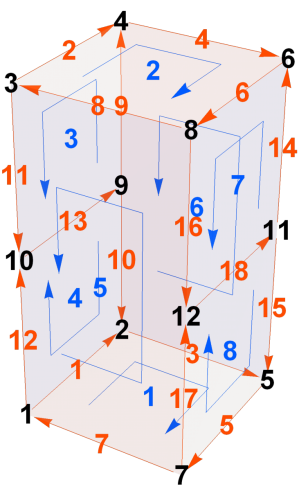
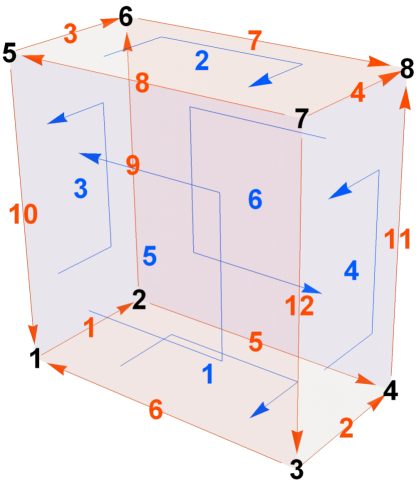
- Utilizes a cell decomposition where group actions fixing a cell setwise also fix it pointwise, simplifying the computation of $E_1$ and $E_2$ pages.
- Applies $K$-theory classification via $K$-cohomology (momentum space) and $K$-homology (real space), with isomorphism between the two for topological crystalline phases.
- Employs Smith decomposition and generalized inverses to compute the cokernel and kernel of homomorphisms in the chain complex, yielding $\mathrm{Ker}\,g / \mathrm{Im}\,f \cong \mathbb{Z}^{\oplus(n-k)} \oplus \bigoplus_{i=1}^{k} \mathbb{Z}_{\lambda_i}$.
- Uses Baer sums to systematically construct all possible extensions of $\mathbb{Z}$-modules, enabling enumeration of candidate $K$-groups from $E_2$ pages.
- Integrates factor systems and irreducible characters to model symmetry actions on Hilbert spaces and gap functions under time-reversal and $SU(2)$ symmetries.
- Implements an algorithmic pipeline for computing cell decompositions, irreducible characters, and $\mathbb{Z}$-module structures using matrix representations and generalized inverses.
Experimental results
Research questions
- RQ1What is the structure of the $E_2$ page of the Atiyah-Hirzebruch spectral sequence for topological crystalline insulators and superconductors in momentum and real space across all 1,651 magnetic space groups?
- RQ2How can the $E_2$ page be used to systematically enumerate all possible $K$-groups compatible with the spectral sequence, given physical constraints?
- RQ3What fraction of 3D symmetry settings can be fully classified via $E_2$-based $K$-group enumeration, and under what assumptions does this hold?
- RQ4How can the extension problem in $K$-theory be solved algorithmically using Baer sums and Smith decomposition to reconstruct $K$-groups from $E_2$ data?
- RQ5What is the computational framework for mapping group actions, cell decompositions, and symmetry representations to the $E_2$ page of the AHSS?
Key findings
- The $E_2$ pages of the momentum-space and real-space AHSS are computed for all 1,651 magnetic space groups, including 528 magnetic layer groups and 393 magnetic rod groups.
- For superconductors, all one-dimensional representations of pairing symmetry are considered, ensuring comprehensive coverage of pairing channels.
- Under a physically reasonable assumption, the authors enumerate all possible $K$-groups compatible with the $E_2$ pages, enabling a stable classification of topological phases.
- The method determines the $K$-groups for approximately 59% of 3D symmetry settings, significantly advancing the systematic classification of topological crystalline phases.
- The complete results, including $E_2$ pages and candidate $K$-groups, are publicly available at the provided URL, supporting reproducibility and further research.
- The framework successfully reconstructs $K$-groups from $E_2$ pages using Smith decomposition and Baer sums, demonstrating a practical pathway from spectral sequence data to physical classification.
Read this paper
Open the full text in the Nubint reader and ask about any passage as you read.
Read this paper on NubintThis review was generated by AI from the original paper. Please check the paper before citing it.