
[Paper Review] Beyond Recommender: An Exploratory Study of the Effects of Different AI Roles in AI-Assisted Decision Making
This study investigates how different AI roles—Recommender, Analyzer, and Devil’s Advocate—affect human decision-making across varying AI performance levels. Findings show that while the Recommender role excels when AI is highly accurate (90%), the Analyzer role significantly outperforms it when AI performance is low (65%), leading to better task performance, more appropriate reliance, and improved user experience.
Artificial Intelligence (AI) is increasingly employed in various decision-making tasks, typically as a Recommender, providing recommendations that the AI deems correct. However, recent studies suggest this may diminish human analytical thinking and lead to humans' inappropriate reliance on AI, impairing the synergy in human-AI teams. In contrast, human advisors in group decision-making perform various roles, such as analyzing alternative options or criticizing decision-makers to encourage their critical thinking. This diversity of roles has not yet been empirically explored in AI assistance. In this paper, we examine three AI roles: Recommender, Analyzer, and Devil's Advocate, and evaluate their effects across two AI performance levels. Our results show each role's distinct strengths and limitations in task performance, reliance appropriateness, and user experience. Notably, the Recommender role is not always the most effective, especially if the AI performance level is low, the Analyzer role may be preferable. These insights offer valuable implications for designing AI assistants with adaptive functional roles according to different situations.
Motivation & Objective
- To investigate whether shifting AI roles beyond mere recommendation can improve human-AI decision-making synergy.
- To address the problem of over-reliance and reduced analytical thinking when AI acts only as a recommender.
- To examine how AI performance level moderates the effectiveness of different AI roles in human-AI collaboration.
- To explore the impact of AI roles on task performance, reliance appropriateness, and user experience in AI-assisted decision-making.
- To provide empirical evidence for adaptive AI role design based on context, performance, and user needs.
Proposed method
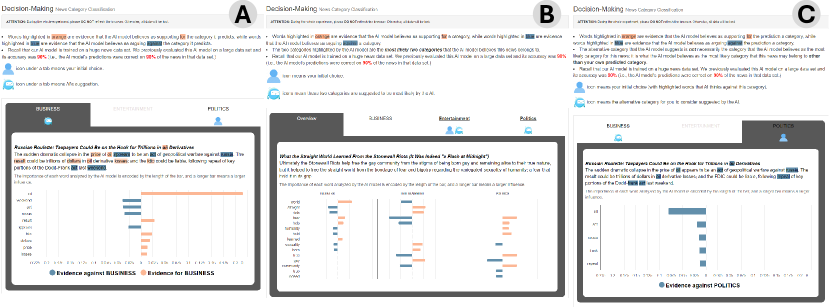
- Conducted a controlled user study with 180 participants recruited via Prolific to classify news articles into business, entertainment, or politics.
- Implemented three AI roles: Recommender (provides recommendation + explanation), Analyzer (presents pros and cons for each option), and Devil’s Advocate (challenges the user’s initial choice).
- Evaluated two AI performance levels: low (65% accuracy) and high (90% accuracy), creating six experimental conditions (3 roles × 2 performance levels).
- Measured task performance, reliance appropriateness (via post-decision confidence and alignment with correct answer), and user experience (satisfaction, helpfulness, trust).
- Used mixed-methods analysis: quantitative metrics for performance and reliance, and qualitative feedback for user experience insights.
- Analyzed interaction effects between AI role and performance level, with statistical testing to validate differences across conditions.
Experimental results
Research questions
- RQ1How do different AI assistant roles affect human task performance in AI-assisted decision-making?
- RQ2How do different AI assistant roles influence the appropriateness of human reliance on AI?
- RQ3How do different AI assistant roles affect user experience, including satisfaction, trust, and perceived helpfulness?
- RQ4How does AI performance level moderate the effectiveness of different AI roles?
- RQ5What are the underlying user behavioral patterns (e.g., engagement, resistance) toward each AI role?
Key findings
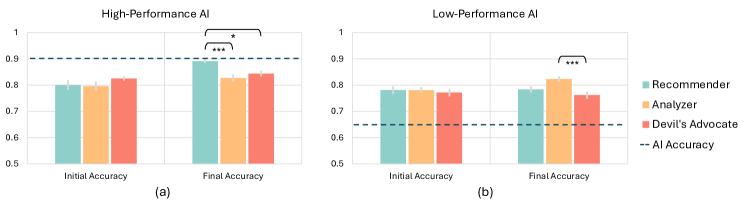
- When AI performance was high (90% accuracy), the Recommender role led to the highest task performance, with 85% of participants selecting the correct category.
- With low AI performance (65% accuracy), the Analyzer role significantly outperformed the Recommender role, achieving 78% correct classifications compared to 69% for Recommender.
- The Analyzer role led to more appropriate reliance across both performance levels, particularly reducing over-reliance when AI was inaccurate.
- Users reported higher satisfaction, helpfulness, and trust with the Analyzer role when AI performance was low, indicating better user experience in low-trust scenarios.
- The Devil’s Advocate role consistently showed low engagement and high reluctance, regardless of AI performance, suggesting users resist critical challenge from AI.
- When AI performance was high, users engaged more with the Analyzer’s evidence-based analysis, indicating that high-quality AI supports deeper cognitive processing.
Read this paper
Open the full text in the Nubint reader and ask about any passage as you read.
Read this paper on NubintThis review was generated by AI from the original paper. Please check the paper before citing it.