
[Paper Review] Determinants of LLM-assisted Decision-Making
A comprehensive integrative literature review that identifies technological, psychological, and decision-specific determinants of LLM-assisted decision-making and presents a dependency framework of their interactions.
Decision-making is a fundamental capability in everyday life. Large Language Models (LLMs) provide multifaceted support in enhancing human decision-making processes. However, understanding the influencing factors of LLM-assisted decision-making is crucial for enabling individuals to utilize LLM-provided advantages and minimize associated risks in order to make more informed and better decisions. This study presents the results of a comprehensive literature analysis, providing a structural overview and detailed analysis of determinants impacting decision-making with LLM support. In particular, we explore the effects of technological aspects of LLMs, including transparency and prompt engineering, psychological factors such as emotions and decision-making styles, as well as decision-specific determinants such as task difficulty and accountability. In addition, the impact of the determinants on the decision-making process is illustrated via multiple application scenarios. Drawing from our analysis, we develop a dependency framework that systematizes possible interactions in terms of reciprocal interdependencies between these determinants. Our research reveals that, due to the multifaceted interactions with various determinants, factors such as trust in or reliance on LLMs, the user's mental model, and the characteristics of information processing are identified as significant aspects influencing LLM-assisted decision-making processes. Our findings can be seen as crucial for improving decision quality in human-AI collaboration, empowering both users and organizations, and designing more effective LLM interfaces. Additionally, our work provides a foundation for future empirical investigations on the determinants of decision-making assisted by LLMs.
Motivation & Objective
- Characterize factors influencing decision-making with LLM support across technological, psychological, and task-specific dimensions.
- Synthesize literature to map interactions and dependencies among determinants.
- Develop a dependency framework to systematize how determinants mutually influence LLM-assisted decision-making.
- Illustrate how determinants affect decision quality and risk management in human-AI collaboration.
Proposed method
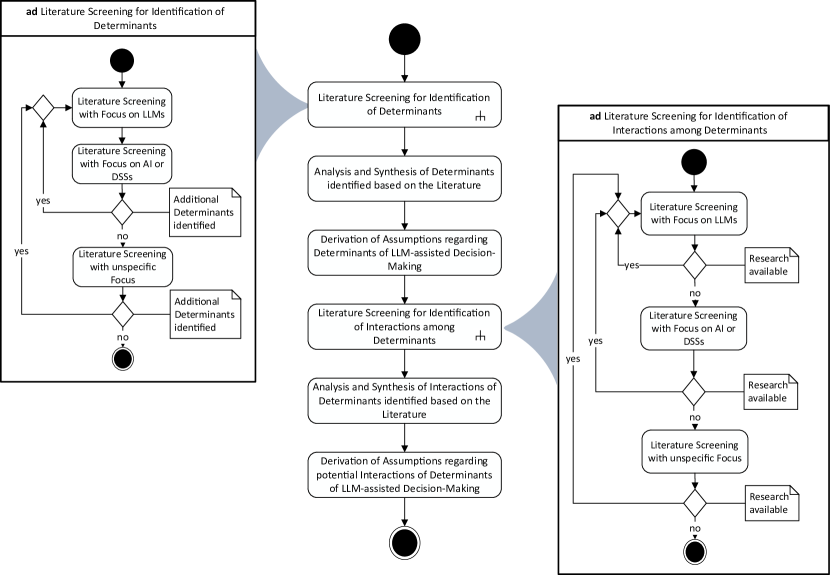
- Conduct an integrative literature review to identify determinants influencing LLM-assisted decision-making.
- Analyze determinants from technological, psychological, and decision-specific perspectives.
- Derive a dependency framework to represent interdependencies among determinants using structured notations.
- Provide scenario-based illustrations to demonstrate determinants in practical contexts.
![Figure 1: Key stages in the decision-making process oriented to Simon [ 169 ] extended by LLM support options.](https://ar5iv.labs.arxiv.org/html/2402.17385/assets/x2.png)
Experimental results
Research questions
- RQ1What determinants influence LLM-assisted decision-making across technological, psychological, and decision-specific domains?
- RQ2How do these determinants interact and depend on each other in affecting decision quality and risk management?
- RQ3How can a dependency framework help designers and organizations improve human-LLM collaboration in decision-making?
- RQ4What scenarios illustrate the impact of identified determinants on LLM-assisted decisions?
Key findings
- Trust in or reliance on LLMs, user mental models, and information-processing characteristics emerge as significant determinants of LLM-assisted decision-making.
- Determinants interact in reciprocal ways, justifying a dependency framework to model interdependencies.
- Technological determinants (e.g., LLM capabilities, transparency, prompt engineering) influence decision outcomes and risk exposure.
- Psychological determinants (e.g., emotions, decision styles) shape how users engage with and interpret LLM outputs.
- Decision-specific determinants (e.g., task complexity, accountability) modulate the usefulness and safety of LLM assistance.
- Application scenarios (S1–S6) demonstrate how determinants play out in real-world decision contexts and validate the framework.
Better researchstarts right now
From reading papers to final review, dramatically reduce your research time.
No credit card · Free plan available
This review was created by AI and reviewed by human editors.