
[Paper Review] Binary Black Hole Merger Rates in AGN Disks versus Nuclear Star Clusters: Loud beats Quiet
This paper demonstrates that binary black hole (BBH) merger rates in active galactic nuclei (AGN) disks significantly exceed those in quiescent nuclear star clusters (NSCs), primarily due to rapid hardening in AGN that shortens BBH lifetimes below the hard-soft boundary, unlike in NSCs where binaries survive longer due to ionization. The authors estimate AGN could contribute 25%–80% of the LIGO-Virgo-measured BBH merger rate, with high-generation hierarchical mergers serving as unique tracers of AGN origins in deep potential wells.
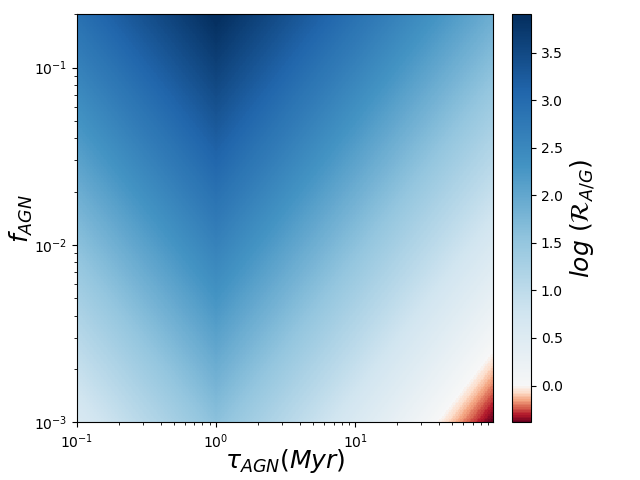
Galactic nuclei are promising sites for stellar origin black hole (BH) mergers, as part of merger hierarchies in deep potential wells. We show that binary black hole (BBH) merger rates in active galactic nuclei (AGN) should always exceed merger rates in quiescent galactic nuclei (nuclear star clusters, NSCs) around supermassive BHs (SMBHs) without accretion disks. This is primarily due to average binary lifetimes in AGN that are significantly shorter than in NSCs. The lifetime difference comes from rapid hardening of BBHs in AGN, such that their semi-major axes are smaller than the hard-soft boundary of their parent NSC; this contrasts with the large average lifetime to merger for BBHs in NSCs around SMBHs, due to binary ionization mechanisms. Secondarily, merger rates in AGNs are enhanced by gas-driven binary formation mechanisms. Formation of new BHs in AGN disks are a minor contributor to the rate differences. With the gravitational wave detection of several BBHs with at least one progenitor in the upper mass gap, and signatures of dynamical formation channels in the $χ_{ m eff}$ distribution, we argue that AGN could contribute $\sim 25\%-80\%$ of the LIGO-Virgo measured rate of $\sim 24 m{Gpc}^{-3} m{yr}^{-1}$.
Motivation & Objective
- To compare BBH merger rates in AGN disks versus quiescent nuclear star clusters (NSCs) around supermassive black holes (SMBHs).
- To identify the dominant physical mechanisms driving differences in merger rates between AGN and NSC environments.
- To assess the contribution of AGN to the observed LIGO-Virgo BBH merger rate, particularly through hierarchical mergers.
- To evaluate the role of gas-driven formation and ionization processes in shaping merger rate disparities.
Proposed method
- Modeling BBH evolution in AGN disks using gas-driven hardening and dynamical friction to calculate merger timescales.
- Comparing these timescales to those in gas-poor NSCs, where binary ionization dominates and prolongs lifetimes.
- Using Monte Carlo simulations to estimate merger rates under varying AGN and NSC conditions, including gas density and disk lifetime.
- Incorporating binary formation mechanisms in AGN disks, including in-situ BH formation from gas accretion.
- Analyzing the expected distributions of mass, spin, and eccentricity for hierarchical mergers to identify AGN-specific signatures.
- Calibrating the fraction of BBH mergers originating in AGN using constraints from LIGO-Virgo observations, especially hierarchical merger rates.
Experimental results
Research questions
- RQ1What drives the difference in BBH merger rates between AGN disks and quiescent NSCs?
- RQ2Why are BBH lifetimes significantly shorter in AGN compared to NSCs?
- RQ3To what extent do gas-driven formation mechanisms in AGN contribute to the rate difference?
- RQ4Can high-generation hierarchical mergers uniquely identify AGN as the origin of BBH mergers?
- RQ5What fraction of the observed LIGO-Virgo BBH merger rate can be attributed to AGN, based on current data?
Key findings
- BBH merger rates in AGN disks are always higher than in quiescent NSCs due to rapid hardening that reduces semi-major axes below the hard-soft boundary.
- The primary driver of this rate difference is the shorter average BBH lifetime in AGN, caused by efficient hardening in dense gas disks.
- Secondary enhancement in AGN comes from gas-driven binary formation, though this contributes only a minor fraction to the overall rate difference.
- AGN could account for 25% to 80% of the LIGO-Virgo-measured BBH merger rate of ~24 Gpc⁻³ yr⁻¹.
- High-generation hierarchical mergers (n > 3) are uniquely indicative of AGN if natal BH spins are near zero, and n > 2 or n > 1 if spins are modest or eccentricity is present.
- The most prolific AGN contributors to BBH mergers are those with short lifetimes (<5 Myr) and high gas densities (>10⁻¹¹ g cm⁻³), limiting IMBH-SMBH binary formation detectable by LISA.
Read this paper
Open the full text in the Nubint reader and ask about any passage as you read.
Read this paper on NubintThis review was generated by AI from the original paper. Please check the paper before citing it.