
[Paper Review] Bridging the Novice-Expert Gap via Models of Decision-Making: A Case Study on Remediating Math Mistakes
This paper introduces ReMath, a benchmark that deconstructs expert math tutors' decision-making into three tasks: error type inference, remediation strategy selection, and response generation. Evaluated on LLMs, providing models with error types and strategies improves response quality by 75% over baseline, yet models still fall short of expert teacher performance, highlighting the need for human-AI collaboration in tutoring.
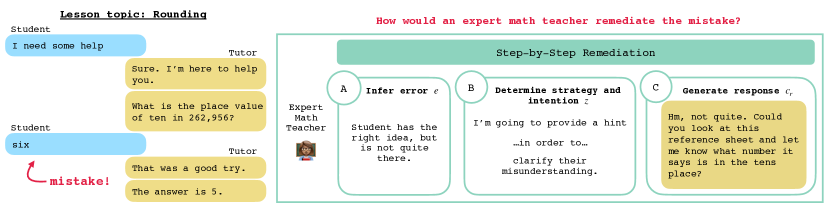
Scaling high-quality tutoring remains a major challenge in education. Due to growing demand, many platforms employ novice tutors who, unlike experienced educators, struggle to address student mistakes and thus fail to seize prime learning opportunities. Our work explores the potential of large language models (LLMs) to close the novice-expert knowledge gap in remediating math mistakes. We contribute Bridge, a method that uses cognitive task analysis to translate an expert's latent thought process into a decision-making model for remediation. This involves an expert identifying (A) the student's error, (B) a remediation strategy, and (C) their intention before generating a response. We construct a dataset of 700 real tutoring conversations, annotated by experts with their decisions. We evaluate state-of-the-art LLMs on our dataset and find that the expert's decision-making model is critical for LLMs to close the gap: responses from GPT4 with expert decisions (e.g., "simplify the problem") are +76% more preferred than without. Additionally, context-sensitive decisions are critical to closing pedagogical gaps: random decisions decrease GPT4's response quality by -97% than expert decisions. Our work shows the potential of embedding expert thought processes in LLM generations to enhance their capability to bridge novice-expert knowledge gaps. Our dataset and code can be found at: \url{https://github.com/rosewang2008/bridge}.
Motivation & Objective
- Address the scalability challenge in high-quality math tutoring by supporting novice tutors with AI assistance.
- Identify the critical gap in current LLMs’ ability to remediate student math mistakes effectively, especially in pedagogical reasoning.
- Develop a structured framework to model expert decision-making in error remediation for better AI tutoring support.
- Evaluate how LLMs perform on real-world tutoring scenarios compared to expert teachers, focusing on response quality and pedagogical sensitivity.
- Demonstrate that providing LLMs with error types and strategies significantly improves their remediation responses, though not to expert levels.
Proposed method
- Co-developed ReMath with experienced math teachers to break down remediation into three distinct tasks: error type inference (Task A), strategy selection (Task B), and response generation (Task C).
- Constructed a dataset of 1st–5th grade math tutoring interactions from Title I schools, annotated by two expert teachers per example for error type and strategy.
- Evaluated state-of-the-art instruct-tuned and dialog LLMs (e.g., GPT-4, Flan-T5, GODEL) on the ReMath benchmark using both automated metrics and human evaluation.
- Applied a hierarchical prompting strategy: first prompting for error type and strategy, then combining them to generate final responses, to assess the impact of structured guidance.
- Used automated metrics (ROUGE, BLEU, Self-BLEU, entropy) and human annotations (preference, usefulness, care, robot-likeness) to evaluate response quality.
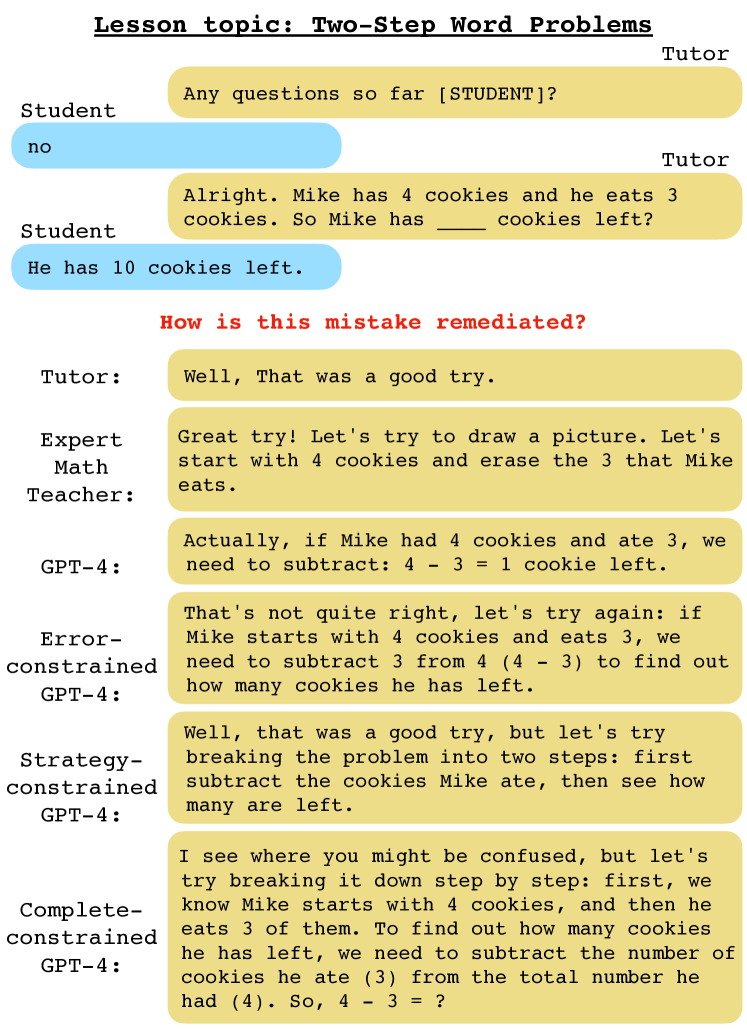
- Compared model outputs under four conditions: unconstrained, with error type (e), with strategy (z), and with both (e,z), to isolate the effect of structured input.
Experimental results
Research questions
- RQ1To what extent can LLMs outperform original novice tutor responses in remediating student math mistakes?
- RQ2How does providing LLMs with error type and remediation strategy information affect the quality of their responses?
- RQ3How do LLM-generated responses compare to expert teacher responses in terms of pedagogical quality, empathy, and accuracy?
- RQ4What role does structured prompting (error type + strategy) play in improving model performance on tutoring tasks?
- RQ5Can current LLMs alone achieve expert-level quality in math error remediation, or is human-in-the-loop necessary?
Key findings
- LLMs consistently outperform original novice tutor responses in remediation quality, with GPT-4 achieving a human preference score of 0.95 on the complete (e,z) condition.
- Providing models with both error type and strategy information leads to a 75% improvement in response quality over unconstrained generation, as measured by human preference.
- Even with full context (error type and strategy), the best model responses (GPT-4) still fall short of expert teacher responses, which received a human preference score of 1.26.
- The inclusion of error type and strategy significantly improves response coherence and pedagogical relevance, reducing hallucination and improving alignment with intended learning outcomes.
- Human evaluation reveals that models without structured input often generate responses that are less useful, less caring, and more robot-like, with GPT-4 scoring -0.04 on the 'care' dimension in the unconstrained setting.
- The best-performing model (GPT-4 with e,z) achieved a ROUGE-L score of 0.16 and a BLEU score of 0.02, indicating moderate fluency and relevance, but still below the expert teacher’s ROUGE-L of 0.91.
Read this paper
Open the full text in the Nubint reader and ask about any passage as you read.
Read this paper on NubintThis review was generated by AI from the original paper. Please check the paper before citing it.