
[Paper Review] Broad Absorption Line Quasars in the Dark Energy Spectroscopic Instrument Early Data Release
This paper presents a catalog of broad absorption line (BAL) quasars identified in the Dark Energy Spectroscopic Instrument (DESI) Early Data Release using an automated detection method. By masking BAL absorption features and recomputing redshifts, the authors reduce average redshift errors by 243 km s⁻¹, significantly improving quasar clustering measurements and enhancing cosmological analysis despite BALs' historical role as a source of contamination.
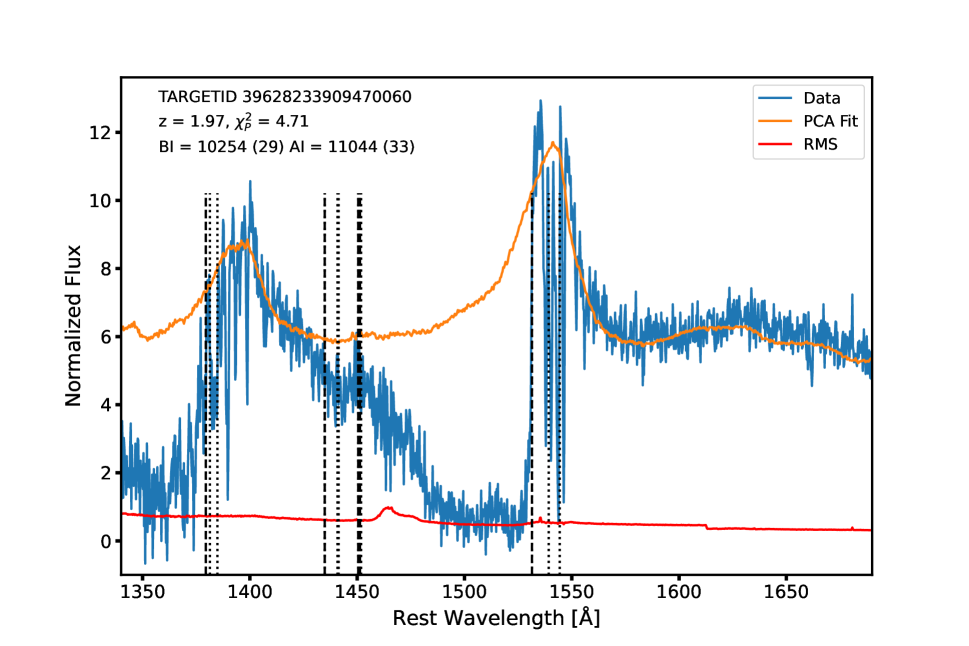
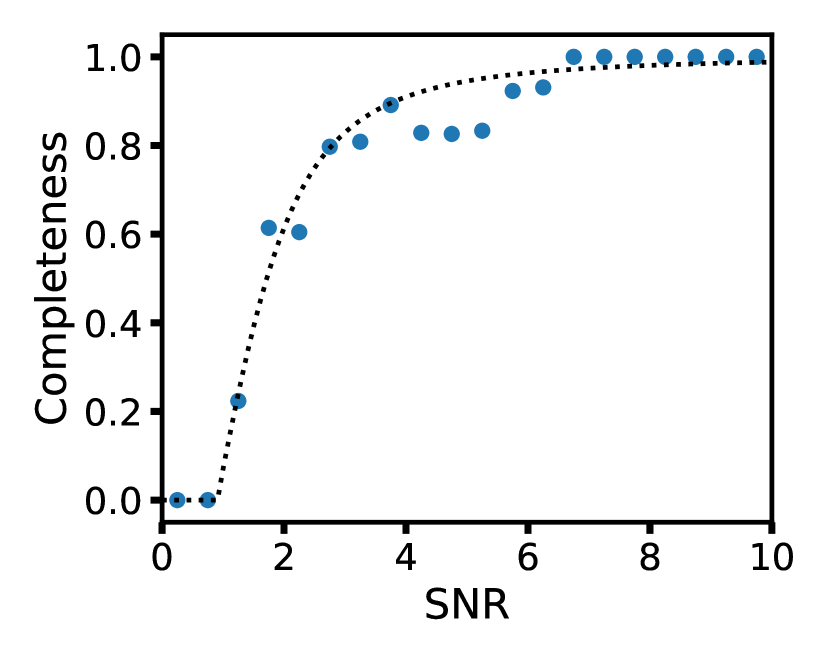
Broad absorption line (BAL) quasars are characterized by gas clouds that absorb flux at the wavelength of common quasar spectral features, although blueshifted by velocities that can exceed 0.1c. BAL features are interesting as signatures of significant feedback, yet they can also compromise cosmological studies with quasars by distorting the shape of the most prominent quasar emission lines, impacting redshift accuracy and measurements of the matter density distribution traced by the Lyman-alpha forest. We present a catalog of BAL quasars discovered in the Dark Energy Spectroscopic Instrument (DESI) survey Early Data Release, which were observed as part of DESI Survey Validation, as well as the first two months of the main survey. We describe our method to automatically identify BAL quasars in DESI data, the quantities we measure for each BAL, and investigate the completeness and purity of this method with mock DESI observations. We mask the wavelengths of the BAL features and re-evaluate each BAL quasar redshift, finding new redshifts which are 243 km/s smaller on average for the BAL quasar sample. These new, more accurate redshifts are important to obtain the best measurements of quasar clustering, especially at small scales. Finally, we present some spectra of rarer classes of BALs that illustrate the potential of DESI data to identify such populations for further study.
Motivation & Objective
- To identify broad absorption line (BAL) quasars in the DESI Early Data Release using automated spectral analysis.
- To address the contamination of quasar redshift measurements and clustering studies caused by BAL features.
- To improve redshift accuracy by masking BAL absorption troughs in C iv, Si iv, N v, and Lyα lines.
- To quantify the impact of BALs on cosmological surveys and assess their scientific value despite prior exclusion.
- To enable more accurate large-scale structure measurements by correcting redshifts after BAL masking.
Proposed method
- Applied an automated algorithm to detect BAL quasars in DESI spectra based on absorption features in C iv, Si iv, N v, and Lyα emission lines.
- Used mock DESI observations to evaluate the completeness and purity of the BAL detection method.
- Masked wavelengths corresponding to BAL troughs in the C iv, Si iv, N v, and Lyα regions to recompute quasar redshifts.
- Compared redshifts before and after masking to quantify systematic shifts and error reduction.
- Calculated the average velocity shift between original and corrected redshifts to assess improvement in accuracy.
- Projected the BAL fraction in the full DESI survey based on catalog completeness and representative samples.
Experimental results
Research questions
- RQ1What is the fraction of BAL quasars in the DESI Early Data Release, and how does it compare to previous surveys?
- RQ2How do BAL absorption features affect quasar redshift measurements, and to what extent can these errors be corrected?
- RQ3What is the impact of masking BAL features on the accuracy of quasar redshifts and clustering measurements?
- RQ4How does the signal-to-noise ratio (SNR) of BAL quasars compare to non-BAL quasars, and what are the implications for cosmological analysis?
- RQ5Can BAL quasars be retained in cosmological surveys to increase statistical power without compromising data quality?
Key findings
- The average redshift shift after masking BAL features is 243 km s⁻¹, indicating a significant correction to original redshift estimates.
- The BAL fraction in the full DESI survey is projected to be approximately 19%, based on representative catalog analysis.
- Masking BAL features reduces redshift errors to levels comparable to non-BAL quasars, as confirmed by mock quasar studies.
- BAL quasars have a higher average signal-to-noise ratio (SNR ≈ 5 per pixel) than non-BAL quasars (SNR ≈ 3), improving data quality.
- Retaining BAL quasars in cosmological analysis increases statistical power and the number of sightlines probing the Lyα forest.
- In some cases, velocity shifts after masking exceed 1000 km s⁻¹, indicating that BALs can cause catastrophic redshift errors if uncorrected.
Read this paper
Open the full text in the Nubint reader and ask about any passage as you read.
Read this paper on NubintThis review was generated by AI from the original paper. Please check the paper before citing it.