
[論文レビュー] Charge Transfer and Zhang-Rice Singlet Bands in the Nickelate Superconductor $\mathrm{La_3Ni_2O_7}$ under Pressure
著者らは La3Ni2O7 に対して 11-band Hubbard model を用い、determinant quantum Monte Carlo および cellular dynamical mean-field theory により、異なるホール分布を持つ2つのスピン縮退帯を明らかにし、低エネルギー物理の4-band t-Jモデルを提案する。
Recently, a bulk nickelate superconductor $\mathrm{La_3Ni_2O_7}$ is discovered at pressures with a remarkable high transition temperature $T_c \sim 80K$. Here, we study a Hubbard model with tight-binding parameters derived from extit{ab initio} calculations of $\mathrm{La_3Ni_2O_7}$, by employing large scale determinant quantum Monte Carlo and cellular dynamical mean-field theory. Our result suggests that the superexchange couplings in this system are comparable to that of cuprates. The system is a charge transfer insulator as hole concentration becomes four per site at large Hubbard $U$. Upon hole doping, two low-energy spin-singlet bands emerge in the system exhibiting distinct correlation properties: while the one composed of the out-of-plane Ni-$d_{3z^2-r^2}$ and O-$p_z$ orbitals demonstrates strong antiferromagnetic correlations and narrow effective bandwidth, the in-plane singlet band consisting of the Ni-$d_{x^2-y^2}$ and O-$p_x / p_y$ orbitals is in general more itinerant. Over a broad range of hole doping, the doped holes occupy primarily the $d_{x^2-y^2}$ and $p_x / p_y$ orbitals, whereas the $d_{3z^2-r^2}$ and $p_z$ orbitals retain underdoped. We propose an effective $ t-J$ model to capture the relevant physics and discuss the implications of our result for comprehending the $\mathrm{La_3Ni_2O_7}$ superconductivity.
研究の動機と目的
- La3Ni2O7 の圧力下における高Tc 超伝導の理解を促進するため、磁気交換とホール分布を検討する。
- 超伝導体 cuprates との類似性を評価するための超交換結合を決定する。
- 半充填時の軌道分解能のホール分布と絶縁状態の性質を特徴づける。
- 圧力下の低エネルギーでスピン縮退帯とその相関特性を同定する。
- La3Ni2O7 の圧力条件下における有効な低エネルギー four-band t-J model を提案する。
提案手法
- Ni 3d および O 2p 軌道を含む ab initio downfolding から得られたパラメータを用いた 11-band ハバードモデルを適用。
- スピン相関とホール濃度を計算するために determinant quantum Monte Carlo (DQMC) を使用。
- 自己エネルギーとスペクトル情報を得るために cellular dynamical mean-field theory (CDMFT) を適用。
- 層間および層内の超交換結合の相対的強さを抽出するためにスピン相関を分析。
- Zhang-Rice様帯の出現を追跡し、局所密度状態を計算。
- 支配的な交換相互作用を捉える有効な four-band t-J モデルを提案。
実験結果
リサーチクエスチョン
- RQ1圧力下の La3Ni2O7 における支配的な磁気交換結合は何か、cuprates とどう比較されるか?
- RQ2半充填時とそれ以外で Ni d および O p 軌道間のホール分布はどうなり、低エネルギー帯の性質はどのようになるか?
- RQ3ZRS-like バンドは出現するのか、平面内と平面外の軌道でその性質はどう異なるか?
- RQ4圧力下での系の主要な物理を捉える有効な低エネルギー t-J モデルは構築できるか?
主な発見
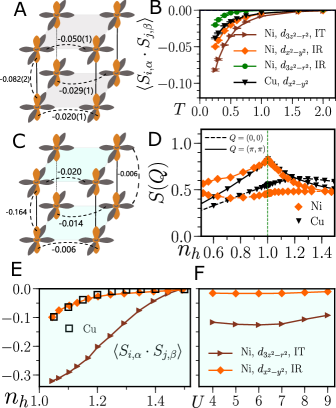
- 半充填時には層間 d3z^2−r^2–d3z^2−r^2 反鉄磁性交換が支配的で、平面内の d_x^2−y^2–d_x^2−y^2 の交換は大きいが弱い。
- ホールドーピングに伴い、異なる相関特性を持つ二つのスピン縮退帯が現れる:狭く、強く相関する平面外の d3z^2−r^2, pz バンドと、より遊離度の高い平面内の d_x^2−y^2, px/py の縮退帯。
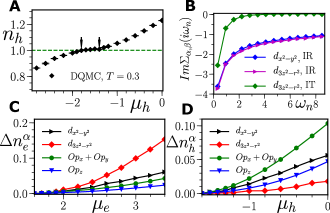
- ホールドーピングは平面軌道(d_x^2−y^2 および px/py)に集中し、平面外軌道(d3z^2−r^2 および pz)は低ドーホールのままで、強い軌道分化を示す。
- 系は半充填時(サイトあたり4つのホール)に電荷移動絶縁体として振る舞い、ホールは主に O 2p 軌道に入り、Zaanen-Sawatzky-Allen の電荷移動物理と一致する。
- 平面内の ZRS様帯は平面外の縮退帯よりも遊離度が高く、二つの帯が潜在的な超伝導性において異なる輸送・相関役割を持つことを示唆する。
- 低エネルギーの主要な磁気交換と La3Ni2O7 の圧力下の低エネルギー物理を捉える有効な four-band t-J モデルを提案する。
より良い研究を、今すぐ始めましょう
論文設計から論文執筆まで、研究時間を劇的に削減しましょう。
クレジットカード登録不要
このレビューはAIが作成し、人間の編集者が確認しました。