
[Paper Review] COIG-CQIA: Quality is All You Need for Chinese Instruction Fine-tuning
This paper presents COIG-CQIA, a high-quality Chinese instruction tuning dataset curated from authentic Chinese internet sources, and analyzes how data quality and provenance affect model performance and safety across multiple scales.
Remarkable progress on English instruction tuning has facilitated the efficacy and reliability of large language models (LLMs). However, there remains a noticeable gap in instruction tuning for Chinese, where the complex linguistic features pose significant challenges. Existing datasets, generally distilled from English-centric LLMs, are not well-aligned with Chinese users' interaction patterns. To bridge this gap, we introduce COIG-CQIA, a new Chinese instruction tuning dataset derived from various real-world resources and undergoing rigorous human verification. We conduct extensive experiments on COIG-CQIA, and compare them with strong baseline models and datasets. The experimental results show that models trained on COIG-CQIA achieve highly competitive performance in diverse benchmarks. Additionally, our findings offer several insights for designing effective Chinese instruction-tuning datasets and data-mixing strategies. Our dataset are available at https://huggingface.co/datasets/m-a-p/COIG-CQIA.
Motivation & Objective
- Create a diverse, high-quality Chinese instruction tuning dataset aligned with real Chinese user interactions.
- Assess how data provenance and quality affect fine-tuned model capabilities across domains and tasks.
- Provide insights for selecting and combining Chinese data sources for instruction tuning.
Proposed method
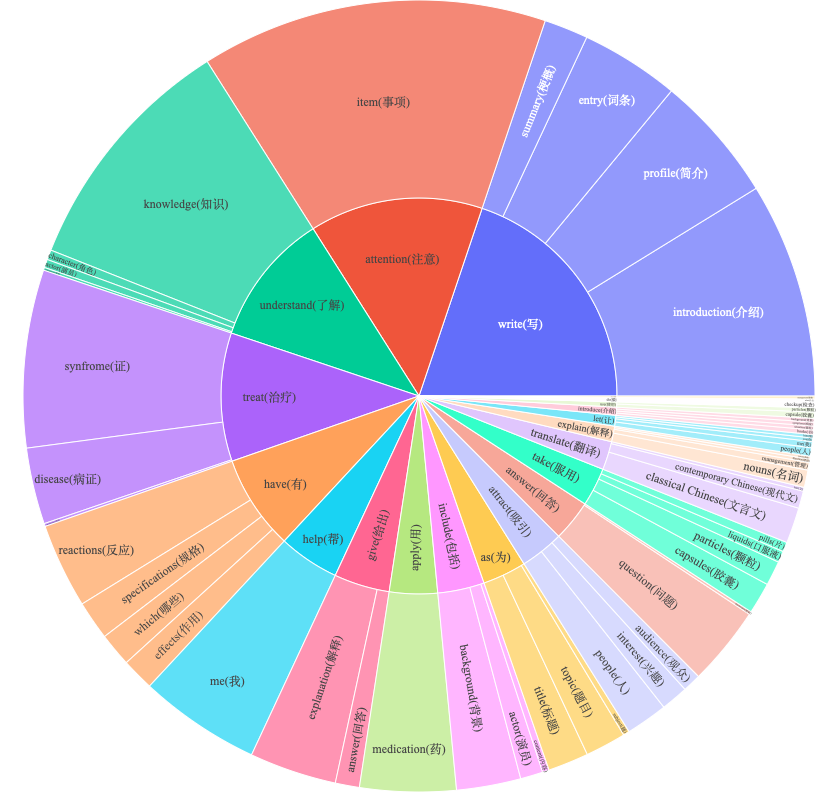
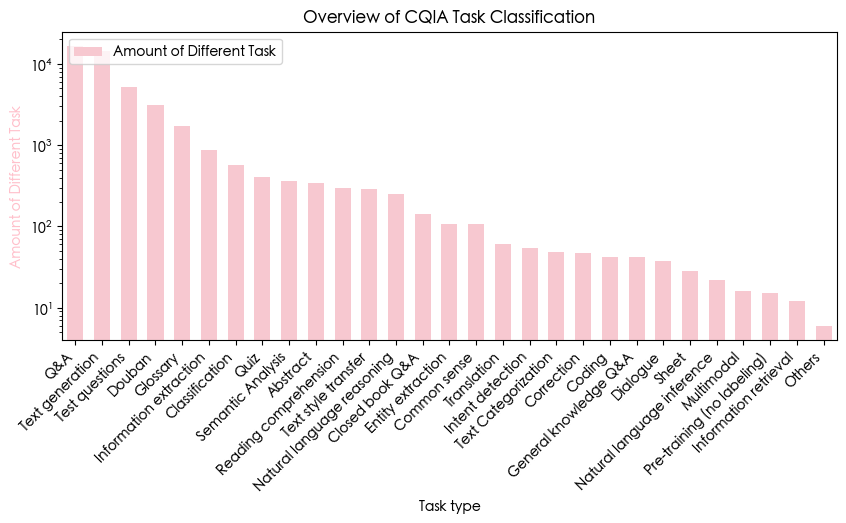
- Curate 48,375 instruction-response pairs from 22 Chinese internet sources across four data types: Social Media, World Knowledge, NLP tasks, and Examinations.
- Apply rigorous manual filtering, restructuring, and review to ensure quality and diversity.
- Evaluate data source impact by fine-tuning language models on CQIA subsets and assessing with model-based and human evaluations.
- Conduct safety and alignment analyses using SafetyBench and human preference studies.
- Compare model performance across tasks (open QA, brainstorming, classification, generation, etc.) and across base model sizes (Yi-6B, Yi-34B, etc.).
Experimental results
Research questions
- RQ1How do data quality and provenance of Chinese instruction data influence LLM fine-tuning performance across diverse tasks?
- RQ2Which Chinese internet data sources most effectively improve instruction-following, knowledge, and safety in fine-tuned models?
- RQ3How does the size of the base model interact with training data quality in terms of performance and safety?
- RQ4What is the relationship between human evaluation and automatic evaluation when assessing Chinese instruction-tuned models?
- RQ5What configurations of data mixtures yield the best overall performance across benchmarks?
Key findings
- Models trained on CQIA subsets excel in generative tasks like brainstorming, generation, and summarization.
- Exam data subset yields best average performance across BELLE-Eval tasks (e.g., Extract, Math).
- Models trained on CQIA-Subset show strong human preference in pairwise evaluations against baselines.
- Yi-6B fine-tuned on CQIA-Subset can outperform larger models on some benchmarks, highlighting data quality effects over sheer size.
- CQIA-Subset models achieve high SafetyBench scores, indicating favorable safety properties relative to baselines.
- Human evaluation shows CQIA-Subset achieves higher preference in real-world Chinese prompts compared to several strong baselines.
Read this paper
Open the full text in the Nubint reader and ask about any passage as you read.
Read this paper on NubintThis review was generated by AI from the original paper. Please check the paper before citing it.