
[Paper Review] Automated Distractor and Feedback Generation for Math Multiple-choice Questions via In-context Learning
This paper proposes an in-context learning approach using large language models (LLMs) to automatically generate plausible distractors and informative feedback messages for math multiple-choice questions. Despite promising results on reference-free metrics, the method faces challenges due to LLMs misinterpreting instructions or copying answers, highlighting limitations in current LLM capabilities for educational feedback generation.
Multiple-choice questions (MCQs) are ubiquitous in almost all levels of education since they are easy to administer, grade, and are a reliable form of assessment. An important aspect of MCQs is the distractors, i.e., incorrect options that are designed to target specific misconceptions or insufficient knowledge among students. To date, the task of crafting high-quality distractors has largely remained a labor-intensive process for teachers and learning content designers, which has limited scalability. In this work, we explore the task of automated distractor and corresponding feedback message generation in math MCQs using large language models. We establish a formulation of these two tasks and propose a simple, in-context learning-based solution. Moreover, we propose generative AI-based metrics for evaluating the quality of the feedback messages. We conduct extensive experiments on these tasks using a real-world MCQ dataset. Our findings suggest that there is a lot of room for improvement in automated distractor and feedback generation; based on these findings, we outline several directions for future work.
Motivation & Objective
- To address the labor-intensive challenge of manually crafting high-quality distractors and feedback for math multiple-choice questions (MCQs).
- To explore the feasibility of using large language models (LLMs) for automated distractor and feedback generation in math MCQs.
- To develop and evaluate novel reference-free metrics using generative LLMs to assess feedback quality, reducing bias from reference-based similarity metrics.
- To identify limitations in current LLM behavior—such as copying answers or misinterpreting feedback instructions—when generating educational feedback.
- To provide a baseline for future work in automated MCQ generation by analyzing performance across multiple prompting strategies and evaluation methods.
Proposed method
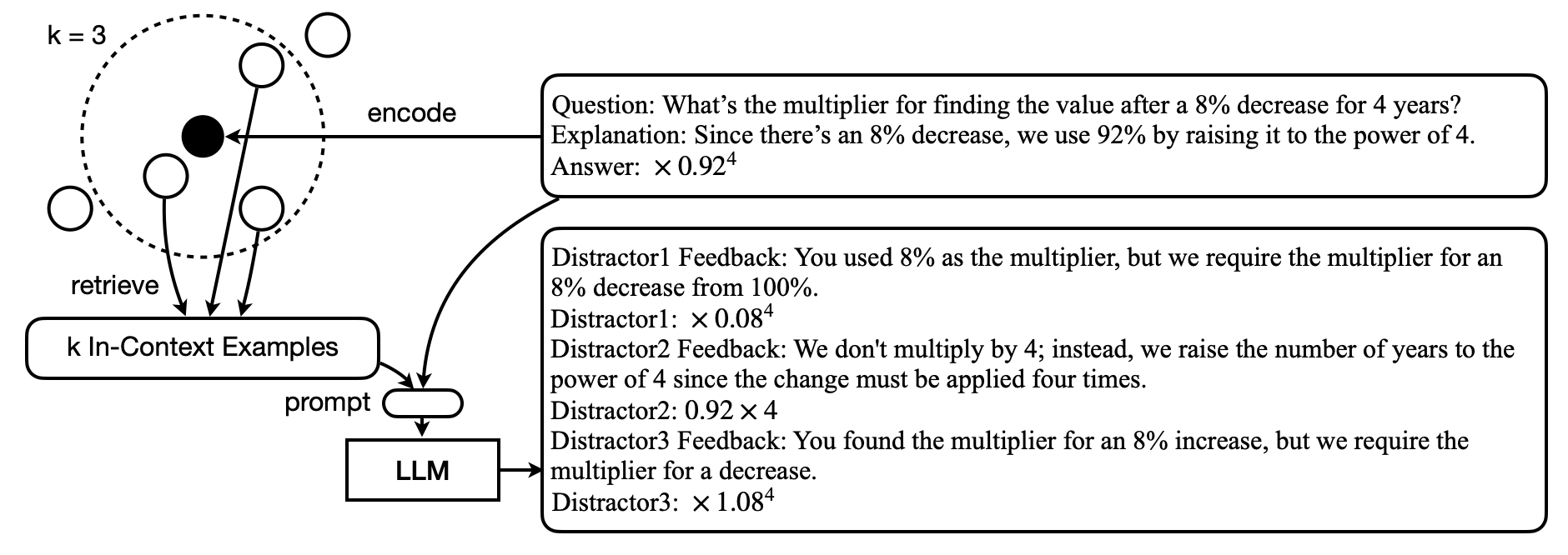
- Employ few-shot in-context learning with in-context examples selected based on semantic similarity (using sentence embeddings) to the target question.
- Formulate distractor generation as a conditional generation task: given a stem and key, generate plausible incorrect options aligned with common misconceptions.
- Formulate feedback generation as a conditional task: given a stem and a specific distractor, generate a feedback message that explains the error and guides the student toward the correct answer.
- Introduce two novel reference-free evaluation metrics—Adj. Pred. and Dist. Pred.—that use a generative LLM to judge the helpfulness and informativeness of feedback without relying on ground-truth references.
- Use both reference-based metrics (e.g., BLEU, ROUGE) and the new reference-free metrics to evaluate feedback quality across different prompting methods.
- Conduct qualitative and quantitative analysis on a real-world math MCQ dataset with student response statistics to assess method performance and error patterns.
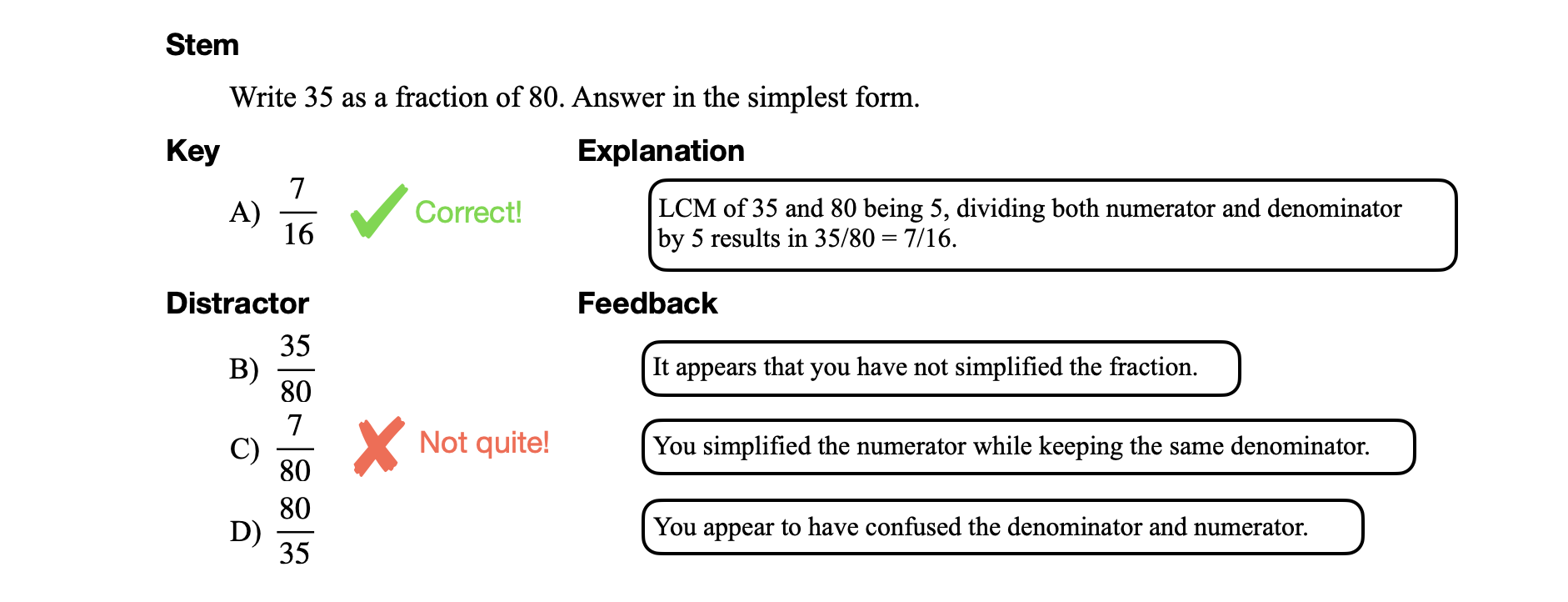
Experimental results
Research questions
- RQ1Can in-context learning with LLMs effectively generate plausible distractors for math MCQs that reflect common student misconceptions?
- RQ2Can LLMs generate feedback messages that are both informative and helpful in correcting student errors, without copying the correct answer or distractor?
- RQ3How do reference-free LLM-based metrics compare to standard reference-based metrics in evaluating feedback quality, and do they reduce bias toward ground-truth style?
- RQ4What are the primary failure modes of LLMs in feedback generation, such as misinterpreting instructions or generating unhelpful content, and how do they affect evaluation?
- RQ5How does the performance of different prompting strategies (e.g., zero-shot, few-shot with kNN, few-shot with random examples) compare on both reference-based and reference-free evaluation metrics?
Key findings
- The kNN-based in-context learning method (kNN^one) outperformed other prompting strategies on reference-free metrics, suggesting it better captures the style and structure of high-quality feedback.
- Zero-shot prompting achieved the highest scores on reference-based metrics, likely due to its tendency to copy the style of ground-truth feedback, but it often included the correct answer or distractor in the feedback, reducing its educational value.
- Reference-free metrics showed much closer performance across methods compared to reference-based metrics, indicating that the latter are biased toward stylistic similarity rather than actual helpfulness.
- The ground-truth feedback outperformed all generated feedback on reference-free metrics, but the gap was smaller than expected, suggesting that LLM-generated feedback can be reasonably effective despite limitations.
- False negatives were common due to LLMs misinterpreting feedback instructions or ignoring context (e.g., when questions frame options as a set), while false positives occurred when LLMs solved the problem independently despite unhelpful feedback.
- The study reveals that current LLMs, even advanced ones like GPT-4, struggle with consistent instruction following and error-specific feedback generation, indicating a need for improved prompt engineering or fine-tuning.
Read this paper
Open the full text in the Nubint reader and ask about any passage as you read.
Read this paper on NubintThis review was generated by AI from the original paper. Please check the paper before citing it.