
[Paper Review] Collectively-modified inter-molecular electron correlations: The connection of polaritonic chemistry and spin glass physics
This focus review maps the dressed electronic-structure problem under collective vibrational strong coupling to the Sherrington-Kirkpatrick spin-glass model, revealing a polarization glass and potential phase-transition-like behavior that links polaritonic chemistry with spin-glass physics.
Polaritonic chemistry has garnered increasing attention in recent years due to pioneering experimental results, which show that site- and bond-selective chemistry at room temperature is achievable through strong collective coupling to field fluctuations in optical cavities. Despite these notable experimental strides, the underlying theoretical mechanisms remain unclear. In this focus review, we highlight a fundamental theoretical link between the seemingly unrelated fields of polaritonic chemistry and spin glasses, exploring its profound implications for the theoretical framework of polaritonic chemistry. Specifically, we present a mapping of the dressed many-molecules electronic-structure problem under collective vibrational strong coupling to the spherical Sherrington-Kirkpatrick (SSK) model of a spin glass. This mapping uncovers a collectively induced instability of the intermolecular electron correlations, which could provide the long sought-after seed for significant local chemical modifications in polaritonic chemistry. Overall, the qualitative predictions made from the SSK model (e.g., dispersion effects, phase transitions, differently modified bulk and rare event properties, heating,...) agree well with available experimental observations. Our connection paves the way to incorporate, adjust and probe numerous spin glass concepts in polaritonic chemistry, such as modified fluctuation-dissipation relations, (non-equilibrium) aging dynamics, time-reversal symmetry breaking or stochastic resonances. Ultimately, the connection also offers fresh insights into the applicability of spin glass theory beyond condensed matter systems suggesting novel theoretical directions such as spin glasses with explicitly time-dependent (random) interactions.
Motivation & Objective
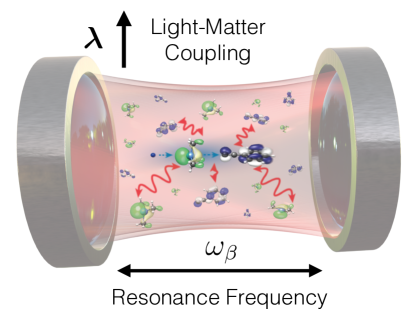
- Motivate how light-matter coupling in optical cavities can induce collective, nonlocal effects on molecular electronic structure.
- Propose a theoretical link between polaritonic chemistry and spin-glass physics via a mapping to the Sherrington-Kirkpatrick model.
- Identify the emergence of frustration, polarization patterns, and potential phase transitions under collective coupling.
- Discuss how spin-glass concepts like frustration, aging dynamics, and stochastic resonances can illuminate polaritonic chemistry mechanisms.
Proposed method
- Use Pauli-Fierz ab initio theory in the long-wavelength, few-mode approximation to describe ensemble-cavity coupling.
- Formulate the dressed electronic problem under cavity coupling with the cavity Born-Oppenheimer approximation for nuclei and displacement field.
- Derive N coupled cavity Hartree equations (cH) for the electronic part with an all-to-all interaction term from the X and x dipole couplings.
- Analyze the system using a Shin-Metiu one-dimensional model to demonstrate collective strong coupling and self-consistent polarization patterns.
- Map the cH equations onto the Sherrington-Kirkpatrick spin-glass model to reveal a polarization-glass instability and discuss its implications.
Experimental results
Research questions
- RQ1Can collective vibrational strong coupling in an optical cavity drive collective electronic effects that feed back on individual molecules?
- RQ2How can the dressed electronic-structure problem under VSC be related to spin-glass physics, and what are the resulting implications for polarization ordering and frustration?
- RQ3Do polarization patterns under VSC resemble spin-glass phenomena such as replica symmetry breaking, aging, or stochastic resonances?
- RQ4What experimental signatures (e.g., NMR observations) support the polarization-glass picture and possible cavity-induced phase transitions?
- RQ5What theoretical directions arise from interpreting polaritonic chemistry through spin-glass concepts?
Key findings
- Under collective VSC, molecular polarizations couple through a quadratic, all-to-all term leading to nonlocal feedback on individual molecules.
- Local molecular polarizations survive in the thermodynamic limit while the macroscopic polarization vanishes, indicating polarization-glass ordering.
- Numerical simulations with Shin-Metiu models show finite local polarization patterns and a rough, almost discontinuous distribution of polarization, consistent with frustration.
- There is evidence of a phase-transition-like instability where self-consistent cavity-Hartree solutions fail to converge at higher collective couplings.
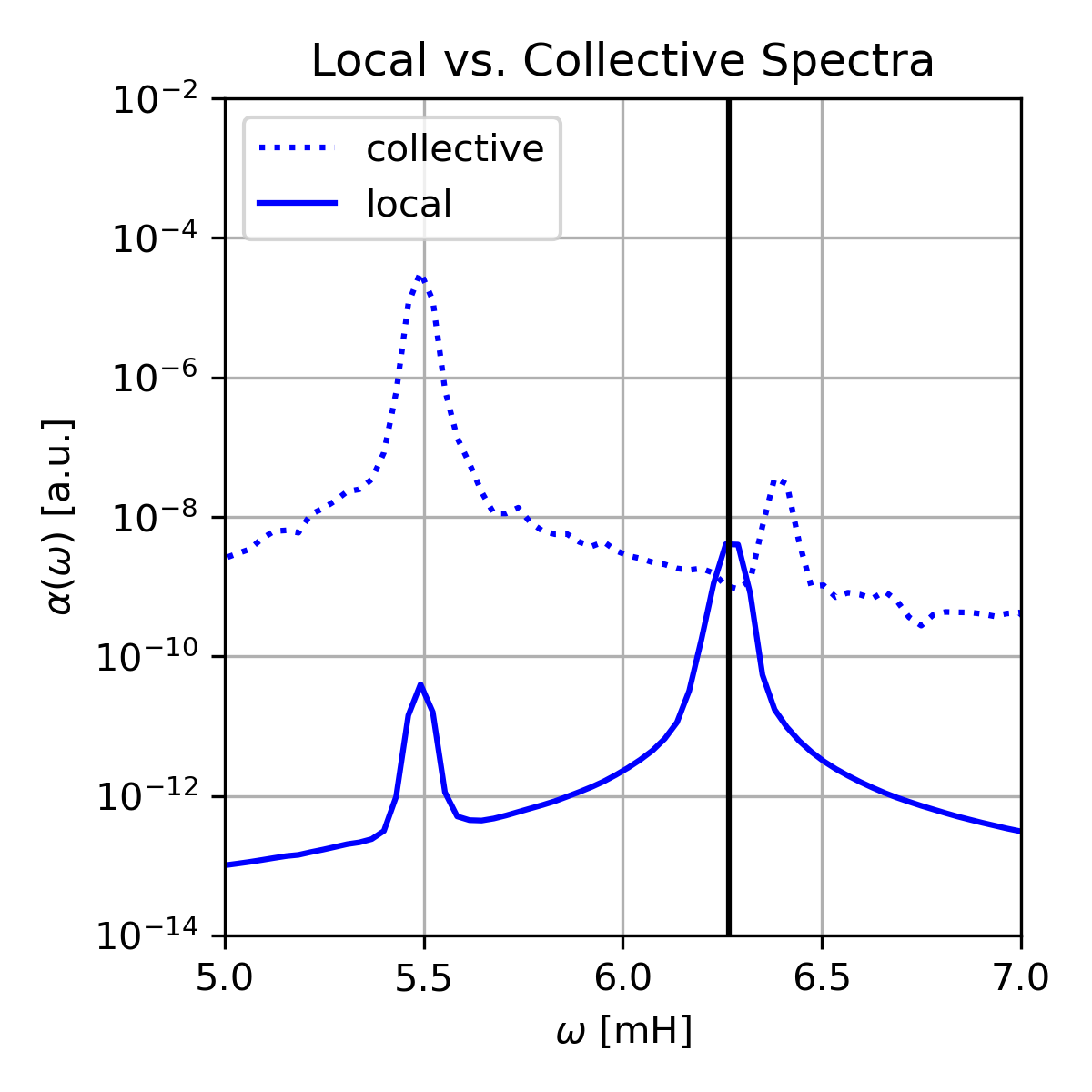
- NMR experiments under VSC show absence of average chemical shifts but altered broadening and a resonance-dependent change in conformational equilibria, aligning with a polarization-glass picture.
- The explicit mapping to the SK spin-glass model provides a framework to apply spin-glass concepts (frustration, aging, stochastic resonance) to polaritonic chemistry.
- The work suggests new theoretical directions such as polarization glasses with time-dependent order parameters and broader applicability of spin-glass theory beyond condensed matter.
Read this paper
Open the full text in the Nubint reader and ask about any passage as you read.
Read this paper on NubintThis review was generated by AI from the original paper. Please check the paper before citing it.