
[Paper Review] Colloquium: Gravitational Form Factors of the Proton
This colloquium reviews the theoretical and experimental advances in measuring the gravitational form factors (GFFs) of the proton, which encode its mechanical properties such as mass, spin, and internal forces. Using deeply virtual Compton scattering and lattice QCD, the study provides the first experimental extraction of the proton's D-term, revealing a peak pressure of ~10^35 Pa—30 orders of magnitude above Earth's atmosphere and exceeding neutron star core pressure.
The physics of the gravitational form factors of the proton, and their understanding within quantum chromodynamics, has advanced significantly in the past two decades through both theory and experiment. This Colloquium provides an overview of this progress, highlights the physical insights unveiled by studies of gravitational form factors, and reviews their interpretation in terms of the mechanical properties of the proton.
Motivation & Objective
- To synthesize recent theoretical and experimental progress in understanding the gravitational form factors (GFFs) of the proton within quantum chromodynamics (QCD).
- To clarify the physical interpretation of GFFs in terms of the proton’s mechanical properties, including mass, spin, and internal stress distributions.
- To review experimental techniques—especially deeply virtual Compton scattering (DVCS)—that enable the measurement of GFFs.
- To present the first experimental extraction of the proton’s D-term, a key GFF related to mechanical forces and pressure within the proton.
- To highlight the implications of these results for understanding the origin of nucleon mass and the equation of state of subatomic matter.
Proposed method
- Theoretical framework based on the energy-momentum tensor (EMT) and generalized parton distributions (GPDs) to define gravitational form factors (GFFs) in QCD.
- Use of dispersion relations and QCD sum rules to constrain GFFs and derive model-independent limits.
- Application of lattice QCD simulations to compute GFFs from first principles in a non-perturbative QCD setting.
- Analysis of deeply virtual Compton scattering (DVCS) processes in electron-proton and electron-positron scattering to extract real and imaginary parts of Compton form factors.
- Utilization of beam spin asymmetries (BSA) and charge asymmetries in e+e− and e−p collisions to access the real part of the GFF H(t).
- Combining data from Jefferson Lab (JLab) and future Electron-Ion Collider (EIC) projects to extend kinematic reach and improve luminosity for GFF measurements.
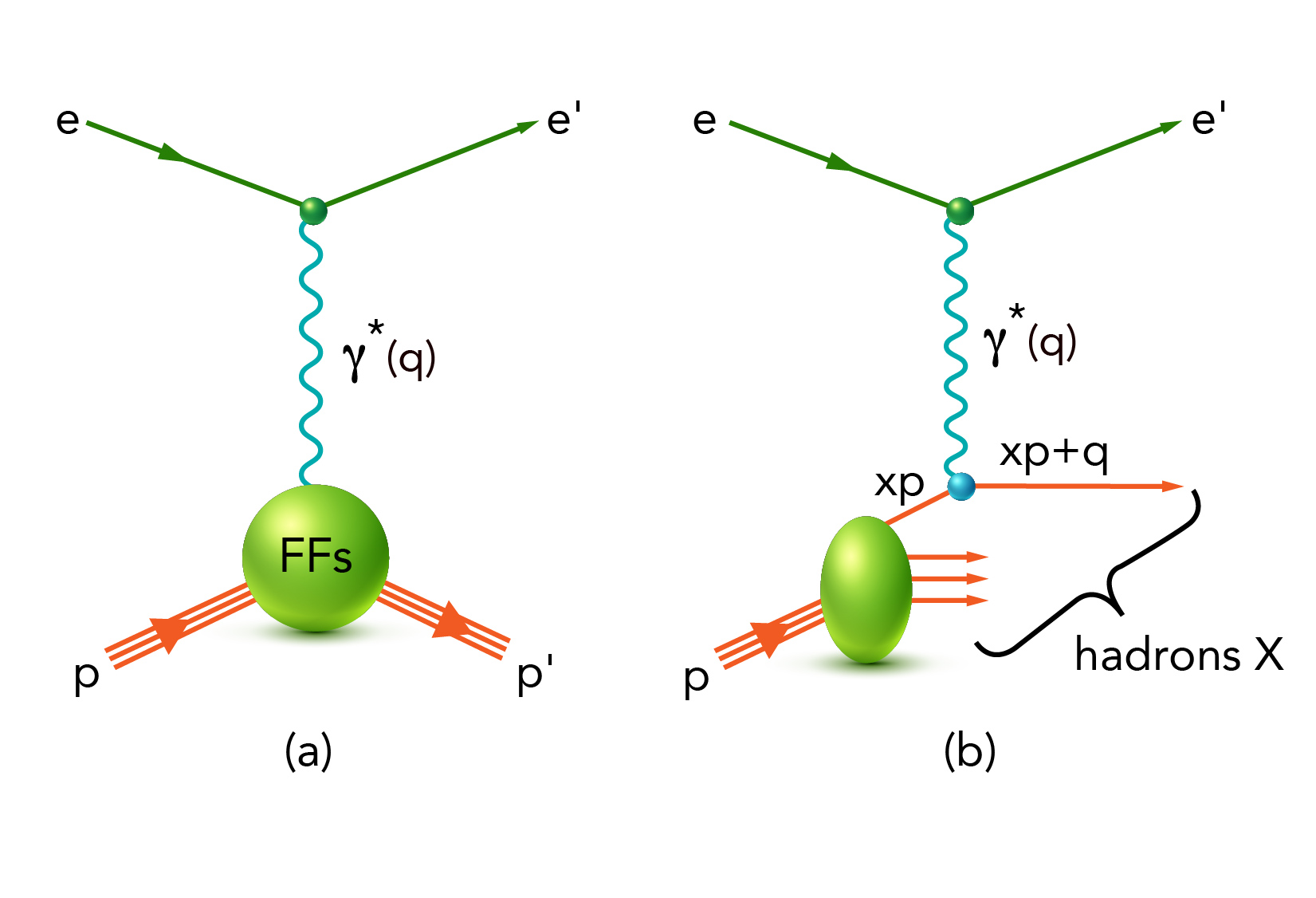
Experimental results
Research questions
- RQ1How do gravitational form factors (GFFs) of the proton encode its mechanical properties such as mass, spin, and internal forces?
- RQ2What is the physical origin of the D-term in the proton’s energy-momentum tensor, and how does it relate to internal pressure and stress distributions?
- RQ3How can the first experimental extraction of the D-term be achieved using deeply virtual Compton scattering (DVCS) and related processes?
- RQ4What is the magnitude and spatial distribution of the internal pressure within the proton, and how does it compare to macroscopic astrophysical objects?
- RQ5How do lattice QCD and model studies constrain the behavior of GFFs, and what do they reveal about the proton’s structure beyond the parton model?
Key findings
- The first experimental extraction of the proton’s D-term was achieved using DVCS data, providing direct access to the mechanical structure of the proton.
- The D-term is found to be negative, indicating a repulsive internal force that contributes to the proton’s mechanical stability and spatial confinement.
- The peak pressure inside the proton is estimated at approximately 10^35 Pascal, exceeding the pressure in neutron star cores by a factor of ~6.
- The mechanical radius of the proton is found to be consistent with the charge radius, indicating a strong correlation between electromagnetic and mechanical structure.
- The real part of the gravitational form factor H(t) was extracted via charge asymmetry measurements in e+e− and e−p scattering, confirming theoretical predictions.
- Future experiments at the Electron-Ion Collider (EIC) in the US and China will extend the kinematic reach and improve precision for GFF measurements, especially in the gluon-dominated regime.
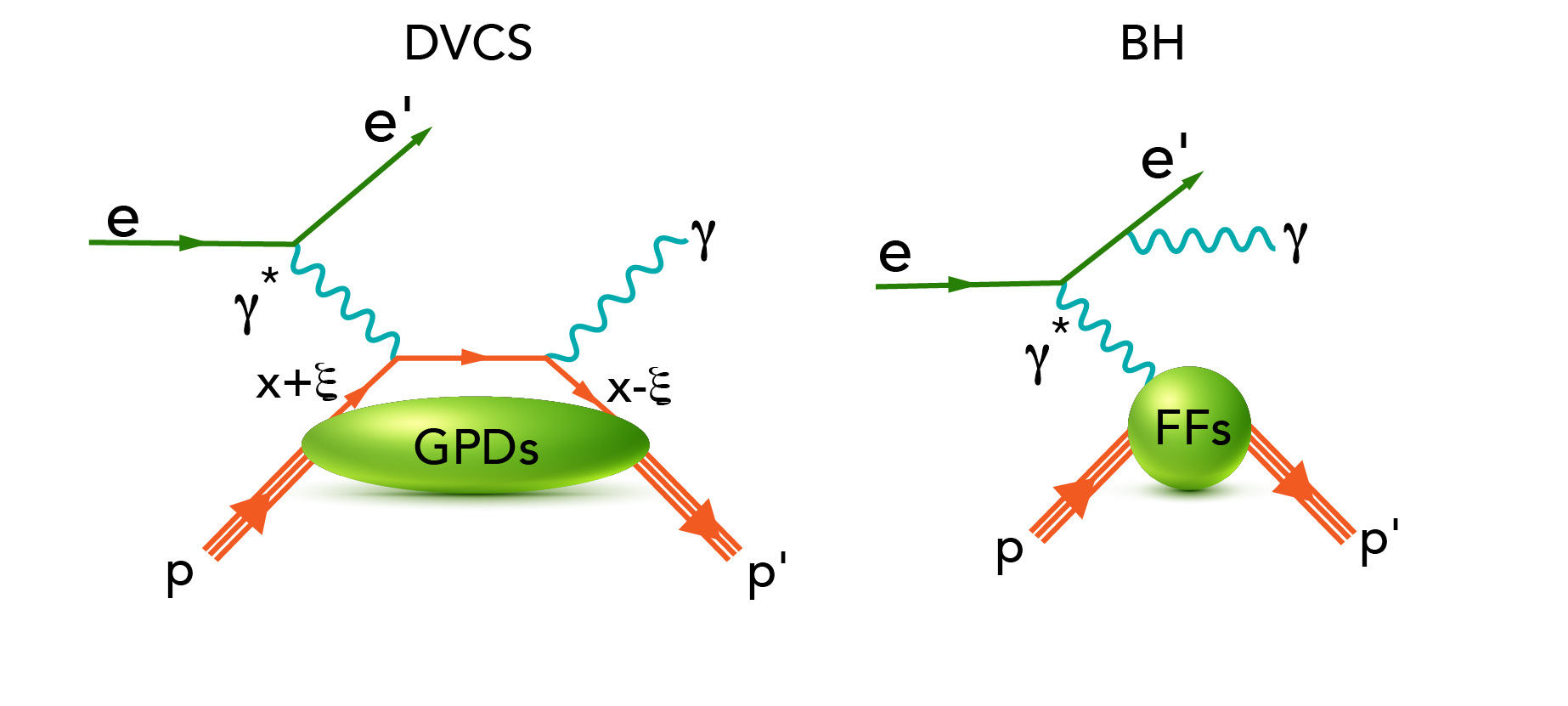
Read this paper
Open the full text in the Nubint reader and ask about any passage as you read.
Read this paper on NubintThis review was generated by AI from the original paper. Please check the paper before citing it.