
[Paper Review] Confronting primordial black holes with LIGO-Virgo-KAGRA and the Einstein Telescope
The paper uses a Bayesian population analysis of LVK GWTC-3 to constrain primordial black holes (PBHs) as dark matter and BH merger progenitors, finding f_PBH ~ 10^-3 and that PBHs cannot dominate CDM, while exploring ABH+PBH mixtures and ET-era predictions.
The detection of gravitational waves (GWs) from binary black hole (BBH) coalescences by the LIGO-Virgo-KAGRA (LVK) Collaboration has raised fundamental questions about the genesis of these events. In this chapter, we explore the possibility that PBHs, proposed candidates for dark matter, may serve as the progenitors of the BBHs observed by LVK. Employing a Bayesian analysis, we constrain the PBH model using the LVK third GW Transient Catalog (GWTC-3), revealing that stellar-mass PBHs cannot dominate cold dark matter. Considering a mixed population of astrophysical black holes (ABHs) and PBHs, we determine that approximately $1/4$ of the detectable events in the GWTC-3 can be attributed to PBH binaries. We also forecast detectable event rate distributions for PBH and ABH binaries by the third-generation ground-based GW detectors, such as the Einstein Telescope, offering a potential avenue to distinguish PBHs from ABHs based on their distinct redshift evolutions.
Motivation & Objective
- Assess whether stellar-mass PBHs can constitute the majority of cold dark matter.
- Infer PBH population parameters under several PBH mass functions using GWTC-3 data.
- Evaluate a mixed ABH+PBH population and quantify the PBH contribution to LVK events.
- Forecast PBH/ABH merger-rate distributions for third-generation detectors like the Einstein Telescope.
Proposed method
- Model PBH merger rate density for early-Universe PBH binaries using Eq. (3).
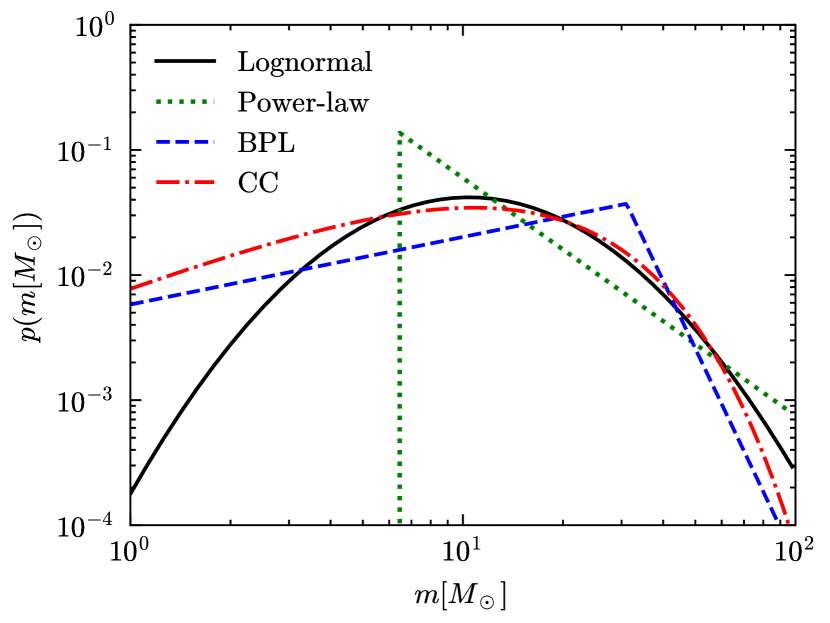
- Consider four PBH mass functions: lognormal, power-law, broken power-law, and critical collapse.
- Use hierarchical Bayesian inference with a population likelihood and detector-selection corrections (Eq. 11-14).
- Convert source-frame rates to detector-frame via R_pop(θ|Λ) = (1+z)^{-1} (dV_c/dz) R(t, m1, m2|Λ).
- Sample hyperparameters with dynesty through the ICAROGW framework to obtain posteriors and evidences (Bayes factors).
- Incorporate GWTC-3 events (69 usable events) with priors for PBH fraction f_PBH and mass-function parameters (Table 2).
Experimental results
Research questions
- RQ1What upper bound on the PBH fraction f_PBH in CDM is allowed by the LVK GWTC-3 BBH data?
- RQ2Which PBH mass-function form best fits the LVK BBH observations among the considered four forms?
- RQ3Does a mixed ABH+PBH population provide a better description of the data than a purely ABH or purely PBH model?
- RQ4What are the predicted PBH/ABH merger-rate evolutions at higher redshift for future detectors like the Einstein Telescope?
Key findings
- PBH abundance in CDM is constrained to be of order 10^-3 across all four mass functions.
- For lognormal, M_c ≈ 17.3 M_sun, σ ≈ 0.71, f_PBH ≈ 1.8×10^-3, with local merger rate R(t0) ≈ 41 Gpc^-3 yr^-1.
- For power-law, M_min ≈ 6.5 M_sun, α ≈ 1.9, f_PBH ≈ 2.3×10^-3, R(t0) ≈ 48 Gpc^-3 yr^-1.
- For broken power-law, m_* ≈ 31 M_sun, α1 ≈ 0.54, α2 ≈ 5.6, f_PBH ≈ 0.9×10^-3, R(t0) ≈ 46 Gpc^-3 yr^-1.
- For critical collapse, M_f ≈ 10.8 M_sun, α ≈ 1.0, f_PBH ≈ 1.5×10^-3, R(t0) ≈ 49 Gpc^-3 yr^-1.
- Across all models, f_PBH remains below 3×10^-3, supporting PBHs as a subdominant component of CDM; a mixed ABH+PBH population can explain features not easily captured by ABHs alone.
- PBH mass-function preference from Bayes factors suggests lognormal provides the best fit among the four, but none capture the full observed mass distribution well.
Read this paper
Open the full text in the Nubint reader and ask about any passage as you read.
Read this paper on NubintThis review was generated by AI from the original paper. Please check the paper before citing it.