
[Paper Review] Constraints on parity and Lorentz violations in gravity from GWTC-3 through a parametrization of modified gravitational wave propagations
The paper introduces a universal parametrization for modified gravitational-wave propagation and uses GWTC-3 data to constrain parity/Lorentz violations, finding no signatures and deriving the strongest bounds to date on several parameters, including the first bound on Lorentz-violating damping.
Gravitational wave (GW) observations provide sensitive tests of parity and Lorentz symmetries of gravity. Any violation of these fundamental symmetries induces possible deviations in the GW propagations. Through a systematic parametrization for characterizing possible derivations from GW propagations in general relativity, we construct the modified GW waveforms generated by the coalescence of compact binaries with the effects of the parity and Lorentz violations as predicted by many parity- and Lorentz-violating gravities and then analyze them with the open data of compact binary merging events detected by LIGO-Virgo-KAGRA Collaboration. No signature of gravitational parity and Lorentz violations are found for most GW events, thereby allowing us to place several of the most stringent constraints on parity and Lorentz violations in gravity and a first constraint on the Lorentz-violating damping effect in GW.
Motivation & Objective
- Motivate a model-independent way to test modifications of GW propagation across many gravity theories.
- Develop a universal four-parameter framework (bar-nu, bar-mu, nu_A, mu_A) to capture GR deviations in GW propagation.
- Construct modified GW waveforms including parity/Lorentz violations and compare with GWTC-3 data.
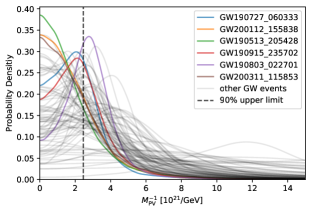
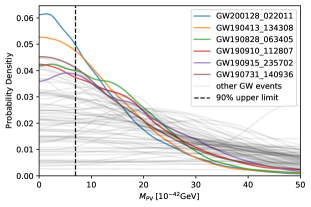
- Derive constraints on parity/Lorentz-violating scales M_PV and M_LV from Bayesian analysis of multiple GW events.
Proposed method
- Propose a parametrized GW propagation equation h''_A + (2 + bar-nu + nu_A) H h'_A + (1 + bar-mu + mu_A) k^2 h_A = 0.
- Decompose into circular polarizations and express parity-violating amplitudes and phases via delta h_1, delta Psi_1 with beta_nu, beta_mu and A_nu, A_mu.
- Model Lorentz-violating damping/dispersion with beta_bar_nu, beta_bar_mu and A_bar_nu, A_bar_mu and relate to M_PV and M_LV.
- Construct modified waveforms tilde{h}_A(f) = tilde{h}_A^{GR}(f) e^{rho_A delta h_1 + delta h_2} e^{i(rho_A delta Psi_1 + delta Psi_2)}.
- Perform Bayesian inference on GWTC-3 events using Bilby/Dynesty with various templates to obtain posteriors for A_nu, A_mu, A_bar_nu, A_bar_mu and translate to M_PV, M_LV.
Experimental results
Research questions
- RQ1Do parity-violating parameters (amplitude and velocity birefringence) leave detectable imprints in GW propagation within current GWTC-3 data?
- RQ2Do Lorentz-violating damping/dispersion effects produce measurable frequency-dependent signatures in observed GW signals?
- RQ3What are the most stringent bounds on the parity-violating scale M_PV and the Lorentz-violating scale M_LV obtainable from GWTC-3?
- RQ4Can a universal parametrization coherently compare a wide class of modified gravity theories with GW observations?
Key findings
- No significant evidence for gravitational parity/Lorentz violations in GWTC-3 data across tested cases.
- Combined 90% bounds on M_PV and M_LV improve or match previous results, with the strongest constraints for certain beta choices (e.g., beta_nu=1, beta_mu=3, beta_bar_mu=4).
- First bound on Lorentz-violating damping (beta_bar_nu=2) derived from GW data.
- Results provide the most comprehensive constraints on modified GW propagations to date for the explored parameter space.
- Constraints allow translating to bounds on couplings in a wide range of modified gravity theories.
Read this paper
Open the full text in the Nubint reader and ask about any passage as you read.
Read this paper on NubintThis review was generated by AI from the original paper. Please check the paper before citing it.