
[Paper Review] Current and future directions in network biology
This paper synthesizes insights from the 2022 Workshop on Future Directions in Network Biology, identifying key computational and algorithmic challenges in modeling biological networks. It proposes advancing multimodal data integration, higher-order network analysis, machine learning on graphs, and network-based personalized medicine, while emphasizing equity, diversity, and inclusion in computational biology research.
Network biology is an interdisciplinary field bridging computational and biological sciences that has proved pivotal in advancing the understanding of cellular functions and diseases across biological systems and scales. Although the field has been around for two decades, it remains nascent. It has witnessed rapid evolution, accompanied by emerging challenges. These challenges stem from various factors, notably the growing complexity and volume of data together with the increased diversity of data types describing different tiers of biological organization. We discuss prevailing research directions in network biology and highlight areas of inference and comparison of biological networks, multimodal data integration and heterogeneous networks, higher-order network analysis, machine learning on networks, and network-based personalized medicine. Following the overview of recent breakthroughs across these five areas, we offer a perspective on the future directions of network biology. Additionally, we offer insights into scientific communities, educational initiatives, and the importance of fostering diversity within the field. This paper establishes a roadmap for an immediate and long-term vision for network biology.
Motivation & Objective
- To identify pressing computational and algorithmic challenges in network biology driven by increasing data complexity and scale.
- To guide the future research direction of network biology by synthesizing discussions from a multidisciplinary workshop.
- To promote equitable, diverse, and inclusive practices in computational biology, especially in nomination and leadership pipelines.
- To advance the integration of multimodal biological data into heterogeneous and dynamic network models.
- To establish a long-term vision for network biology that supports personalized medicine and systems-level understanding of disease.
Proposed method
- Conducted a workshop at the University of Notre Dame (2022) with leading researchers in computational and algorithmic network biology.
- Synthesized discussion outcomes into a consensus paper co-authored by workshop participants, representing diverse subfields and career stages.
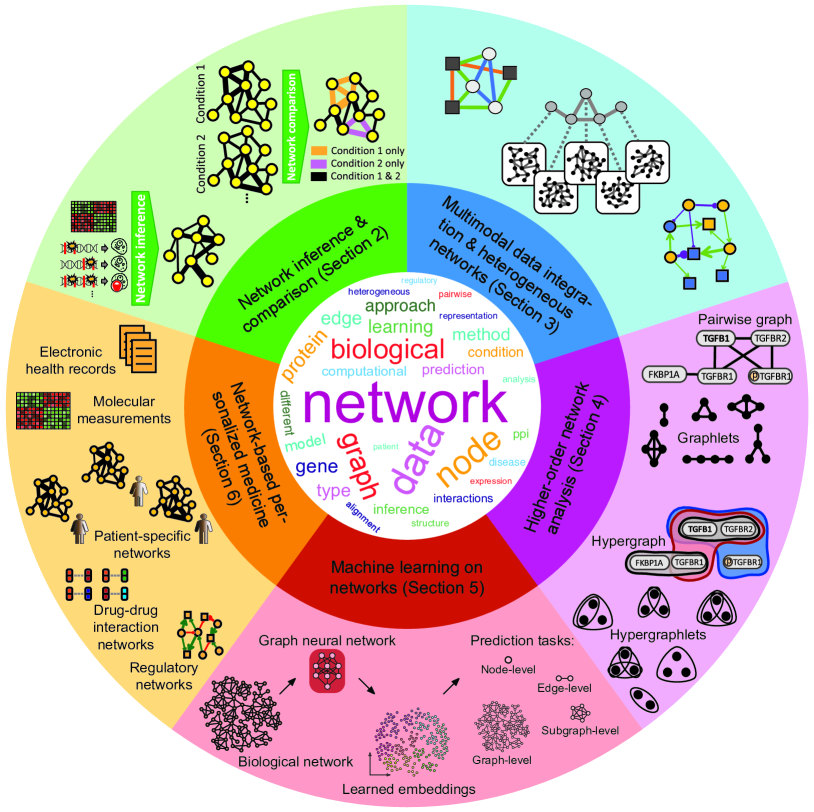
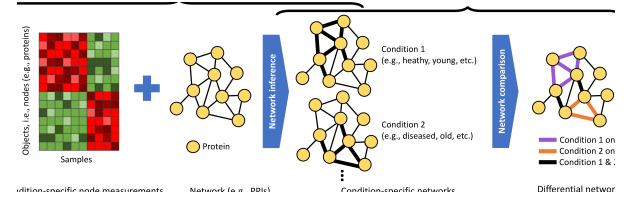
- Categorized key research directions into five core themes: inference and comparison of biological networks, multimodal data integration, higher-order network analysis, machine learning on networks, and network-based personalized medicine.
- Evaluated diversity and inclusion (EDI) metrics in the International Society for Computational Biology (ISCB), using publicly available data to assess representation gaps.
- Proposed strategies to reduce bias in nomination processes and improve access to conferences for researchers from underrepresented and low-income regions.
- Advocated for systemic, funded initiatives by institutions and professional societies to embed equity into research infrastructure and training.
Experimental results
Research questions
- RQ1What are the most pressing computational and algorithmic challenges in network biology given the rise of multi-omics and heterogeneous data?
- RQ2How can machine learning models on biological networks be made more interpretable, generalizable, and scalable to complex systems?
- RQ3What are the key barriers to equitable participation in computational biology, particularly in leadership and recognition roles?
- RQ4How can network biology evolve to support precision medicine through dynamic, condition-aware, and multimodal network models?
- RQ5What institutional and cultural changes are needed to achieve diversity in computational biology that reflects the broader population?
Key findings
- The field of network biology faces accelerating challenges due to increasing data complexity, size, and heterogeneity across biological scales.
- Multimodal data integration and higher-order network analysis (e.g., hypergraphs, motifs) are emerging as critical frontiers for modeling complex biological systems.
- Machine learning on networks, especially graph neural networks and large language models, show strong potential but require improved interpretability and robustness.
- EDI disparities persist in nomination pipelines, with only 22–28% of nominees for major ISCB awards being female, despite 32.8% of ISCB membership being female.
- The field is more gender-diverse in biology-focused subfields than in computationally focused ones, suggesting recruitment from biology backgrounds could improve diversity.
- Systematic, funded initiatives are essential to address gatekeeping barriers and ensure equitable access to conferences, funding, and leadership roles in computational biology.
Read this paper
Open the full text in the Nubint reader and ask about any passage as you read.
Read this paper on NubintThis review was generated by AI from the original paper. Please check the paper before citing it.