
[Paper Review] Data for: Intervalley coherence and intrinsic spin-orbit coupling in rhombohedral trilayer graphene
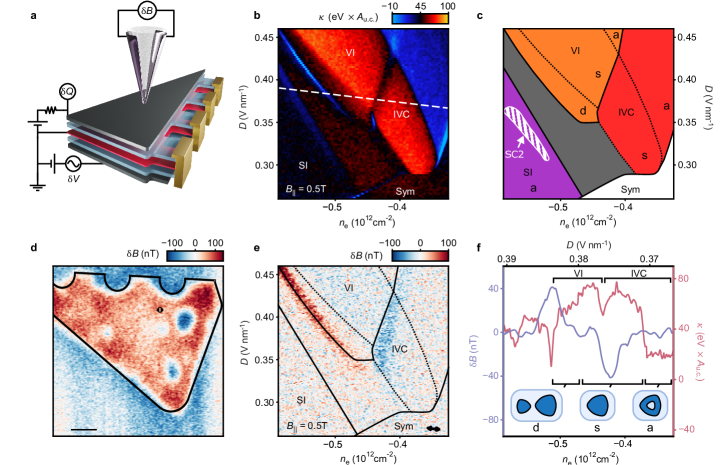
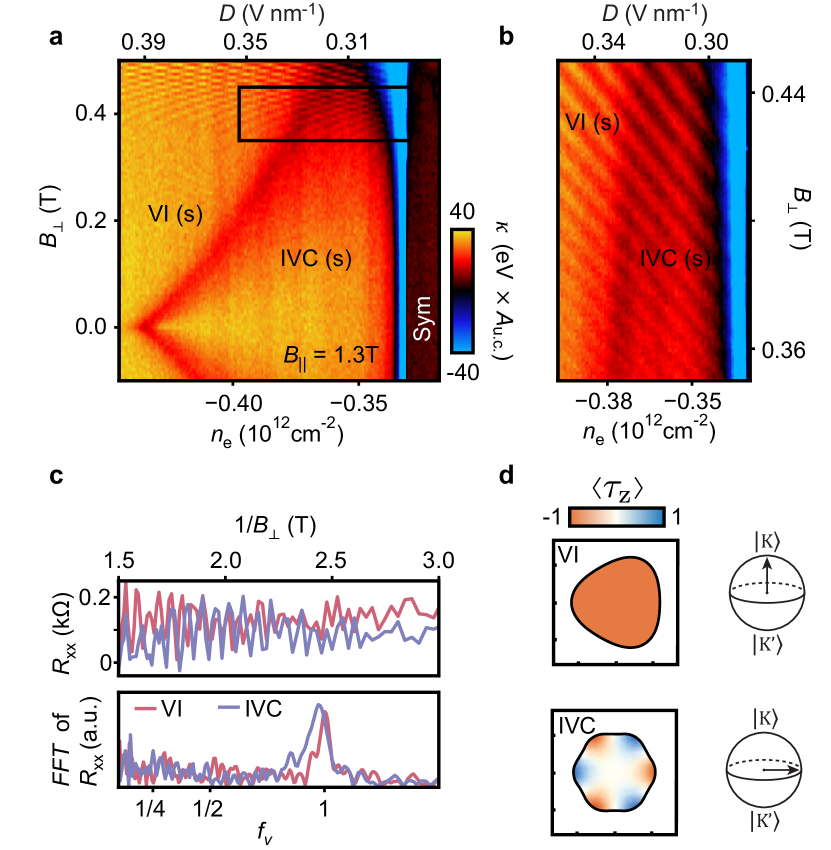
This study investigates intervalley coherence (IVC) and intrinsic spin-orbit coupling (SOC) in rhombohedral trilayer graphene using electronic compressibility and local SQUID magnetometry. It reveals a competition between valley-imbalanced (VI) and IVC states, with SOC suppressing in-plane magnetic susceptibility in the VI phase, enabling extraction of a spin-orbit coupling strength of λ ≈ 50 μeV, and identifying a hybrid VI-IVC phase driven by SOC.
Data files and data fitting code for manuscript "Intervalley coherence and intrinsic spin-orbit coupling in rhombohedral trilayer graphene." Analysis files Figure3.ipynb and Extracting_lambda.ipynb generate processed data for Fig 3 and extract values of lambda (spin orbit coupling strength) respectively.
Motivation & Objective
- To resolve the role of intrinsic spin-orbit coupling in stabilizing correlated phases in rhombohedral trilayer graphene.
- To map the phase diagram of rhombohedral trilayer graphene in the quarter metal regime with high spatial and field resolution.
- To distinguish between valley-imbalanced (VI) and intervalley coherent (IVC) states using local magnetic response and compressibility.
- To experimentally determine the strength of intrinsic spin-orbit coupling in hexagonal boron nitride-encapsulated trilayer graphene.
Proposed method
- Electronic compressibility is measured via bottom-gate modulation and top-gate charge detection to map the inverse compressibility κ as a function of carrier density and displacement field.
- Local magnetic response is probed using a scanning SQUID magnetometer with kHz-frequency excitation on the bottom gate to detect phase transitions.
- Phase boundaries are identified by fitting compressibility peaks to Gaussian functions to extract transition densities n*.
- The spin-orbit coupling strength λ is extracted by fitting the field dependence of n* to a functional form involving λ, g-factor, and μB, with uncertainty quantified across multiple fit ranges.
- The in-plane magnetic susceptibility is compared between VI and IVC phases to isolate SOC effects.
- Systematic errors in μ and Δm are assessed by integrating compressibility data and assuming constant Δμ over the transition region.
Experimental results
Research questions
- RQ1What is the role of intrinsic spin-orbit coupling in stabilizing or suppressing specific correlated phases in rhombohedral trilayer graphene?
- RQ2How do intervalley coherent (IVC) and valley-imbalanced (VI) states compete in the phase diagram of trilayer graphene under in-plane magnetic fields?
- RQ3What is the experimentally determined strength of intrinsic spin-orbit coupling in hBN-encapsulated rhombohedral trilayer graphene?
- RQ4How does spin-orbit coupling influence the in-plane magnetic susceptibility of the VI phase?
- RQ5What is the nature of the hybrid phase with both VI and IVC character, and how is it stabilized by SOC?
Key findings
- The intrinsic spin-orbit coupling strength in the system is measured to be λ ≈ 50 μeV, with a range of 30–65 μeV across four transitions.
- Spin-orbit coupling suppresses the in-plane magnetic susceptibility of the VI phase, enabling its experimental extraction.
- A hybrid phase with mixed VI and IVC character is identified, driven by the interplay of spin-orbit coupling and electron correlations.
- The phase diagram reveals a subtle competition between IVC and VI states, with IVC dominating at low fields and VI emerging at higher in-plane fields.
- The measured field dependence of the transition density n* is consistent with a model involving spin-orbit coupling and Zeeman splitting, with λ extracted from fitting.
- Systematic errors in μ and Δm are found to be field-independent, supporting the reliability of the extracted λ and Δm values.
Read this paper
Open the full text in the Nubint reader and ask about any passage as you read.
Read this paper on NubintThis review was generated by AI from the original paper. Please check the paper before citing it.