
QUICK REVIEW
[Paper Review] DESI 2024 III: Baryon Acoustic Oscillations from Galaxies and Quasars
DESI Collaboration, A. G. Adame|arXiv (Cornell University)|Apr 3, 2024
TL;DR
DESI 2024 III presents BAO measurements from galaxies and quasars using DESI DR1 data, achieving sub-percent precision across six redshift bins and revealing BAO in all bins.
ABSTRACT
We present the DESI 2024 galaxy and quasar baryon acoustic oscillations (BAO) measurements using over 5.7 million unique galaxy and quasar redshifts in the range 0.1
Motivation & Objective
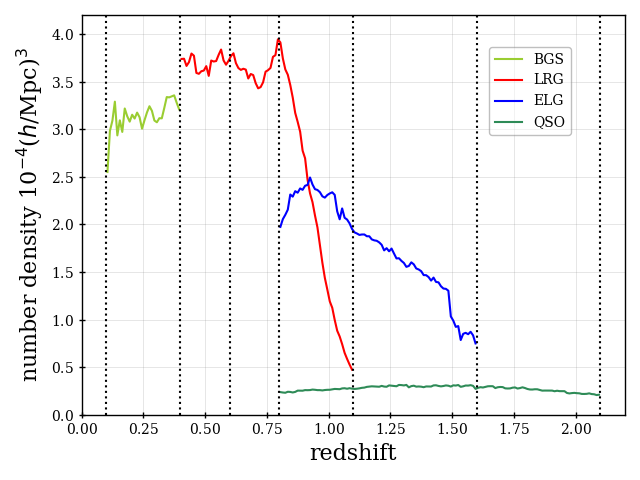
- Measure BAO signals from multiple DESI tracers (BGS, LRGs, ELGs, QSOs) in DR1 over 0.1 < z < 2.1.
- Develop and validate a unified BAO analysis pipeline across tracers.
- Quantify systematics with mocks and blinded catalogs to achieve robust BAO distance constraints.
- Re-analyze SDSS BOSS/eBOSS results with the improved DESI methodology for consistency checks.
- Provide constraints on distance measures (D_A, H) and cosmological implications in companion papers.
Proposed method
- Blinded catalog-level analysis to avoid confirmation bias.
- Unified BAO fitting and reconstruction across all tracers.
- Use of a fiducial Planck 2018 LCDM cosmology for distance measurements.
- Construction of large-scale structure catalogs with tracer-specific redshift bins.
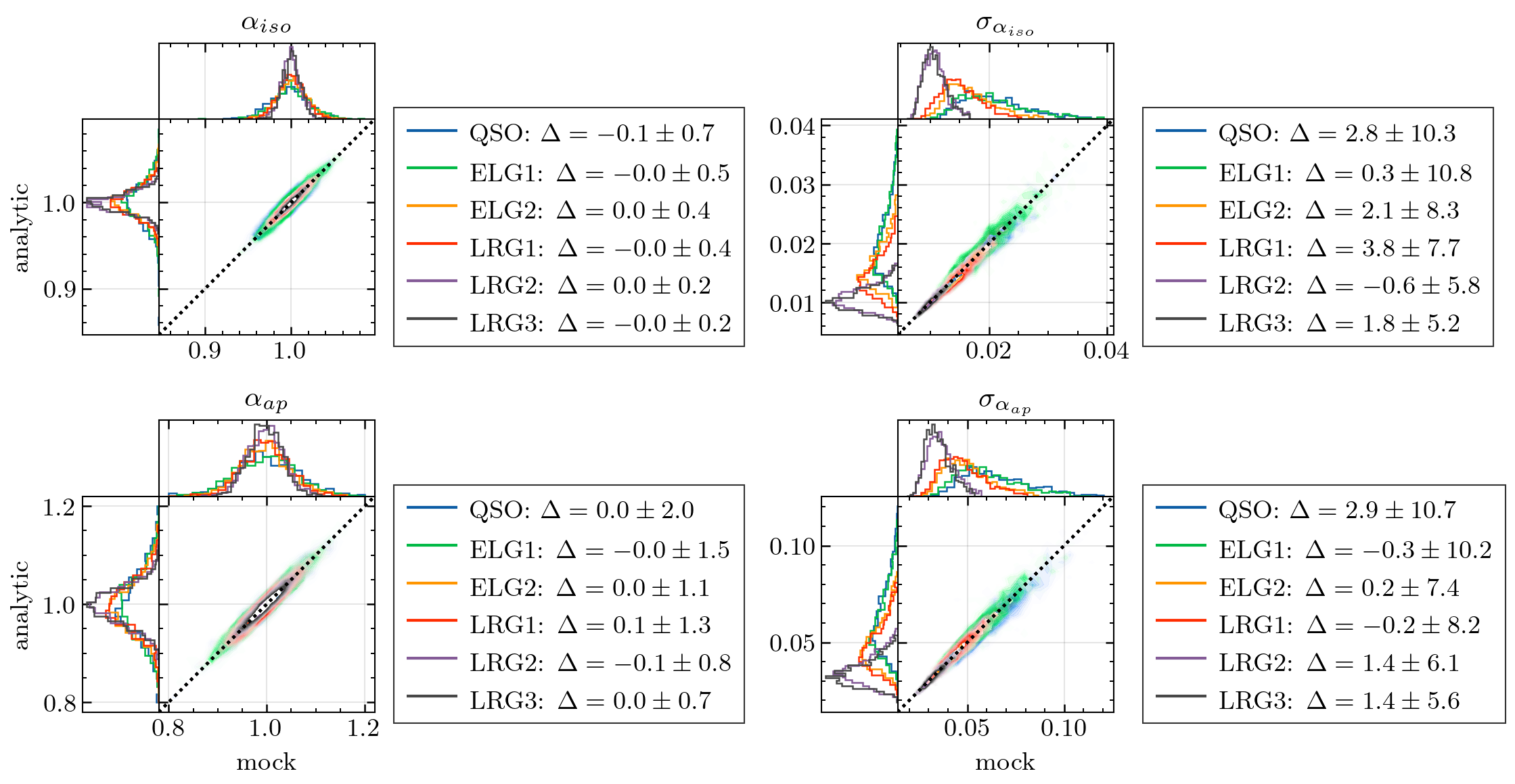
- Estimation of covariance matrices using analytical and mock-based methods.
- Incorporation of reconstruction (RecSym) and broadband marginalization improvements.
Experimental results
Research questions
- RQ1What is the BAO signal strength in each DESI tracer and redshift bin?
- RQ2How do BAO-derived distance measures D_A(z) and H(z) constrain the expansion history when combining tracers?
- RQ3How do improvements in BAO fitting, reconstruction, and covariance estimation affect the precision and robustness of the measurements?
- RQ4Do DESI DR1 BAO results show consistency with previous SDSS/BOSS/eBOSS analyses under the new methodology?
- RQ5What are the systematic error budgets relative to statistical uncertainties for DR1 BAO measurements?
Key findings
- BAO detections are achieved in all six redshift bins, with the highest significance of 9.1 sigma at z_eff ≈ 0.93.
- Total effective survey volume is ~18 Gpc^3 with combined BAO precision of ~0.52%, a 1.2-fold improvement over previous first-year results.
- Measured BAO scale constraints place a 0.86% precision on the BAO scale.
- Results suggest measurements are systematically larger than Planck 2018 LCDM predictions at z < 0.8.
- Re-analysis of SDSS BOSS/eBOSS data using DESI methodology shows scatter consistent with SDSS theoretical systematics.
- Measurements are translated into transverse comoving distance D_A(z) and radial H(z) to constrain cosmological models in companion papers.
Read this paper
Open the full text in the Nubint reader and ask about any passage as you read.
Read this paper on NubintThis review was generated by AI from the original paper. Please check the paper before citing it.