
[Paper Review] Distributed VC Firms: The Next Iteration of Venture Capital
This paper proposes a 'distributed venture capital firm' model that replaces traditional VC fund structures with software-automated, pod-based teams governed by deal-by-deal incentives to realign GP incentives with startup success. By decentralizing functions into specialized Pods and using codified, performance-based payouts, the model aims to eliminate misaligned incentives and improve innovation funding efficiency.
Using a combination of incentive modeling and empirical meta-analyses, this paper provides a pointed critique at the incentive systems that drive venture capital firms to optimize their practices towards activities that increase General Partner utility yet are disjoint from improving the underlying asset of startup equity. We propose a "distributed venture firm" powered by software automations and governed by a set of functional teams called "Pods" that carry out specific tasks with immediate and long-term payouts given on a deal-by-deal basis. Avenues are provided for further research to validate this model and discover likely paths to implementation.
Motivation & Objective
- To identify systemic flaws in the traditional '2-20' venture capital model that misalign GP incentives with startup success.
- To critique the historical adoption of the '2-20' fee structure as arbitrary and not empirically grounded.
- To propose a new model—distributed venture capital firms—where functional Pods handle specific tasks with immediate, deal-specific payouts.
- To address the free-rider problem and scalability limits in traditional VC through algorithmic coordination and codified incentives.
- To lay the foundation for a new venture capital paradigm that prioritizes innovation outcomes over GP utility.
Proposed method
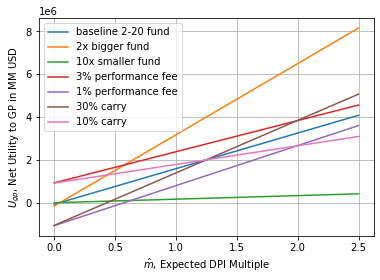
- Develops a mathematical utility model for standard VC funds using parameters like fund size, lifespan, management fee (2%), GP commitment (1%), and carry (20%).
- Proposes a 'distributed venture capital firm' with functional Pods (e.g., Sourcing, Deal Execution, Monitoring) that operate with immediate and long-term payouts per deal.
- Introduces 'Pod Leads' to delegate ownership and enable scalable governance beyond Dunbar’s number.
- Uses codified incentives to ensure financial rewards are distributed based on individual contributions per deal, not team-wide outcomes.
- Applies algorithmic coordination to maintain alignment and efficiency across distributed, autonomous Pods.
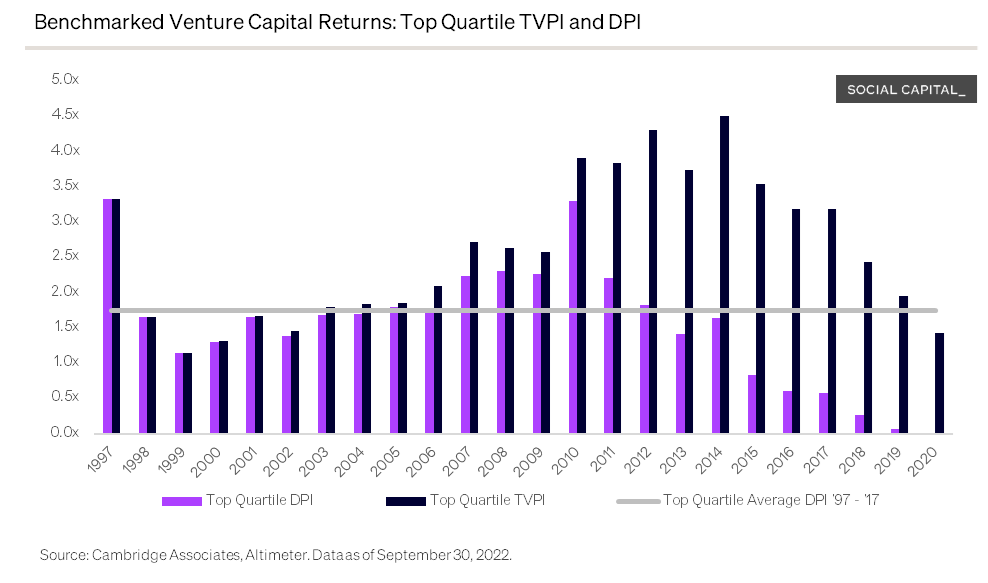
- Employs performance metrics such as DPI, IRR, and RVPI to benchmark fund performance across lifecycle stages.
Experimental results
Research questions
- RQ1How do the incentives in the standard '2-20' VC model misalign with actual startup performance and LP outcomes?
- RQ2What key performance indicators (KPIs) best reflect fund performance across different lifecycle stages of a venture fund?
- RQ3Can a decentralized, pod-based structure with deal-by-deal payouts improve incentive alignment and innovation outcomes in venture capital?
- RQ4How can software automation and algorithmic coordination scale venture capital operations beyond traditional hierarchical limits?
- RQ5What structural, legal, and technological innovations are needed to implement distributed venture capital firms at scale?
Key findings
- The standard '2-20' model generates an average IRR of 19% for VC funds, but this is still below the S&P 500’s 11% annual return, indicating suboptimal risk-adjusted performance.
- A strong power law distribution exists in VC returns, where a small fraction of funds capture the majority of gains, suggesting systemic inefficiency.
- The '2-20' fee structure originated from anecdotal precedent (Phoenician merchants) rather than empirical analysis, raising concerns about its long-term sustainability.
- Even top-quartile VC funds struggle to achieve a 2x DPI (distributions to paid-in capital), indicating persistent underperformance.
- The proposed distributed VC model with Pods and deal-specific payouts can reduce free-rider problems and improve incentive alignment.
- The model enables scalability beyond Dunbar’s number through well-defined interfaces and algorithmic coordination, supporting larger, more efficient venture teams.
Read this paper
Open the full text in the Nubint reader and ask about any passage as you read.
Read this paper on NubintThis review was generated by AI from the original paper. Please check the paper before citing it.