
[Paper Review] DUVET: sub-kiloparsec resolved star formation driven outflows in a sample of local starbursting disk galaxies
This paper presents sub-kiloparsec resolved measurements of star formation-driven outflows in 10 local starbursting disk galaxies using Keck/KCWI, establishing how outflow properties scale with local SFR and stellar mass surface densities.
We measure resolved (kiloparsec-scale) outflow properties in a sample of 10 starburst galaxies from the DUVET (Deep near-UV observations of Entrained gas in Turbulent galaxies) sample, using Keck/KCWI observations of H$β$ and [OIII]~$λ$5007. We measure $\sim460$ lines-of-sight that contain outflows, and use these to study scaling relationships of outflow velocity ($v_{ m out}$), mass-loading factor ($η$; mass outflow rate per SFR) and mass flux ($\dotΣ_{ m out}$; mass outflow rate per area) with co-located SFR surface density ($Σ_{ m SFR}$) and stellar mass surface density ($Σ_{\ast}$). We find strong, positive correlations of $\dotΣ_{ m out} \propto Σ_{ m SFR}^{1.2}$ and $\dotΣ_{ m out} \propto Σ_{\ast}^{1.5}$. We also find shallow correlations between $v_{ m out}$ and both $Σ_{ m SFR}$ and $Σ_{\ast}$. Our resolved observations do not suggest a threshold in outflows with $Σ_{ m SFR}$, but rather we find that the local specific SFR ($Σ_{ m SFR}/Σ_\ast$) is a better predictor of where outflows are detected. We find that outflows are very common above $Σ_{ m SFR}/Σ_\ast\gtrsim 0.1$~Gyr$^{-1}$ and rare below this value. We argue that our results are consistent with a picture in which outflows are driven by supernovae, and require more significant injected energy in higher mass surface density environments to overcome local gravity. The correlations we present here provide a statistically robust, direct comparison for simulations and higher redshift results from JWST.
Motivation & Objective
- Motivate and constrain how star formation-driven outflows regulate disks by measuring resolved outflow properties in a local, high-SFR sample.
- Quantify how outflow mass flux and velocity scale with local star formation rate and stellar mass surface densities.
- Assess whether a threshold in Sigma_SFR governs outflows and identify the best local predictors for outflow incidence.
- Compare observed scaling relations to theoretical models of supernova- vs. radiation-driven outflows and to simulations.
Proposed method
- Obtain KCWI red-side integral field data for 10 face-on DUVET galaxies with sub-arcsecond seeing.
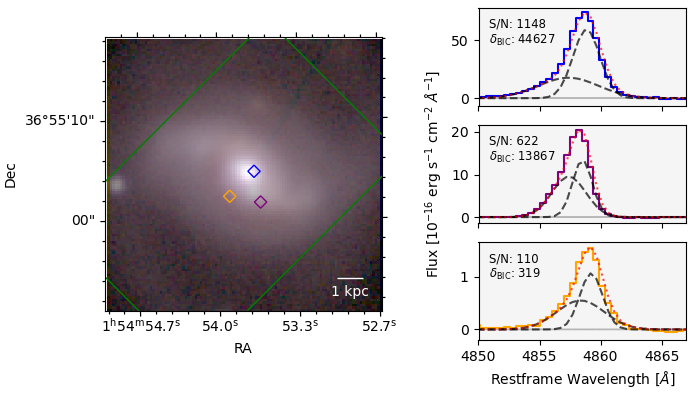
- Fit Hβ and [OIII] 5007 emission with single and double Gaussians per spaxel to identify outflow components using BIC criteria.
- Compute v_out from Gaussian fits as |v_narrow−v_broad|+2σ_broad, corrected for instrumental dispersion and galaxy inclination where needed.
- Derive spaxel-by-spaxel SFR from extinction-corrected Hβ and Hα/Hβ scaling, and compute local SFR and stellar-mass surface densities.
- Investigate power-law scalings of dotΣ_out, η, and v_out with Σ_SFR and Σ_* using orthogonal distance regression.
Experimental results
Research questions
- RQ1What are the resolved relationships between outflow properties (velocity, mass flux, mass loading) and local gas/star formation properties (Σ_SFR, Σ_*)?
- RQ2Do local regions in starburst disks show a threshold or a continuous trend in outflow driving efficiency with Σ_SFR?
- RQ3Which local parameter best predicts the presence and strength of outflows in these galaxies?
- RQ4How do the observed scaling relations compare with energy- vs. momentum-driven outflow models and with simulations?
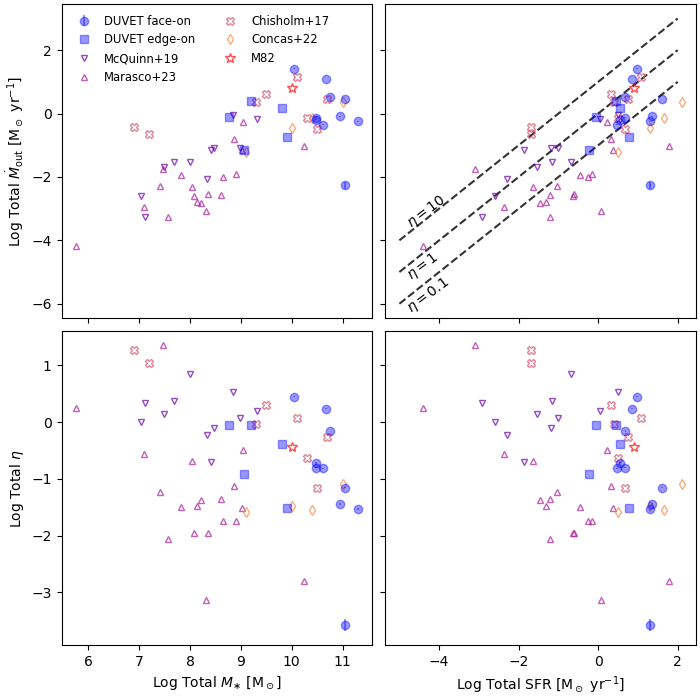
- RQ5How do resolved, local measurements compare to global galaxy outflow relationships in the literature?
Key findings
- DotΣ_out scales with Σ_SFR as ~Σ_SFR^1.2 (extinction-corrected) and ~Σ_SFR^1.0–1.25 (nocorrected, depending on method).
- DotΣ_out also scales with Σ_* as ~Σ_*^1.7 (extinction-corrected).
- v_out shows a shallow dependence on both Σ_SFR and Σ_* rather than a strong threshold.
- Local specific SFR (Σ_SFR/Σ_*) is a better predictor of where outflows are detected than Σ_SFR alone.
- Outflows are common above Σ_SFR/Σ_* ≳ 0.1 Gyr^-1 and rare below this value.
- Results favor a supernova-driven outflow picture that requires higher surface density environments to overcome local gravity, with quantitative scaling usable for simulations and JWST-era comparisons.
Read this paper
Open the full text in the Nubint reader and ask about any passage as you read.
Read this paper on NubintThis review was generated by AI from the original paper. Please check the paper before citing it.