
[Paper Review] Emergence of synchronisation in a driven-dissipative hot Rydberg vapor
The paper demonstrates Kuramoto-like synchronisation in a hot Rydberg rubidium vapor driven to high-lying Rydberg states, showing how global mean-field coupling yields phase- and frequency-entrained oscillations observable in probe transmission.
We observe synchronization in a thermal (35-60 °C) atomic (Rb) ensemble driven to a highly excited Rydberg state (principle quantum number n ranging from 43 to 79). Synchronization in this system is unexpected due to the atomic motion; however, we show theoretically that sufficiently strong interactions via a global Rydberg density mean field cause frequency and phase entrainment. The emergent oscillations in the vapor's bulk quantities are detected in the transmission of the probe laser for a two-photon excitation scheme.
Motivation & Objective
- Motivate and understand how nonlinear, dissipative many-body systems can exhibit self-sustained oscillations and synchronisation.
- Demonstrate experimentally that a hot atomic vapor driven to Rydberg states can synchronise despite rapid atomic motion.
- Explain how global coupling via Rydberg-density mean field leads to entrainment of many velocity classes.
- Link observed bulk oscillations to limit cycles arising from Hopf bifurcations in a three-level driven-dissipative model.
Proposed method
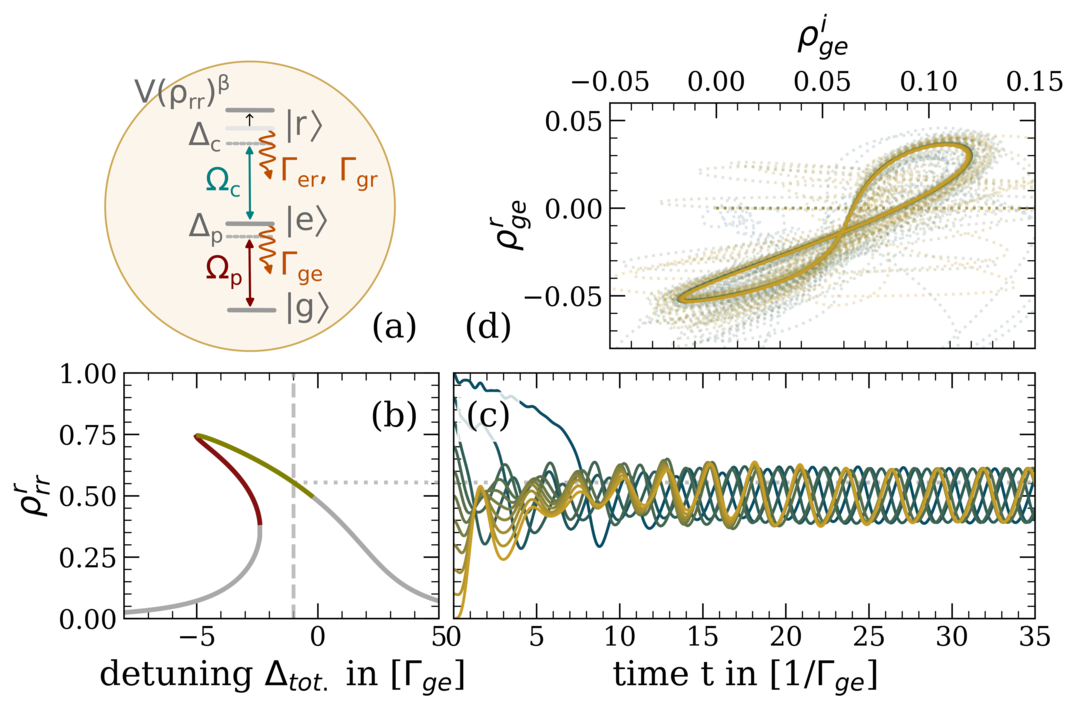
- Model a three-level driven-dissipative system with a Rydberg-density dependent mean-field shift V(rho_rr)^β.
- Analyze steady states and Hopf bifurcations via linearisation (Jacobi) to identify limit cycles.
- Simulate a thermal vapor with many velocity classes coupled through a global Rydberg density mean field.
- Experimentally drive rubidium atoms in a heated vapor with two-photon excitation and detect oscillations in probe transmission.
- Vary Rabi frequencies, detunings, and density to map the synchronisation window and compare with simulations.
Experimental results
Research questions
- RQ1Can a globally coupled ensemble of driven-dissipative oscillators exhibit synchronisation in a hot vapor despite atomic motion?
- RQ2What role does the Rydberg-density mean-field coupling play in entraining phases and frequencies across velocity classes?
- RQ3How do system parameters (Rabi frequencies, density, detuning) influence the onset and characteristics of the synchronised state?
- RQ4Are observed oscillations consistent with Hopf-bifurcation-induced limit cycles in the nonlinear three-level model?
Key findings
- Synchronisation emerges in a hot Rydberg vapor when velocity classes are globally coupled through a Rydberg-density mean field.
- Individual velocity classes exhibit limit cycles via Hopf bifurcations, but global coupling entrains many classes into a single frequency and fixed phase relation.
- Oscillation frequencies observed in the bulk transmission range from about 10 kHz to 25 kHz, with persistent cases up to 43 kHz.
- The synchronised state persists for minutes under fixed parameters, indicating robust non-equilibrium phase behavior.
- Synchronisation regions can appear in multiple detuning windows and shift with Rabi frequencies and density, consistent with a Kuramoto-like transition.
- The thermal-vapor model reproduces key experimental features, supporting the interpretation of a globally coupled oscillator ensemble.

Read this paper
Open the full text in the Nubint reader and ask about any passage as you read.
Read this paper on NubintThis review was generated by AI from the original paper. Please check the paper before citing it.