
[Paper Review] Empathetic AI for Empowering Resilience in Games
This paper proposes a data-driven 6-phase framework to detect and model emotion regulation strategies in team-based game chat logs, enabling the development of Empathetic AI (EAI) assistants that support player resilience. By analyzing de-identified chat data from a cooperative alternate reality game (LUX), the method identifies affective states, sequences, and regulation patterns, laying the foundation for AI interventions that enhance emotional coping and team resilience in serious and competitive games.
Failure and resilience are important aspects of gameplay. This is especially important for serious and competitive games, where players need to adapt and cope with failure frequently. In such situations, emotion regulation -- the active process of modulating ones' emotions to cope and adapt to challenging situations -- becomes essential. It is one of the prominent aspects of human intelligence and promotes mental health and well-being. While there has been work on developing artificial emotional regulation assistants to help users cope with emotion regulation in the field of Intelligent Tutoring systems, little is done to incorporate such systems or ideas into (serious) video games. In this paper, we introduce a data-driven 6-phase approach to establish empathetic artificial intelligence (EAI), which operates on raw chat log data to detect key affective states, identify common sequences and emotion regulation strategies and generalizes these to make them applicable for intervention systems.
Motivation & Objective
- To address the lack of AI systems that support emotion regulation in team-based games, especially in serious and competitive gaming contexts.
- To identify and model collective emotion regulation strategies from raw player chat data during failure or stress events.
- To develop a scalable, data-driven framework for detecting affective states and regulatory behaviors in multiplayer game interactions.
- To lay the groundwork for future empathetic AI assistants that intervene in real time to support mental well-being and resilience.
- To generalize findings from a single game (LUX) to broader applications in esports, educational games, and collaborative environments.
Proposed method
- Collect de-identified chat logs from players in a team-based alternate reality game (LUX) designed to induce stress and failure.
- Apply human-annotated labeling to identify key affective states (e.g., frustration, encouragement) and context-specific events.
- Construct dependency graphs from labeled sequences to model temporal relationships between emotional states and regulatory actions.
- Use process mining and fuzzy logic techniques to generalize patterns from small-scale labeled data into abstracted regulatory sequences.
- Leverage machine learning models such as ATTBLSTM and semi-supervised learning (e.g., GAM) in future phases to automate strategy detection from large-scale data.
- Integrate findings into a pipeline for potential deployment in intervention systems, including dynamic difficulty adjustment or AI chatbots.

Experimental results
Research questions
- RQ1How can emotion regulation strategies be identified from raw team chat logs in multiplayer games?
- RQ2What recurring patterns of affective states and regulatory behaviors emerge during gameplay failures or stressors?
- RQ3How can these detected patterns be abstracted into generalizable models for AI intervention?
- RQ4What role does social, collective emotion regulation play in team resilience during game challenges?
- RQ5How might such a system be extended to support long-term mental well-being and performance in serious and competitive gaming?
Key findings
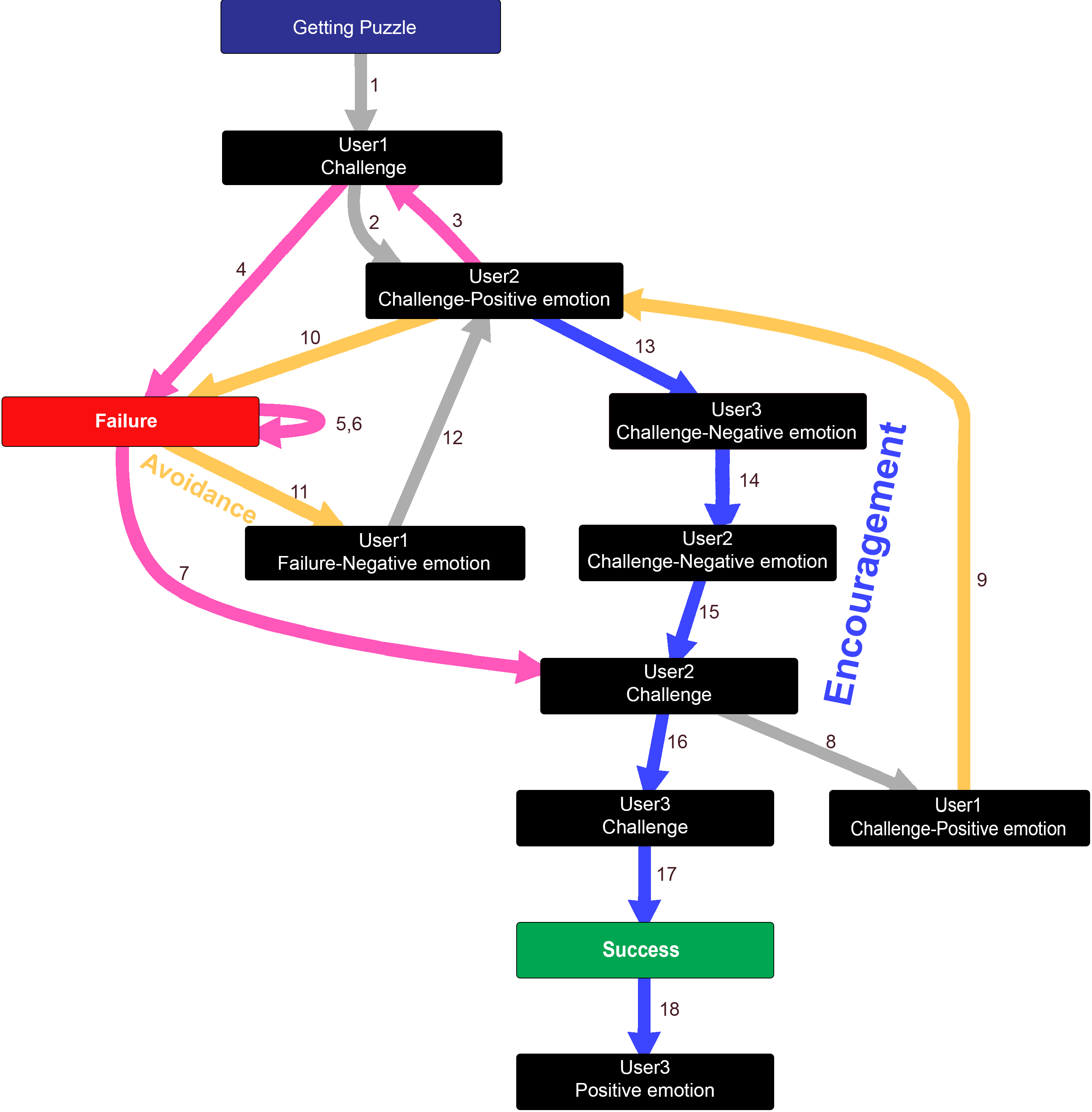
- The study successfully identified recurring emotion regulation patterns in team chat logs, including supportive messaging, re-framing of failure, and encouragement after setbacks.
- Human-annotated labeling revealed that players frequently use verbal strategies such as active listening, validation, and constructive feedback to regulate teammates’ emotions.
- Dependency graphing of affective sequences enabled visualization of transitions from negative to positive emotional states, indicating effective regulation.
- The framework demonstrated feasibility in detecting emotion regulation without relying on symbolic rule-based systems, instead using data-driven pattern extraction from real player interactions.
- Preliminary results support the potential for training generalizable models (e.g., ATTBLSTM, GAM) on large-scale chat data to automate emotion regulation detection.
- The approach is generalizable to other team-based games and platforms where text-based communication is central to team dynamics.
Read this paper
Open the full text in the Nubint reader and ask about any passage as you read.
Read this paper on NubintThis review was generated by AI from the original paper. Please check the paper before citing it.