
[Paper Review] Enumeration of spin-space groups: Towards a complete description of symmetries of magnetic orders
The paper systematically enumerates spin-space groups (SSGs) by constructing them from invariant subgroups of space groups and 3D real representations of quotient groups, yielding a comprehensive online database and an algorithm to identify SSGs in magnetic materials.
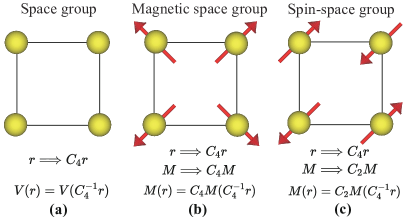
Symmetries of three-dimensional periodic scalar fields are described by 230 space groups (SGs). Symmetries of three-dimensional periodic (pseudo-) vector fields, however, are described by the spin-space groups (SSGs), which were initially used to describe the symmetries of magnetic orders. In SSGs, the real-space and spin degrees of freedom are unlocked in the sense that an operation could have different spacial and spin rotations. SSGs gives a complete symmetry description of magnetic structures, and have natural applications in the band theory of itinerary electrons in magnetically ordered systems with weak spin-orbit coupling. Altermagnetism, a concept raised recently that belongs to the symmetry-compensated collinear magnetic orders but has non-relativistic spin splitting, is well described by SSGs. Due to the vast number and complicated group structures, SSGs have not yet been systematically enumerated. In this work, we exhaust SSGs based on the invariant subgroups of SGs, with spin operations constructed from three-dimensional (3D) real representations of the quotient groups for the invariant subgroups. For collinear and coplanar magnetic orders, the spin operations can be reduced into lower dimensional real representations. As the number of SSGs is infinite, we only consider SSGs that describe magnetic unit cells up to 12 times crystal unit cells. We obtain 157,289 non-coplanar, 24,788 coplanar-non-collinear, and 1,421 collinear SSGs. The enumerated SSGs are stored in an online database at \url{https://cmpdc.iphy.ac.cn/ssg} with a user-friendly interface. We also develop an algorithm to identify SSG for realistic materials and find SSGs for 1,626 magnetic materials. Our results serve as a solid starting point for further studies of symmetry and topology in magnetically ordered materials.
Motivation & Objective
- Provide a complete symmetry description of magnetic orders via spin-space groups (SSGs).
- Enumerate SSGs by exploiting invariant subgroups of 230 space groups and quotient-group representations.
- Offer a public database and practical algorithm to assign SSGs to real magnetic materials.
Proposed method
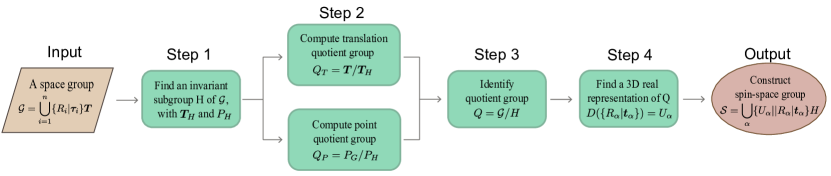
- Define spin-space groups as extensions that combine lattice operations with 3D real representations for spin rotations.
- Enumerate invariant subgroups H of each space group G and compute quotient groups Q=G/H isomorphic to point groups.
- Assign 3D real representations of Q to generate SSGs via G(S)=⊔α{Uα||Rα|tα}H, with spin parts Uα in O(3).
- Handle collinear and coplanar orders by using 1D or 2D real representations for Q respectively.
- Restrict magnetic unit cells to up to 12 times the crystal unit cell to obtain a finite catalog.
- Provide an online database of SSGs and develop an algorithm to identify SSGs in materials databases.
Experimental results
Research questions
- RQ1How can spin-space groups be exhaustively enumerated from 230 space groups?
- RQ2What is the structure of SSGs for different magnetic order types (non-coplanar, coplanar-non-collinear, collinear)?
- RQ3Can a practical finite catalog of SSGs be produced by restricting magnetic unit cells to a computable range (≤12× crystal cell)?
- RQ4How can SSGs be identified for real magnetic materials using a determining algorithm?
Key findings
- Identified 157,289 non-coplanar SSGs.
- Identified 24,788 coplanar-non-collinear SSGs.
- Identified 1,421 collinear SSGs.
- Special case when quotient group is crystallographic point group yields 68,922 non-coplanar SSGs within the 12× limit.
- Developed an online database at ssg (and reference site) for the enumerated SSGs.
- Applied algorithm finds SSGs for 1,626 commensurate magnetic materials from datasets like Bilbao Crystallographic Server.
Read this paper
Open the full text in the Nubint reader and ask about any passage as you read.
Read this paper on NubintThis review was generated by AI from the original paper. Please check the paper before citing it.